Wer kennt das nicht? Ein Buch liegt auf dem Nachttisch, das man unbedingt lesen möchte (oder lesen sollte, wie man meint), doch es kommt nie dazu. Nun haben wir auch ein Wort dafür: Vorsatzbuch. Wie gut, dass uns P. Karpiczenko im NZZ-Magazin immer wieder neue Wörter vorschlägt.
Erasmus+ is now open for UK organisations in education, training, youth and sport!
Grants of over £400 million are available for studying or training in Germany and more than 30 other EU countries.
ℹ️ https://t.co/pUCsS64iVh
Junge Deutsche und Brit*innen: Dieser Deal ist für euch
Der UK-EU-Gipfel öffnet neue Türen: Erasmus+, das Youth Experience Scheme und mehr Möglichkeiten, im jeweils anderen Land zu leben, zu lernen und zu arbeiten
Meine Gedanken dazu heute in der ZEIT👇
https://t.co/p6AAvkVkQd
Meet your German tutor: Stefan Oloffs, native speaker, teaching German in London since 2007. One-to-one lessons, face to face or online, built on a needs analysis.
https://t.co/Kqxcqn7yVy
Freund or boyfriend? In German, the article decides. Ein Freund is a friend. Mein Freund is usually heard as your boyfriend. To keep it clear: ein Freund von mir. #LearnGerman
Can AI teach you German? It's excellent for practice material and checking drafts, but it has read German, not lived it. Practical tips on combining AI with lessons, from a native German tutor:
https://t.co/4UHXJj9hKn
Moving to Germany from the UK? Many roles let you start in English. Your Anmeldung, tenancy agreement and permanent residence call for German. What you need, and how to prepare before you go: https://t.co/1SpGdj8Asu
Auf den Tisch or auf dem Tisch?
Wohin stellst du die Tasse? Auf den Tisch.
Wo steht die Tasse? Auf dem Tisch.
Practise all nine Wechselpräpositionen and check your answers instantly:
https://t.co/6UYfo8JfXj
#German#Deutsch
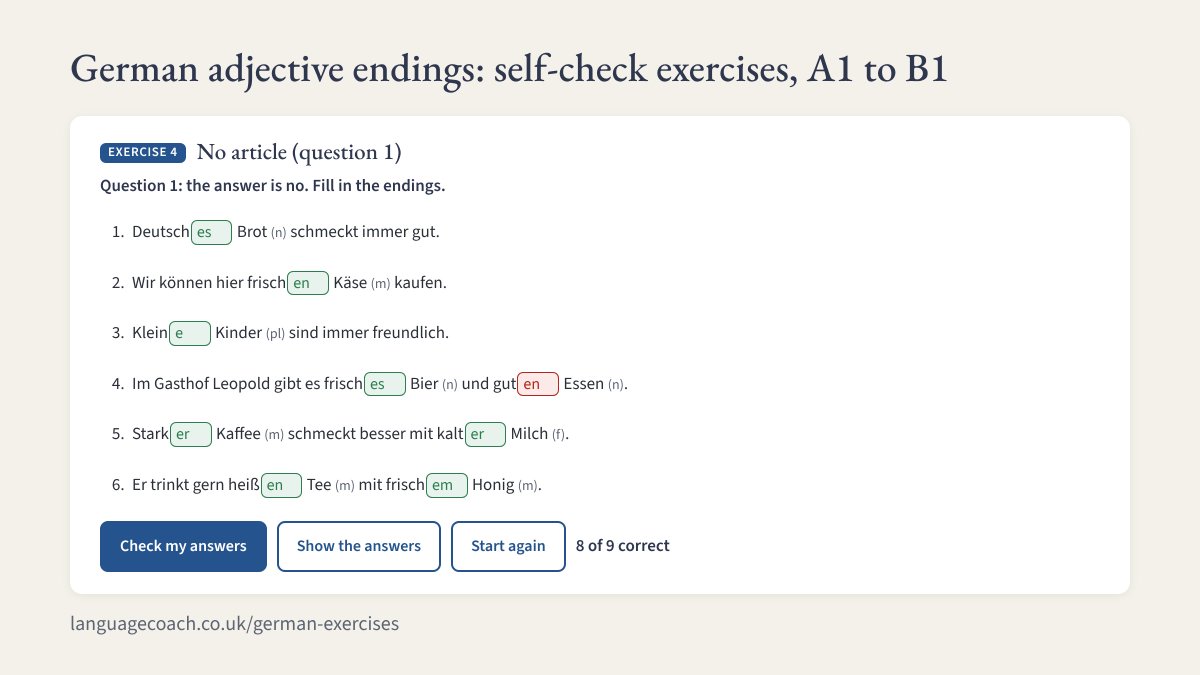
German adjective endings come down to four questions. We have put free self-check exercises online, A1 to B1, from short phrases to full sentences. Teachers are welcome to use them with their students. Link in reply.
Can AI teach you German? It's excellent for practice material and checking drafts, but it has read German, not lived it. Practical tips on combining AI with lessons, from a native German tutor:
https://t.co/4UHXJj9hKn
Which level of German do you need to follow a meeting, write to clients or negotiate? A guide to the CEFR levels, A1 to C2, and what each means at work:
https://t.co/4fIA1pYq3j
Dative object, modal verb, declension: the grammar terms every German course assumes you know. About 25 of them, explained in plain English with an example each, in one glossary: https://t.co/74hyaL7AlA
Native German tutor in London 🇬🇧🇩🇪 for 1-to-1 and corporate German lessons at your office, home, or online across Central London, the City & Canary Wharf. Tailored for business & professionals.
Book your assessment: https://t.co/3ymwWSALR0
#GermanTutor#London#CityOfLondon
Das Verb ausweisen kennen wir. Es wird transitiv (jemanden ausweisen) oder reflexiv (sich ausweisen) verwendet. Hier geht es um ein anderes Verb: sich ausmenschen. Ob wir uns künftig bei allem, was wir selbst verantworten und nicht die KI machen lassen, ausmenschen müssen?
Very exiting for the polyglot traveller starting with French and Flemish, moving on to Dutch, German, Swiss German and finally Italian. Unless they are asleep, that is.
Tomorrow, a new railway line will effectively make 1,000 kilometres of Europe disappear while you sleep.
European Sleeper is launching a direct night train from Brussels to Milan.
You board in Brussels in the evening.
During the night, the train crosses Belgium and Germany, follows the Rhine south, enters Switzerland and crosses the Alps.
By morning, you can wake up near Lake Como and continue to Milan.
The service will run three times a week, with stops including Liège, Cologne, Lugano and Como.
And it joins a growing network.
European Sleeper already runs overnight trains linking Brussels with Prague and Paris with Berlin.
The interesting thing about night trains is that they change European geography without making trains faster.
A 1,000-kilometre journey that consumes most of a day becomes something that happens while you sleep.
Europe spent decades trying to reduce travel times.
Night trains use a different trick.
They turn travel time into sleeping time.
Most corporate students don't need German—their colleagues speak good English. That's exactly why learning it matters. It's a choice, not a necessity. People notice that you bothered. Corporate German training in London:https://t.co/1z1kvPVbTJ