The first of two panels for the launch of The Proof in the Code, @KSHartnett 's new book on the development of Lean and Mathlib.
The Mathematicians. Thursday, June 11, 5pm UTC:
Johan Commelin, Director of the Mathlib Initiative and assistant professor at Utrecht University
Kevin Buzzard, Professor of Pure Mathematics at Imperial College London, who created the Natural Number Game and leads the effort to formalize Fermat's Last Theorem in Lean
@AlexKontorovich , Distinguished Professor of Mathematics at Rutgers University, award-winning mathematical communicator, and maintainer of the PrimeNumberTheoremAnd project
They discuss what it means to formalize mathematics in Lean and how computer verification is changing the way mathematicians collaborate, build trust, and decide what counts as proof.
Register: https://t.co/p5JDkaZGGg
A two-part online panel series marks the launch of The Proof in the Code, @KSHartnett 's new book on the development of Lean and Mathlib. Registration links below.
The Mathematicians. Thursday, June 11, 5pm UTC. Johan Commelin, Kevin Buzzard, and Alex Kontorovich join Kevin Hartnett to discuss what it means to formalize mathematics in Lean, and how computer verification is changing the way mathematicians collaborate, build trust, and decide what counts as proof.
The Builders. Friday, June 12, 5pm UTC. Leo de Moura, Sebastian Ullrich, and Jeremy Avigad join Kevin Hartnett to talk about Lean from the inside: its origins, its design, and the road from a research project to a system now used across mathematics and AI.
The Mathematicians: https://t.co/p5JDkaZGGg
The Builders: https://t.co/TlNoeigxwj
Mathematically, Aumann’s theorem means I have to agree to agree with Scott! 🤝 Happy to bring formal verification to economics. Catch our exclusive in @FortuneMagazine. @axiommathai@leanprover
The new 𝚌𝚋𝚟 tactic in Lean 4.30.0 brings call-by-value evaluation into the proof layer.
"Call-by-value" is how most software runs: arguments are computed before being passed to a function. 𝚌𝚋𝚟 lets you use that same model to close proof goals, and is useful for software verification, formalized math, and domain-specific verification workflows alike.
Tactic reference: https://t.co/QbQJOnwZu7
#LeanLang #LeanProver #ProofAssistant #OpenSource #FormalVerification
We did it!
Thrilled to announce that with my team at FAIR Meta we released 25+ auto-formalized mathematics textbooks covering analysis, algebra, geometry, topology, combinatorics, probability, statistics, PDEs, number theory, and theoretical computer science - the largest such effort to date.
Updates since then:
* Deepseek v4 is out. There *is* a 2-bit quant that can run within 90 GB ( https://t.co/yM1HMZXkXn ), and it works, however it's only fast on Apple hardware (I've head ~35 tok/s). On AMD, it's ~7 tok/s. IMO actually taking the effort to properly support more than one hardware manufacturer is a great example of the difference between mere "decentralized AI" and genuine "CROPS AI". I hope we can become better at this.
* https://t.co/CFYF1smBH3 also has alpha telegram support now. However, the path to adding your account is quite janky
* https://t.co/za4h233eYz looks promising as a way to run "dense" models (eg. Qwen 27B) more efficiently. It's janky, but on my 5090 laptop it seems to be ~2x more tok/s than llama.cpp
* VoxTerm (local AI recording, no third-party servers) continues to be developed https://t.co/GSdKzkD9Ql
And there's a lot more projects coming on the horizon.
One other thing that has been on my mind is that there's actually a lot of intersection between "CROPS ethereum access layer" and "CROPS AI". For example, we want a ZK way to make (paid) calls to remote LLMs. But if we have this, then it's just as useful for solving another problem: private RPC reads in Ethereum.
Another example: application-specific finetuned LLMs. Leanstral ( https://t.co/ilfww8ekJu ; I get ~38 tok/s on AMD) fits into < 70 GB, but can hold its own against 1T models on writing Lean code. Things like this are a huge boon for writing more secure code ( https://t.co/6YPWgVSzCg ). We should have models finetuned for Ethereum-related use cases as well.
Lean 4.30.0 is live!
The release notes highlight four areas: a new 𝚜𝚢𝚖 => tactic, 𝚌𝚋𝚟 out of experimental, a completed LCNF compiler backend, and a full Lake cache overhaul.
On 𝚜𝚢𝚖 =>: "Unlike 𝚐𝚛𝚒𝚗𝚍 =>, which eagerly introduces hypotheses and applies proof by contradiction, 𝚜𝚢𝚖 => gives users explicit control over each step."
On the compiler: the expand reset/reuse port "results in a ~15% decrease in binary size and slight speedups across the board."
Full release notes: https://t.co/qSFWZVjK4x
The 2026 Jean-Pierre Demailly Prize for Open Science in Mathematics has been awarded to Mathlib! From the citation:
"Mathlib is widely recognized as an exceptional contribution to the mathematical community. It is seen as having an exceptionally broad structural significance for the future of mathematics. It is not only a resource of immediate value, but also an infrastructure with the potential to transform mathematical practice in a lasting way.
The project plays a central role in the formalization and verification of mathematics. This aspect is of particular importance in the current scientific context, as formal proof verification, automated reasoning, and AI-assisted mathematical work are likely to play an increasingly significant role in the years ahead.
Mathlib is also widely viewed as exemplary in its openness and collaborative organization. It lowers barriers to participation, enables contributions from a broad international community, and provides a framework in which mathematical knowledge can be verified, shared, preserved, and reused at large scale.
For all these reasons, Mathlib is not merely a successful project within an existing category, but it is helping redefine the way mathematical knowledge may be produced, checked, and disseminated in the future."
Congratulations!! https://t.co/TZ9qnyjoBh
More big news from Mathlib:
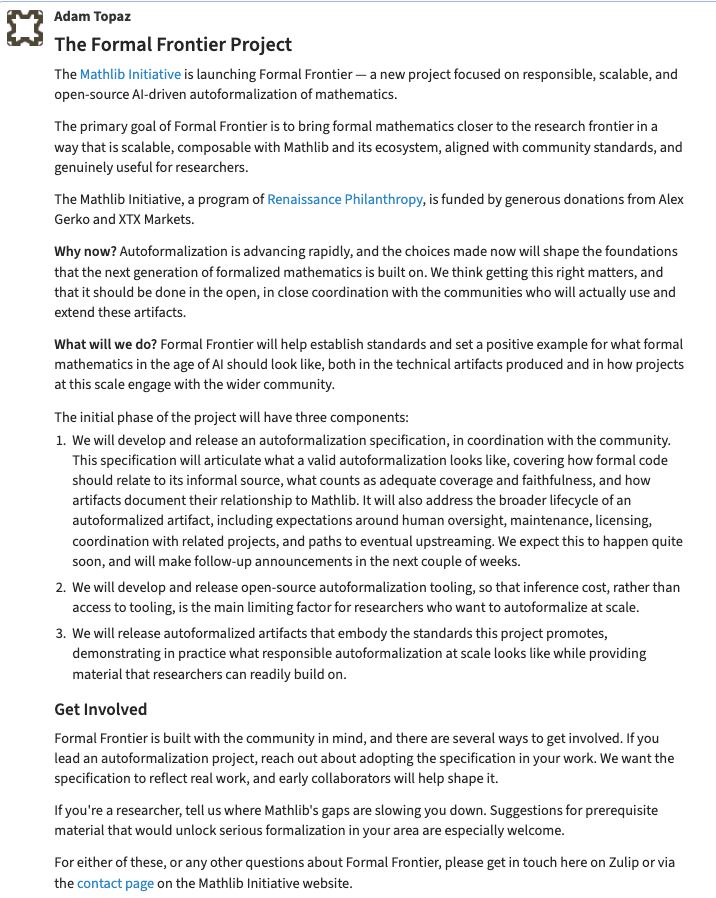
# The Formal Frontier Project
The Mathlib Initiative is launching Formal Frontier — a new project focused on responsible, scalable, and open-source AI-driven autoformalization of mathematics.
The primary goal of Formal Frontier is to bring formal mathematics closer to the research frontier in a way that is scalable, composable with Mathlib and its ecosystem, aligned with community standards, and genuinely useful for researchers.
The Mathlib Initiative, a program of Renaissance Philanthropy, is funded by generous donations from Alex Gerko and XTX Markets.
Why now? Autoformalization is advancing rapidly, and the choices made now will shape the foundations that the next generation of formalized mathematics is built on. We think getting this right matters, and that it should be done in the open, in close coordination with the communities who will actually use and extend these artifacts.
What will we do? Formal Frontier will help establish standards and set a positive example for what formal mathematics in the age of AI should look like, both in the technical artifacts produced and in how projects at this scale engage with the wider community.
The initial phase of the project will have three components:
We will develop and release an autoformalization specification, in coordination with the community. This specification will articulate what a valid autoformalization looks like, covering how formal code should relate to its informal source, what counts as adequate coverage and faithfulness, and how artifacts document their relationship to Mathlib. It will also address the broader lifecycle of an autoformalized artifact, including expectations around human oversight, maintenance, licensing, coordination with related projects, and paths to eventual upstreaming. We expect this to happen quite soon, and will make follow-up announcements in the next couple of weeks.
We will develop and release open-source autoformalization tooling, so that inference cost, rather than access to tooling, is the main limiting factor for researchers who want to autoformalize at scale.
We will release autoformalized artifacts that embody the standards this project promotes, demonstrating in practice what responsible autoformalization at scale looks like while providing material that researchers can readily build on.
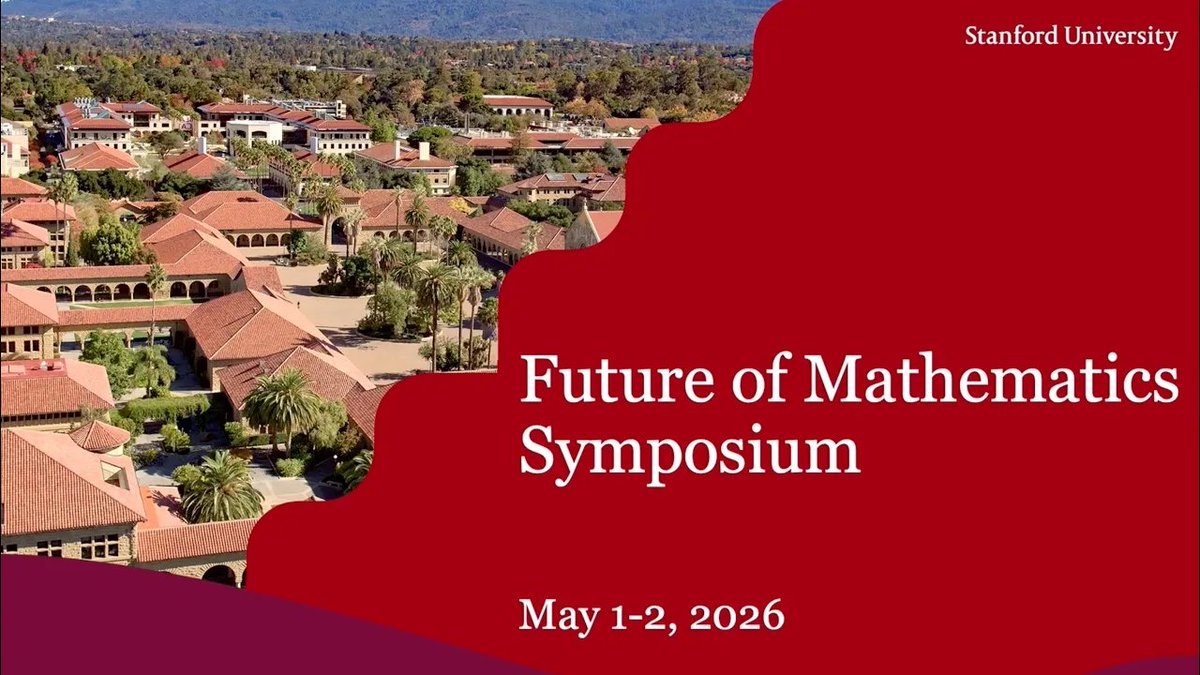
All Future of Mathematics Symposium talks are now available on Youtube, linked below.
Panels:
Formal and Informal Methods - Freedman, Barrett, Abouzaid, Haskell
AI for Mathematics - Arora, Brown, Luong, Vakil
Fields & Roundtable - Tao, Viazovska, Vakil, Haskell
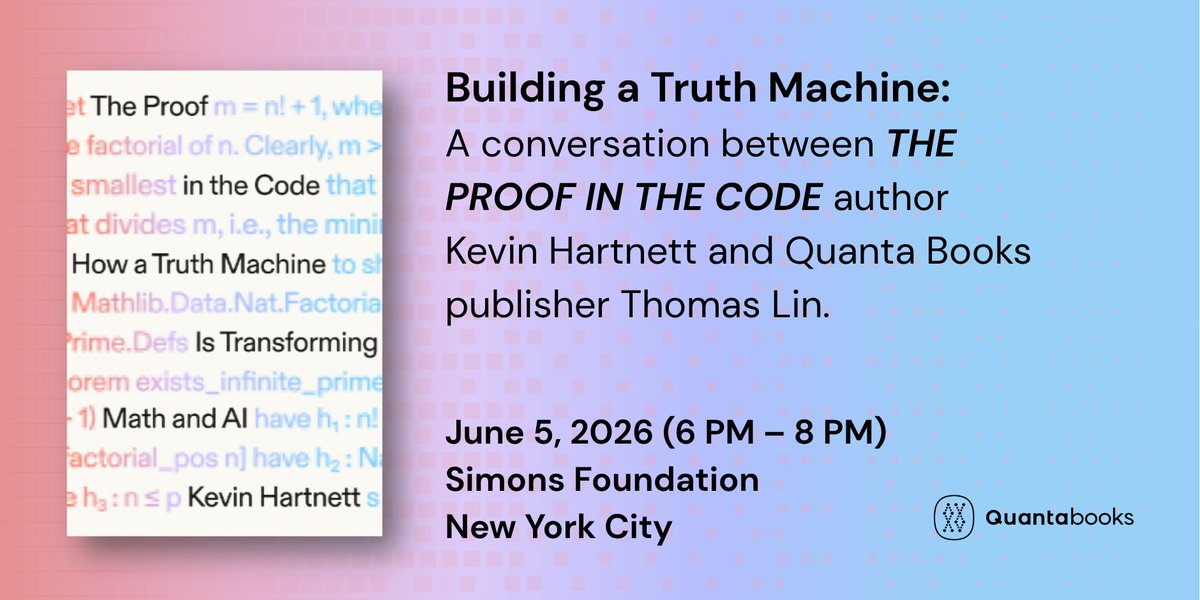
Join us on 6/5 at 6 PM for an SF Presents talk with Kevin Hartnett (@KSHartnett) and Thomas Lin (@7homaslin) as they explore the future of math and grapple with the existential question: Can computers reveal universal truths?
All Future of Mathematics Symposium talks are now available on Youtube, linked below.
Day 1 talks:
Leonardo de Moura, Amazon
Clark Barrett, Stanford
Michael Freedman, Harvard
Kevin Buzzard, Imperial
Andrea Bertozzi, UCLA
Adam Brown, DeepMind
Deirdre Haskell, Fields Institute
New blog post: On the Unreasonable Effectiveness of Property-Based Testing for Validating Formal Specifications.
https://t.co/Lfrjyao3sY
The gist: randomised testing can validate formal specs. It's very cheap and powerful: we found bugs in specs of VERINA and CLEVER benchmarks.
@KSHartnett , former senior writer at @QuantaMagazine, has written the inside story of Lean. The Proof in the Code, out June 9 from @QuantaBks.
Grant Sanderson (@3blue1brown): "Kevin Hartnett perfectly captures the unlikely story of Lean's birth and development."
🔗More here: https://t.co/mpmR9KOE1D
Many people have claimed that with AI-assisted bug finding, secure code (and hence trustless anything) will be impossible.
I have a much more optimistic take, and AI-assisted formal verification is a major part of the reason why:
https://t.co/0ceMBZ6uqj
ICYMI: A few quality of life improvements landed in Aristotle Web to make it much more interactive and responsive:
▪ Live Updates. Aristotle can now share updates while it's in the middle of a run, so that you always know what it's doing and whether it's on track.
▪ Steering. You can message Aristotle while it's working if you want to redirect it, or if you just want to let it know it's doing a great job.
Keep the feedback coming; we'll continue cooking ...
Recordings and slides from Software Verification in Lean 2026 are now available.
The one-day workshop and multi-day hackathon, held in Paris in April, brought together researchers from the Beneficial AI Foundation, @CryspenHQ, @ethereumfndn, @GoogleResearch, @leanprover, @MSFTResearch and others to share recent advances in building verified software.
Recordings: https://t.co/KzlJZJwKHf
SVIL website: https://t.co/2NfzbWb8n4
#LeanLang #LeanProver #FormalVerification #SoftwareVerification