My latest paper is out! thanks to all the authors and @MRC_LMS for a great effort. We questioned the potency of mouse primordial germ cells (PGCs) and propose that PGCs exhibit a latent pluripotency. Brief summary and pretty videos below. Check it out https://t.co/IVHPN7ag6k
New Paper Alert 🥳Our work showing that histone modifications are critical for regulating the specification of epiblast and primitive endoderm lineages in rabbit blastocysts has just been published !
https://t.co/rYXNUxB9fk
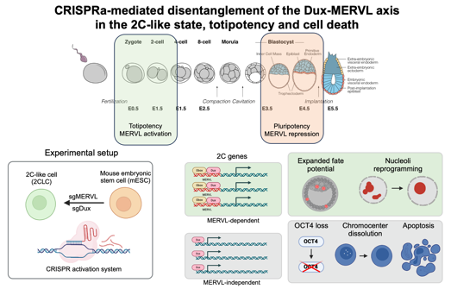
Maybe my last post here? ---> Follow the lab on 🦋🦋🦋 ! Happily retweeting new preprint: @Paul_Chammas postdoc paper @MRC_LMS , teasing apart Dux vs MERVL in the 2C-like state. Not all 2C-like cells are created equal....
Happy to share our latest #preprint showcasing the work done during my postdoc in the lab of @MPercharde at the @MRC_LMS. We used CRISPRa to disentangle the close relationship between Dux and MERVL elements in the induction of the 2-cell like state. https://t.co/F40Vfn6KVR (1/8)
Academic Women Association (AWA) is back, with a Christmas networking event 🎄
When: Thursday 5th December, 3.30 pm
Where: Ex Libris, 1st floor Commonwealth building, Hammersmith Campus
Book Here: https://t.co/sHDTTY2Ihr
Many congratulations to Miguel! He will be part of our mentoring session at the GRS Germinal stem cell biology 2025. You can apply now https://t.co/7Y8AR93eJ2
This is very amazing and unexpected award! Thank National Academy of Medicine NAM. Using Naked Mole-Rat Lymph Nodes as Bioreactor for Ovarian Rejuvenation - https://t.co/3IDv1j2jP4 https://t.co/uF56CsZgq7
Our work establishing the orphan nuclear receptor NR5A2 as an essential regulator of early mouse development is finally out! We show that NR5A2 is required for the development of a viable morula.
https://t.co/1mi2hCuxqf
In April, Professor Petra Hajkova, deputy director of the @MRC_LMS, was awarded the prestigious Cheryll Tickle Medal. This medal is awarded annually to mid-career, female scientists for outstanding achievements in the field of Developmental Biology.
https://t.co/wTxnoAtAxz
EMBO Gold Medal awarded to Elvan Böke @LabBoke to recognize her pioneering research on physiological mechanisms that enable oocytes to stay healthy over decades of dormancy @CRGenomica
https://t.co/bO8c42rNiB
Delighted to share our most recent paper explaining why DNA Translesion Synthesis (TLS) is required for fertility. Huge amount of work from @Pranay_Shahh and a great collaboration with @ReikLab at Altos Labs, @HGLeitch and the Garaycoechea Lab @_Hubrecht Institute (link below)
Last chance to register for the Women’s Health in the Workplace event, a safe space to discuss health challenges (physical and mental) faced by women in the academic workplace and the policies around them. https://t.co/wYDkBQQoC7
@ImperialSandC@ImperialMed@imperialcollege
Preprint alert! With Irene Amblard @CroBeaver@BorisLenhard@ImperialMed@MRC_LMS we dissect a regulatory circuit that operates during mouse caudal body dev to control Cdx2
Spoiler alert - a single motif switch converts a silencer into an enhancer: https://t.co/3FgZdHsQmu
What a fantastic inspirational talk we had at our last AWA event by Prof Helena Teede!
Thank you everyone for coming, stay tuned for the next AWA event in April.
#AWA#AcademicWomenAssociation
Our findings support the proposition that PGCs exhibit latent pluripotency and it remains possible that the chimaera assay does not provide PGCs enough time to subdue naive pluripotency as they do in vitro.
My latest paper is out! thanks to all the authors and @MRC_LMS for a great effort. We questioned the potency of mouse primordial germ cells (PGCs) and propose that PGCs exhibit a latent pluripotency. Brief summary and pretty videos below. Check it out https://t.co/IVHPN7ag6k
In contrast, PGC-like cells (PGCLCs) contribute to mid-gestation chimaeras. This indicates that naive pluripotency is more accessible in PGCLCs than with their in vivo counterparts.