🚀 We made a big update to the camera-ready version of our ICML 2026 paper: IDLM: Inverse-distilled Diffusion Language Models
Main highlights:
🧮 TinyGSM/GSM8K results
⚖️ More baselines + metrics
📉 GenPPL–entropy frontier.
📝 New IDLM blog post
1/4 Today, we’re releasing Mercury 3. Mercury 3 is by far our most powerful model and the most intelligent diffusion LLM ever released. It outperforms GPT-6 Luna and Haiku 5.5 on quality while running at 1000+ tok/sec.
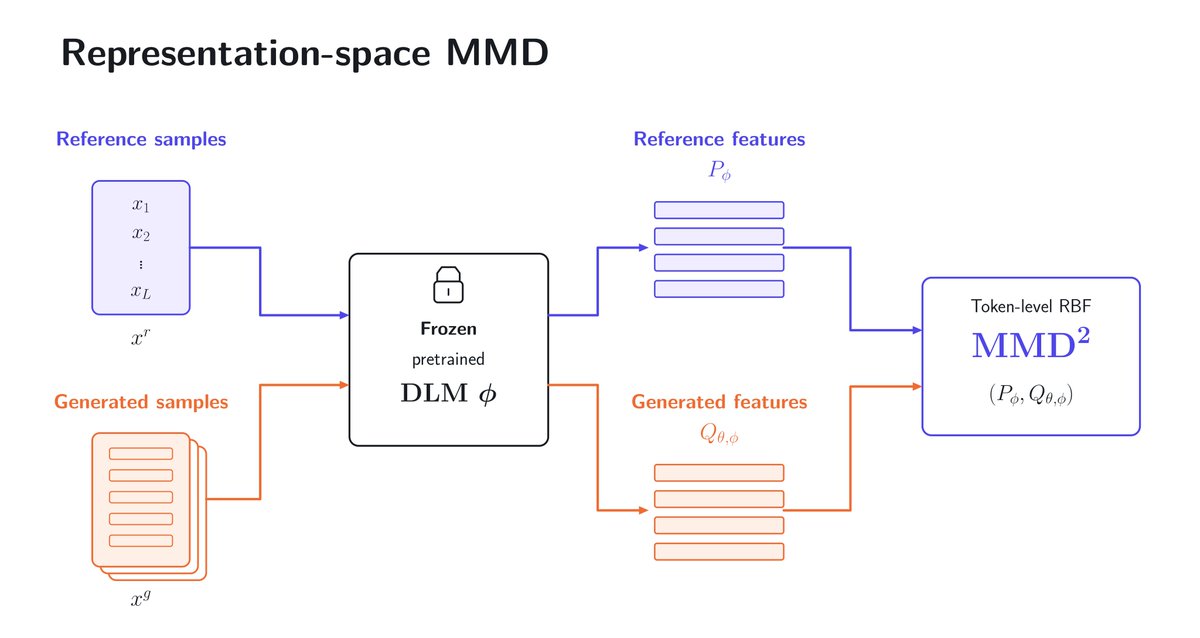
Introducing a simple method to post-train both discrete and continuous diffusion LMs.
It's based on Maximum Mean Discrepancy (MMD) that matches token-level feature distributions. Our method improves generation and speed on OWT/GSM8K and scales to 16B models. 🧵
Is factorization itself the problem for few-step discrete diffusion on downstream tasks?
AlphaDLM keeps factorization but changes the loss: 34.6% on GSM8K across 4 model evaluations, and 7.66% in one!
Our new work on how factorization and the training objective interact 🧵
🔥Welcome 🔺Simplex Diffusion Models🔻!
Standard discrete diffusion models suffer from "information collapse" because they discard uncertainty at intermediate steps by sampling categorical tokens. (1/5)
Can we train a one-step discrete generator without a teacher model?
Introducing Discrete Beckmann Transport Models 🛸 — a new family of discrete generative models that provably carries any point in the latent space to a fixed point on the vertices of the simplex in a single step.
We achieve the diversity-coherence Pareto frontier for unconditional language modeling and SOTA few-step reasoning performance, with 84.6% accuracy in 4 NFEs on Sudoku-Hard and 16.8% in 32 NFEs on TinyGSM/GSM8K.
Joint work with @ShiyiWangML from my visit at Harvard!
Also, huge thanks to @msalbergo and @BrianLee794309 for the helpful discussions and guidance :D
More in 🧵
Can neural networks learn to think by denoising?
Excited to share Thinking with Looped Flows!
We train recurrent reasoning with local denoising objectives. It is a new approach for reasoning that achieves SoTA on ARC-AGI-1 and 2 among looped models.
In collaboration with @chandavidlee, @FEijkelboom, @nmboffi, @ismaililkanc, @jw9730.
1/🧵
New blog post: continuous diffusion for language is back!
This research direction receded into the background for a while, but as of this year, it is once again a hot topic. I wrote down a historical perspective and some thoughts on the recent revival.
https://t.co/wNafED6aDB
📢Aug 17 (Mon): Self-conditioned Flow Map Language Models via Fixed-point Flows
🤔Self-conditioning is a core technique that enhances continuous flow-based language models by allowing the model to condition on its own denoising estimate. While empirically successful, maximizing its potential is difficult due to a number of reasons:
1️⃣ The underlying mechanisms driving its performance improvements are poorly understood
2️⃣ It remains unclear how to leverage self-conditioning for few-step generators based on flow maps
🔑To address these issues, the authors propose fixed-point flows, a two-dimensional class of self-conditioned flows. They identify that flow models with self-conditioning actually solve a fixed-point iteration that bootstraps the learned denoiser's performance.
🔧The framework distills these fixed-point flows by compressing both dimensions of the process: the fixed-point iterations (via fixed-point distillation) and the flow process (via flow map distillation). This ensures the resulting fixed-point flows define valid, highly efficient flow maps.
📈The resulting model, FMLM*, outperforms state-of-the-art self-conditioned and few-step models in one- and few-step generation on OpenWebText. The study demonstrates that properly compressing both the fixed-point and flow dimensions unlocks superior few-step generation capabilities.
This Monday, Jaehoon Yoo (@wognsfjq96) and Wonjung Kim (@wonjung_ki13109) will present their recent paper on the FMLM* framework.
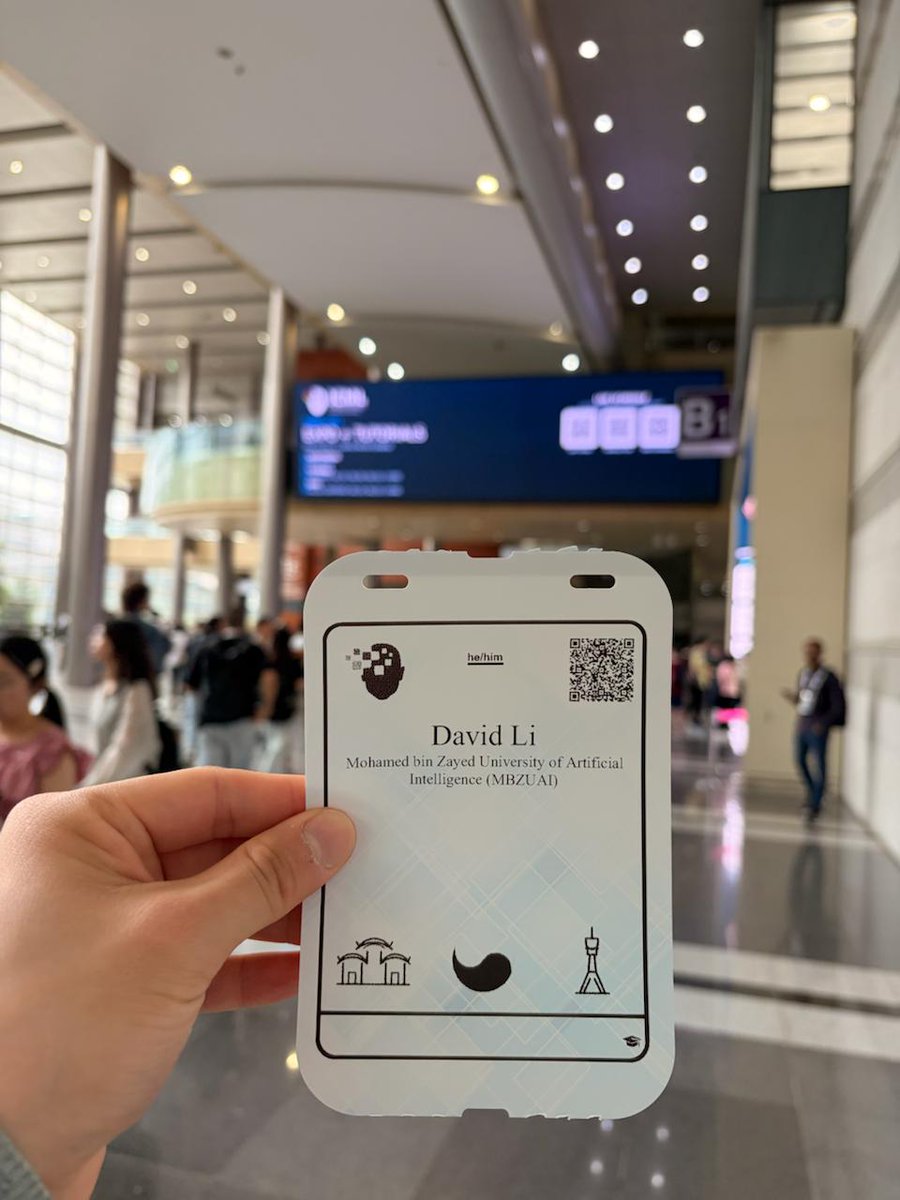
Six papers at #ICML2026 in Seoul 🇰🇷
One of the works that drew the most attention was IDLM: Inverse-distilled Diffusion Language Models. We extend inverse distillation to discrete diffusion language models, reducing inference steps while preserving the generation quality
🧵 1/5
📢 Diffusion circle at @icmlconf 2026: join us Thursday July 9 at 3:30PM at the information desk / job board, we'll head out from there and find a spot to sit. No agenda, just get together and talk shop.
Please tell your friends and tag people who might be interested!
If you’re around, come say hi at the posters or message me. Always happy to chat about diffusion, language models, vision, and new research ideas. I’ll share more ICML notes, events, and interesting papers in my Telegram channel: https://t.co/iszxS5iiWf #ICML2026