Personal tweets from Jim Lobe, Contributing Editor @RStatecraft, director @LobeLog.com (2007-19), DC bureau chief, Inter Press Service (1980-85, 1989-2016).
This is an obscene desecration of the memories of those who stormed the beaches of Normandy, and especially of those who fell.
It is not difficult to imagine that if Hegseth were born a generation earlier, he too could have been at Normandy in June 1944. I just don't know on which he would have best fit in.
It’s like an article from the Onion:
as “the Pentagon raises threat of Israel spying on US to highest level”, Congress is focused on…more deeply integrating Israel into core US national security functions, including intelligence.
But you also refused to engage with the *legitimate* critiques of this section.
What happens when US and Israeli interests diverse?
What happens if we need to stop cooperating - but are too integrated to do so quickly or cheaply (i.e. Turkey & F-35s?)
https://t.co/8BKfZ8IlDc
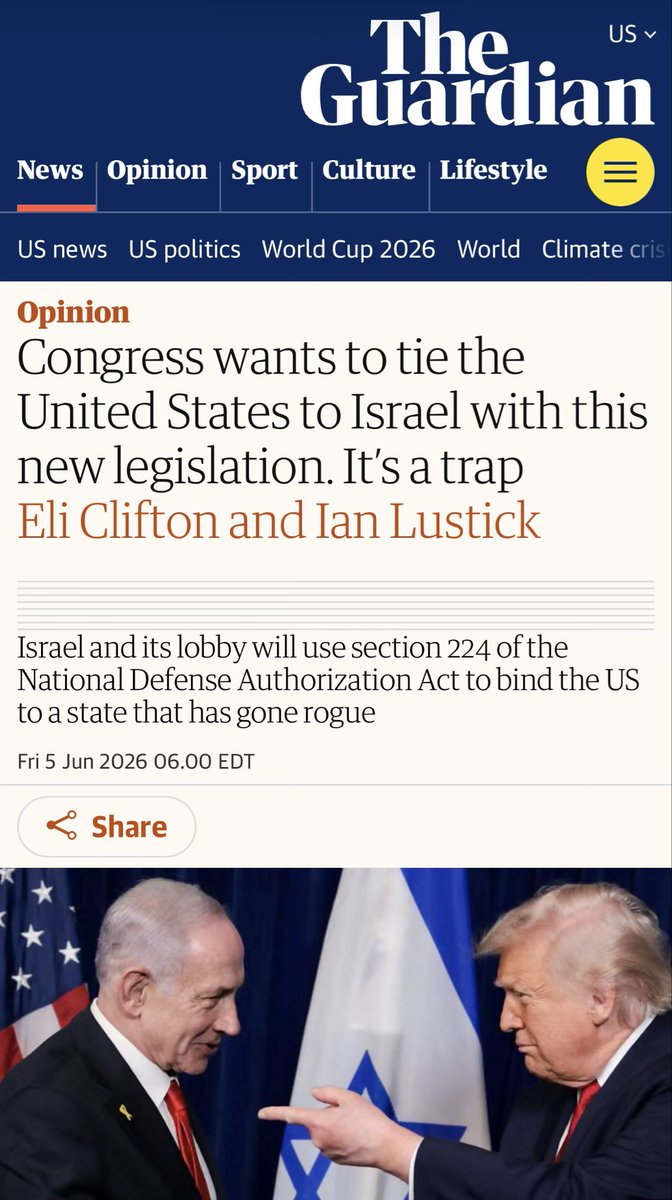
Section 224 of the defense budget - legislation that would deeply intertwine the US & Israeli militaries - traces back to two dark money pro-Israel groups: AIPAC & FDD.
Ian Lustick & I analyze how legislation originating with Israel’s lobby was injected into the NDAA. LINK 👇
A striking trend in Iranian media: more commentators are openly warning that the U.S. and Israel could ultimately resort to nuclear weapons if the current conflict escalates and drags on
Embedded in this argument is a growing claim that Iran’s last remaining deterrent is rapid nuclear weaponization
Whether intended to shape Washington and Jerusalem’s calculations or to prepare public opinion for abandoning Khamenei’s long-standing anti-nuclear weapons fatwa, the debate itself marks a notable shift in Iran’s strategic discourse
https://t.co/Pb91vxPKtL
The 1948 Nakba is very well known, but the ethnic cleansing of 1967 is discussed far lesn, ad it was utterly horrific. Historian Adam Raz has p,ublishsed a well-resourced account in Haaretz today, built on Israeli documents. Here are the main findings:
1) Israel expelled and drove out roughly 300,000 Arabs in 1967, about 200,000 Palestinians from the West Bank and Gaza, and about 120,000 Syrians from the Golan, where only some 6,000 of an estimated 130,000 remained. One soldier described the Gaza raids: "We grabbed guys, stood them up and eliminated them. In hindsight it looks like murder."
2) This was not an accident; it was intentional policy, prepared for since the early 1960s. Defense Minister Dayan wanted the West Bank emptied and repeatedly welcomed reports of flight. Many villages were destroyed. The KKL later planted Canada Park over the ruins of Imwas, Beit Nuba and Yalu. One soldier said the columns of expelled families reminded him of Jews "trudging through occupied Europe," and his heart sank at the sight.
3) Those trying to return were slaughtered. Troops were ordered to shoot to kill without warning. When one soldier asked whether to fire even if he heard babies crying, the answer was: "Don't be a girl." The IDF itself reported nearly 150 Palestinians killed this way by early September, and Chief of Staff Rabin confirmed these were the standing orders.
4) Crimes were widespread: systematic looting, the execution of unarmed prisoners and civilians, and the bulldozing of Golan villages "so there'd be nowhere to return to." One of the officers who ordered prisoners executed was Moshe Levi — later IDF Chief of Staff. A soldier wrote to his girlfriend that they had turned Sinai into a "valley of slaughter," adding: "I saw too many murders to cry."
5) The legal warnings were ignored. In December 1967, Foreign Ministry legal adviser Theodor Meron wrote that the expulsions were "a grave breach of the Geneva Convention." His summary line captures the whole episode: the Ministerial Committee for Security Affairs "decided to approve the policy anyway."
This sounds incredibly familiar, doesn't it? This is the Israeli way of war, based one slaughter and ethnic cleansing. Nothing changed.
To judge the U.S.-Lebanon-Israel statement on "pilot zones" for deployment of Lebanon's army, we should see what lies behind it: Israel's strategy to bolster its security by exacerbating the insecurity of neighboring countries and societies. Mine at Diwan: https://t.co/7spwsocifY
Revealed: Israel’s curriculum for ‘influencing public consciousness’
A leaked Defense Ministry tender lays out the army’s training program for manipulating public opinion in Israel and abroad.
@ha_makom
https://t.co/5C1yc8quJj
Right after the WSJ reports that Trump will only resume the war if Iran hits US troops, this Israeli front group declares that the US needs to keep US troops at the bases where Iran can hit them.
By “U.S. Needs Its Mideast Bases”, FDD means “Israel Needs U.S. Mideast Bait”:
One of the chief architects of the 2003 Iraq war, which Trump called “the single worst decision ever made," has high praise for his backfiring war against Iran:
The Israeli Defense Ministry is training 320 "influence experts" per year on using deepfakes, psycohological warfare, propaganda, and deception. Some of the courses specifically focus on how to conduct influence operations in the US.
Trump's candid remarks are extremely important for understanding the current debate over Iran's nuclear program.
First, Trump is effectively acknowledging that there is no realistic military solution to the most critical aspect of Iran's nuclear challenge: its stockpile of enriched uranium, particularly the roughly 440 kilograms enriched to 60% purity.
Second, while it may be theoretically possible to remove or secure this material through military action, the practical realities are far more daunting. Any such operation would entail substantial risks to U.S. forces, including casualties, hostage scenarios, and the possibility of a prolonged military commitment. For a president highly sensitive to the political costs of military losses, the shadow of Operation Eagle Claw, the failed 1980 hostage rescue mission that damaged Jimmy Carter's presidency, still looms large.
As a result, Washington is left with two deeply problematic options.
The first is a negotiated agreement with Tehran that would involve diluting, exporting, or otherwise neutralizing the enriched uranium stockpile as part of a broader framework that freezes and significantly constrains Iran's nuclear program. The political price, however, would likely be sanctions relief and a measure of economic and political stabilization for a regime that both Israel and the United States were openly seeking to weaken only months ago.
The second option is essentially strategic containment: maintain intelligence surveillance over the nuclear material and rely on the assumption that intelligence penetration is sufficient to provide warning if Iran decides to move toward weaponization. Yet this approach carries its own risks. Nearly a year after the confrontation with Israel, international monitoring remains severely degraded. The IAEA no longer has meaningful access to key enrichment sites, and visibility into Iran's activities is far below what it was before the crisis.
The bottom line is that Trump is implicitly admitting that there is no straightforward military answer to the Iranian nuclear problem. Destroying facilities is one thing; securing or removing hundreds of kilograms of highly enriched uranium is something else entirely. Such a mission would resemble a major military occupation rather than a conventional strike, with unprecedented operational, political, and strategic risks. Given Iran's ability to target forces involved in such an operation, it is far from clear that any U.S. president would be willing to authorize it.
The challenge, however, is that the alternatives are hardly reassuring. Reaching an agreement with a regime increasingly dominated by the Islamic Revolutionary Guard Corps is difficult. At the same time, intelligence monitoring alone may prove insufficient, particularly as many in Tehran have drawn the lesson that only a credible nuclear deterrent can prevent future Israeli military action.
In that sense, the Iranian nuclear issue has not disappeared despite two major military confrontations. If anything, it has become more
acute.
#iran
"The entire country of Israel has a GDP that is less than a single town in my district, yet somehow Netanyahu thinks he could tell the American people what we should do" -- @RepRoKhanna
https://t.co/oMYrfzUZuU
NEW: A House committee summarily struck down an amendment to strip a measure from the massive annual defense policy bill that would further integrate the US and Israeli defense industries.
More from @KelleyBVlahos
https://t.co/SGxuoLrYhb
Update: The House Armed Services Committee just rejected an amendment that would have removed this provision. A recorded vote was NOT requested, meaning the American public will never know which Members supported or opposed this pivotal legislation.
The interpretation in Tehran is that Trump only responds to power. In this view, the more #Iran stands firm and demonstrates resolve and a willingness to escalate, the greater the chance that he will back down:
Iran threatens to target Israel if Israel strikes Beirut → Trump calls Netanyahu and urges restraint.
Iran targets U.S. bases in the Persian Gulf in retaliation for U.S. strikes on its coastal military positions → Trump adopts a softer tone toward the Iranian leadership.
The President just admitted calling Netanyahu "f--ing crazy" & we just learned that the proposal to integrate the U.S. & Israeli militaries was "Netanyahu's initiative."
In short, a "f--ing crazy" foreign leader is now drafting U.S. foreign policy.
Hayman, former chief of Israeli military intelligence, in a PBS interview, suggests the Kurdish ground offensive was meant to be the opening salvo of a US/Israeli war against Iran, and that Trump backed out under pressure from Erdogan. 1/14