Even if you are "doing everything right" in terms of lifestyle you're likely to be facing ageing diseases in your 80s - @statto at #FoundersLongevityForum@LDNTechWeek
Solving this goes beyond lifestyle into rejuvenation style treatments and medicines
Cell therapies have enormous potential in longevity and regenerative medicine more broadly. But why are they still so expensive and hard to scale?
Read more from our CSO Partner, Manish Chamoli PhD
https://t.co/w1gC6ebalR
Exciting news - Vincere has teamed up with Beiersdorf, the company behind leading skin care brands like NIVEA and Eucerin, to develop mitophagy-enhancing molecules for anti-aging skin care!
You can learn more and chat with the team at:
https://t.co/8TojQTAxZ2
1/n Fun journey continues: Our new @CellStemCell paper out on how the Inherent & Dormant Plasticity of mouse naive PSCs can be "Exaggerated" to Directly form ~E8.5 Transgene-Free (TF) Mouse SEMs & WITHOUT inducing 8-16-Morula-like "Embryo Founder Cells". https://t.co/xpAKUaBdbp
@slatestarcodex has written a great article on the burgeoning field of embryo selection, featuring our recently launched company @herasight. Scott has used the technology himself and gives an overview of the field - this is an essential read for anyone curious to learn more.
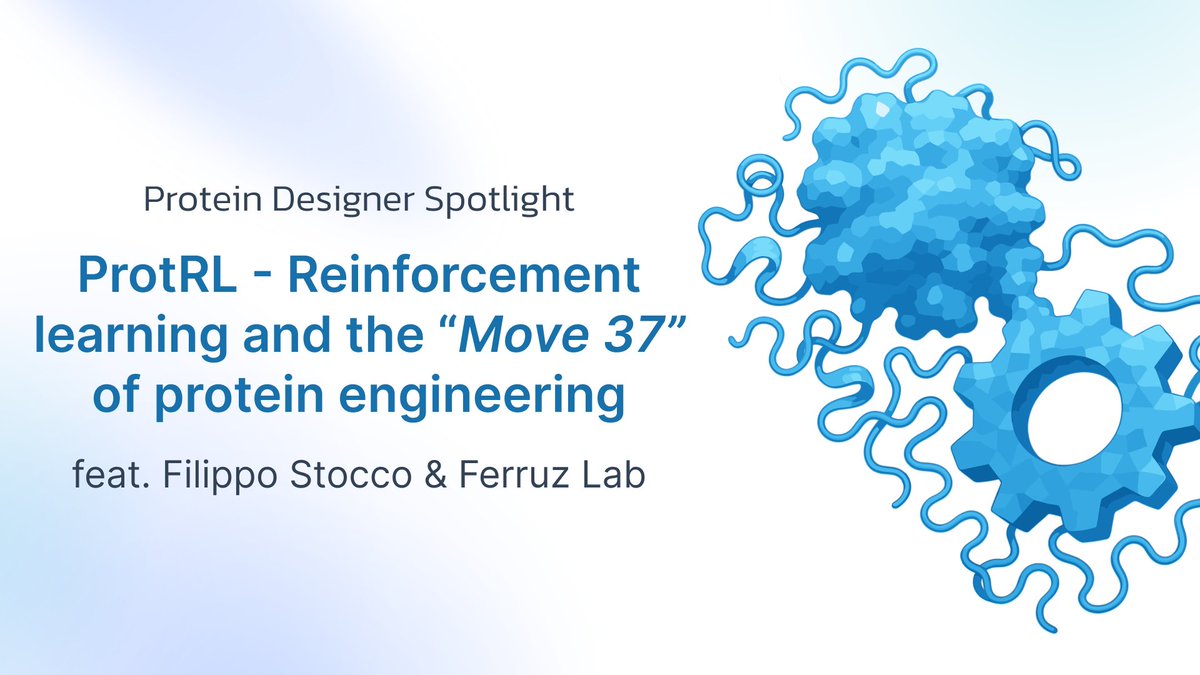
How can you use Reinforcement Learning to make better proteins and what does a “Move 37” moment in protein design look like?
We’re taking a look at ProtRL: a framework for aligning protein language models to your desired distributions using reinforcement learning. Filippo Stocco from Noelia Ferruz' lab is telling us all about how it works, why reinforcement learning is important for protein engineering, and how these proteins perform when tested in our lab at Adaptyv.
The crossover between crypto and longevity folk seems confusing at first...
Both require you to deeply question concepts that most people hold as unquestionable: money and death.
Worth a listen to @brian_armstrong with @NiklasAnzinger
https://t.co/9oBfiDOjQP
Why do people avoid directly expressing the desire: "I don't want to die"?
It's not just about disappointment: it will happen anyway, so why upset yourself?
It's not just about becoming an outcast: people will think you're strange. The fear of death doesn't raise social status.
It's about the need for a complete overhaul of one's worldview. Everything must be reassessed.
We all consider people whose actions will lead to our death in the future to be bad.
But we also can't call those who do nothing, leading to our death, good either.
"I don't want to die" is a breakdown of moral principles, if, of course, this desire is overwhelming.
"I don't want to die" is a true new ethic, where everything is subordinated to the struggle for existence.
You must behave differently if you seriously don't want to die.
Calls for the fight for life cause an unpleasant feeling that comes from any moralizing. All these considerations require energy, which the brain deems unacceptable. All these considerations take time to understand what to do.
"I don't want to die" is a confrontational position. It's a demand for everyone to act against death. The struggle for existence is a confrontation with the world.
Can we do without a struggle? Yes, it has been done before and turned out poorly.
https://t.co/e1d4mksBm6 out of the traps with $35 million fund for #petlongevity
Early-stage fund will back innovative startups in Europe, Asia and the US that are focused on pets’ longevity, health and therapeutics.
#investment#funding#petcare
https://t.co/Er99PLC92M
@biogerontology Is this going to be changed by development of lower cost ways of conducting trials?
I've seen some companies work on "in silico" type simulation of human trails with different molecules, to help reduce the time and cost
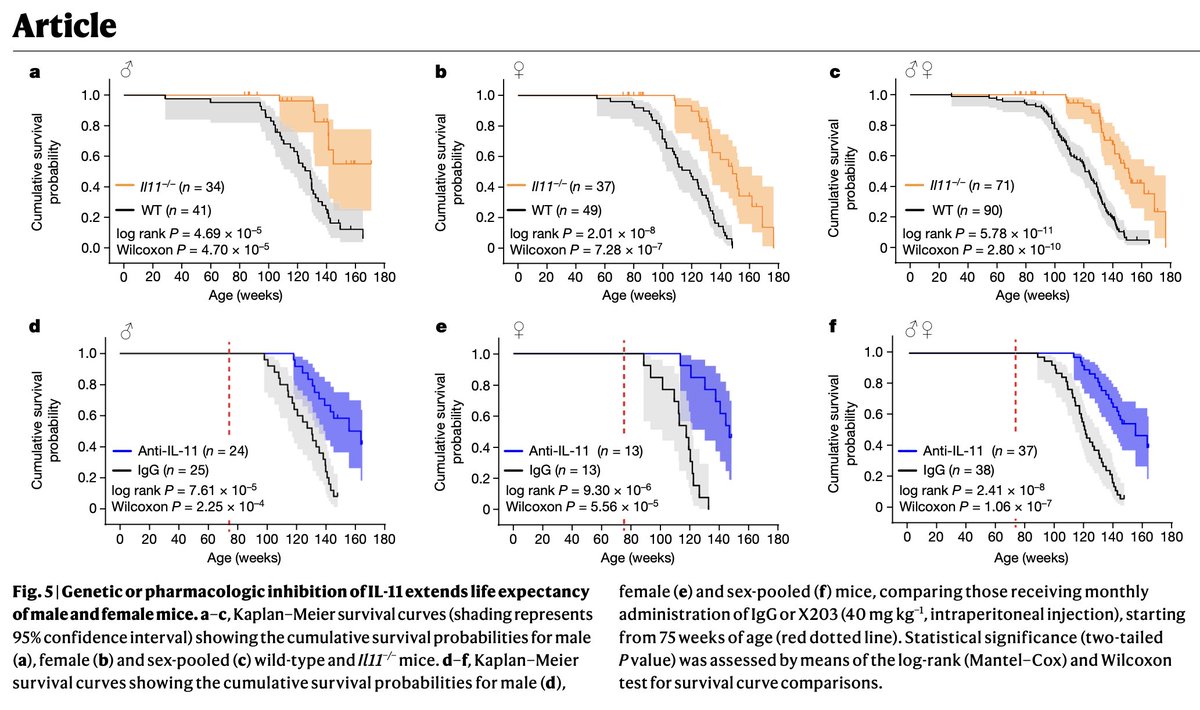
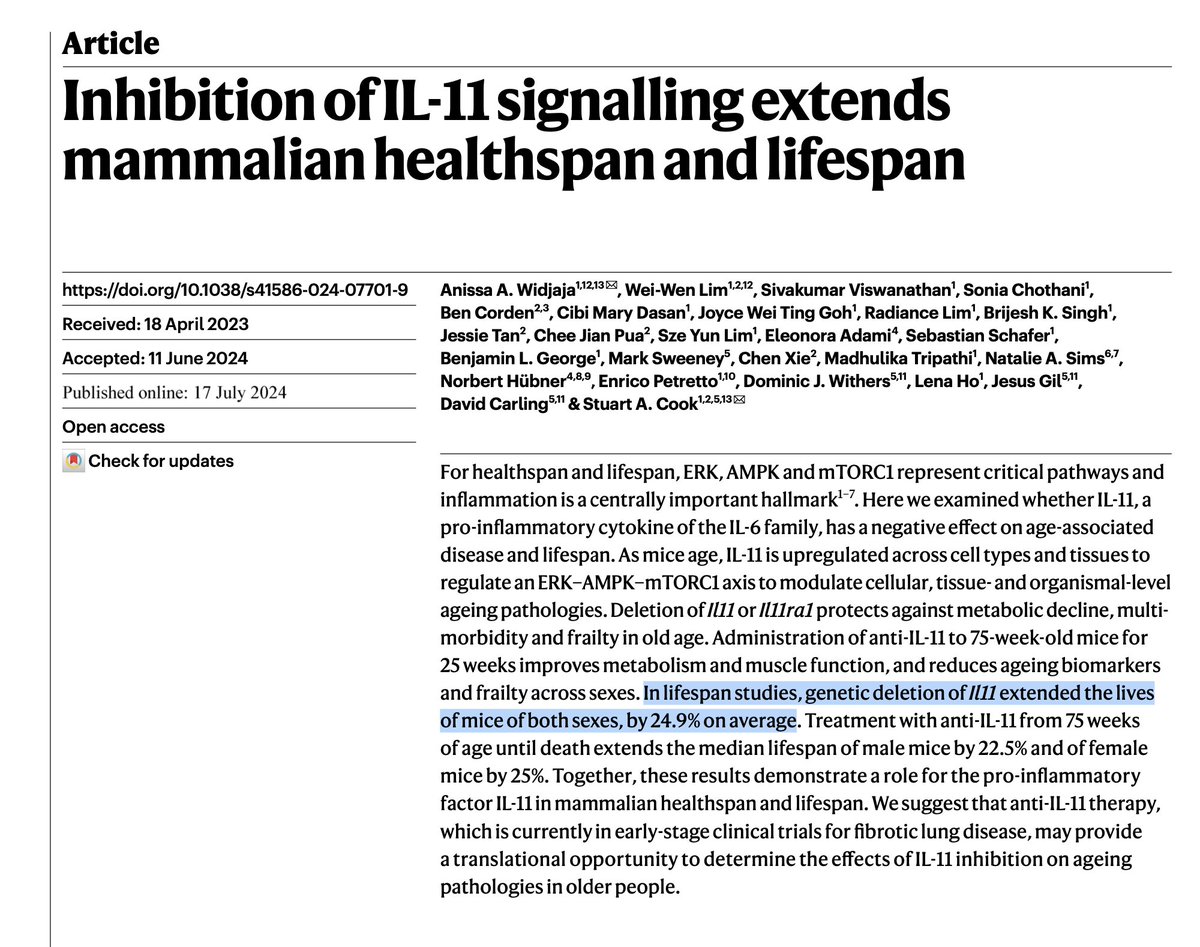
This paper will make waves in the aging research community and the results will need to be replicated (I would not fully believe it until I see ITP data) but looks very promising.
IL-11 and downstream targets are very promising.
Congrats to the team and kudos to Singapore!
Source: https://t.co/aL2yi8RFk4
This new paper provides a potential explanation for why psilocybin has such a profound impact on alleviating depression...
It indicates a long lasting reduction in self-focused thinking and rumination!
After a high dose of psilocybin, the brain desynchronizes at a massive scale, causing loss of our sense of self, time, and space. This may drive the burst of plasticity caused by psychedelics. The next day, brain activity has largely returned to normal, but an echo remains – a reset of circuits critical to the sense of self.
Our study is out today in @Nature https://t.co/PjACA6nkAy