IS THE ECONOMIST ALWAYS WRONG?
Scandalously, in some circles @TheEconomist has a reputation as a contrarian indicator. This week we fessed up to getting a big call on oil prices from April wrong.
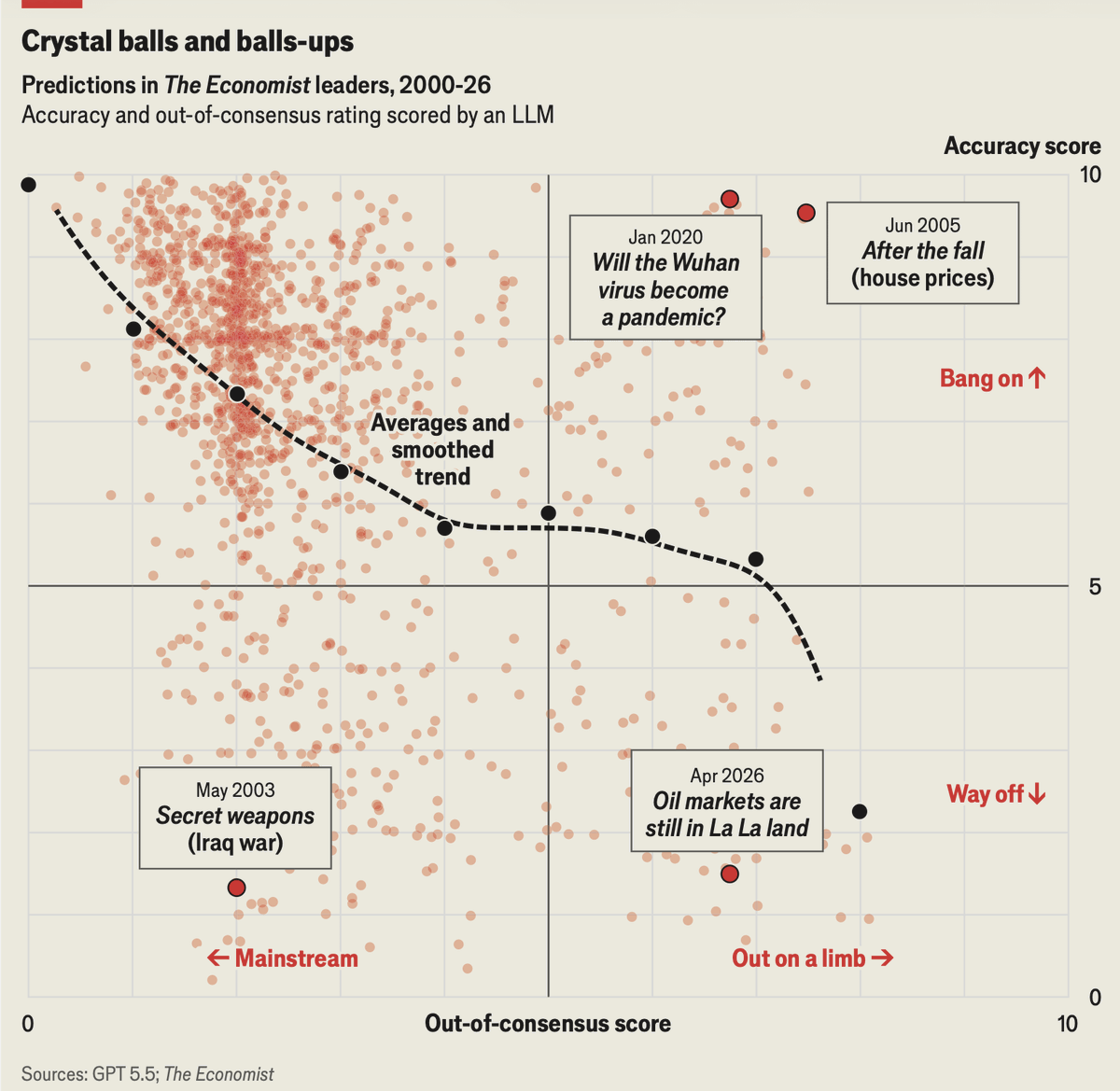
Obviously our goal is not perfectly-hedged (and perfectly boring) predictive accuracy: often it is to stimulate, provoke, and challenge. But I did want to test that wider allegation, so I ran a series of LLM scorers across our full leader database since 2000 (7,000 leaders in all.)
You can see the results in the chart below: each dot is one of the 1,400 leaders where we identified concrete and falsifiable predictions that were central to the argument. Higher = more accurate, further to the right = more contrarian.
We do well, unsurprisingly, when aligned with conventional wisdom. We often do worse when truly out on a limb. But actually, on average, we are a bit likelier to be right than wrong on our somewhat-out-of-consensus calls. All round, a respectable performance.
And as @ecurrnomics points out an accompanying leader, there is no shame at all in being beaten by the market: as good free-marketers we believe deeply in the aggregated wisdom of prices.
Take a look at my piece here, which includes a canter through our best and worst calls of the last quarter-century: https://t.co/WyKqangFrE
I rarely post on Europe because @lugaricano always has better takes than mine. It is hard to be the second act!
His post this morning:
https://t.co/GmsvvMTVIW
on the two Europes is particularly striking. Figure 1, which I reproduce here, is something European policymakers should keep in mind every day.
Beyond the raw, somewhat abstract figures for GDP per capita, there is a reality I see every time I travel to Western Europe. I moved to the U.S. in 1996, six weeks after graduating from college. Every time I visit, I can tell that Spain (especially outside Madrid) is further behind the U.S. today than it was the day I left.
The malaise in countries such as France, Germany, Italy, and Spain is not just economic. The public conversation is also more insular and focused on distributional fights over a pie that grows much less than in the past, with many more claimants. While I can listen to dozens of incredibly exciting podcasts in the U.S. about deep learning and technology, most of what one hears in Europe (Luis excepted!) is second-rate.
Of course, this is not to say that everything is perfect in the U.S. Far from it. One only needs to ride the subway in Seoul a couple of times to realize that New York City is, on many dimensions, a major underperformer. When I visit New York City, I am not amazed by its prosperity but wonder how much richer it could be with a half-decent government. And California’s policies are a textbook example of how to waste the immense resources of one of the luckiest places on Earth.
And Europe still has centuries of beautiful architecture and culinary traditions going for it
But, Western Europe, thou art weighed in the balances, and art found wanting.
Hoy ha salido publicada en @elmundoes una entrevista que @dprietoelmundo me hizo hace unas semanas:
https://t.co/ciJRMljdxj
Hablo de muchas cosas, desde inmigración hasta vivienda. Pero, personalmente, la parte que me parece más importante es la que incluyo en el pantallazo.
España necesita un cambio radical de dirección. El sistema actual está sacrificando a todos los menores de 50 años en el altar del estatus quo. ¿Y lo peor? Que encima los que disfrutan de este estatus quo ni se dan cuenta de ello y que la alternativa que parece venir no va a ser tal.
El 21 de diciembre de 2010, hace casi 15 años, publiqué “La incierta deriva de Rajoy: de 'popular' a Populista” con @lugaricano en El Confidencial
https://t.co/UscGrS3ASR
(que, por cierto, hizo muy poca gracia a mucha gente del PP).
Copio:
“Cada día, al leer el periódico, vemos noticias que cuentan como el PP vota en contra de la congelación de las pensiones o de la reducción de sueldo de los funcionarios, no apoya el incremento de la edad de jubilación o tiene una actitud cuando menos equívoca con los desmanes de los controladores aéreos…
Tomemos el caso del retraso de la edad de jubilación a los 67 años. El sistema público de pensiones español lleva arrastrando desde hace décadas un problema de sostenibilidad implícito causado por el dramático cambio demográfico que estamos experimentando. La necesidad de retrasar la edad de jubilación existe desde la década de los 90 del siglo pasado y por unos motivos u otros nunca se ha afrontado, como todos los organismos internacionales, incluida ayer mismo la OCDE, nos lo recuerdan. La crisis económica únicamente nos está forzando aquí a hacer algo que teníamos que completar de todas maneras. Los errores del Gobierno no son la causa del cambio de la edad de jubilación y frases como la de Tomás de Burgos -“Para hacer la reforma de pensiones que necesita España no hace falta ampliar la edad de jubilación legal. Nosotros apostamos por incentivar que de forma voluntaria se pueda continuar más allá de los 65”- son para nosotros profundamente incomprensibles…
¿Se entiende la lista de 11 consejeros que Cajamadrid propone para el consejo del banco del SIP con Bancaja y otras entidades? ¿Se entiende la demanda contra los administradores del BdE en la CCM? ¿Se entiende el nivel de endeudamiento de Madrid o de Valencia?”
En 2010, advertíamos que el PP, si llegaba al poder, poco iba a hacer. Y efectivamente, hizo lo mínimo y siempre empujado por Bruselas.
¿Se cree alguien que Feijóo va a hacer ahora algo?
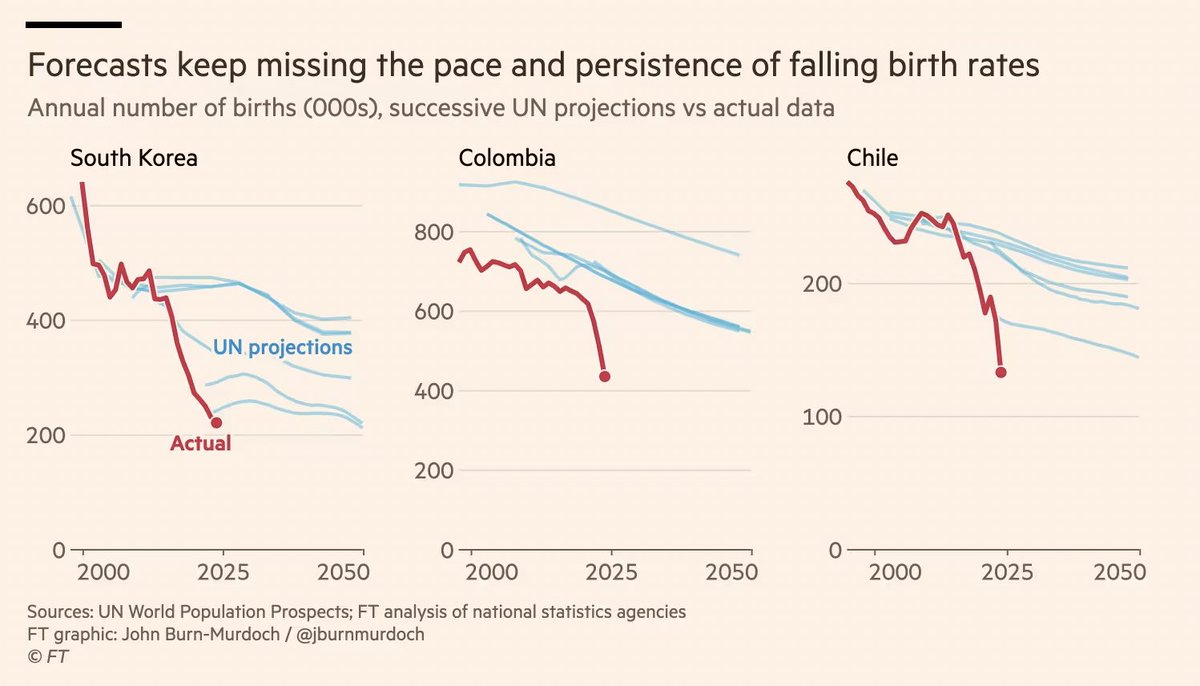
The region’s fertility rates are falling faster than expected, forcing governments to rethink healthcare, education and pension policies, says @jpspinetto https://t.co/4wZUM0v7xB
I am a former H1B visa holder and US citizen.
When I arrived in the US in 2004 with a trekker's backpack, an F1 visa, and $2,000, I had no idea how this country would change my life. Within six years, I was hired by MIT as an Assistant Professor and within ten I had started my own company. The US provided me with a level of opportunity that I doubt I would have seen anywhere else in the world.
So let me tell you why I think the US is a perfect complement to foreign talent and why it is in our interest to keep it this way.
I moved to the US in 2004 to pursue a PhD in Physics. When I landed, I expected my American classmates to be more advanced than I was in theoretical physics concepts. But I was wrong. I quickly realized that I had taken more graduate level courses than them. Their bachelor education had meandered through multiple topics, while I had been on a 100% physics and math track that helped me test out of graduate courses and move right into research.
And that is where the American magic began. Back home, my brief encounters with research focused on making small improvements on well-established problems using sophisticated tools. Many people were competing to show how smart they were by dominating byzantine methods. In the US, I saw many researchers succeed by picking “simple” but relevant problems. That was a perfect complement for my technical background. I felt like Daniel San the moment he figured out the value of waxing all of those cars. I finally was at a place where my skills were useful.
America is a land opportunity in big part because it has a fantastic work culture that values things such as relevance, communication, and simplicity. In X, international comparisons of work culture often veer into formal things like maternity leave. But as someone that has worked in a few countries, I am convinced that many subtle things, such as knowing how to take turns during a meeting, or responding to an email quickly, can go a long way. In many countries, work is an overregulated bureaucratic nightmare. American culture can be extremely refreshing for foreigners who know what it means to battle unnecessary processes and rules.
But there is more. The US work culture is also open and optimistic. Most countries suffer from “well intentioned” cronyism, where people hire, associate, and promote others based on personal relationships. This certainly happens to some degree in the United States, but less than in other places. That openness, however, is key for providing opportunities for outsiders with more skills than networks. Also, many countries pessimistic work cultures, where people shoot others down as a way to flex their wit. But as Nat Friedman said, “Pessimists sound smart. Optimists make money.” American can-do attitude is a valuable intangible that is prevalent in the US.
Now, to the point of this post, these aspects of American work culture are great complements for skilled foreign workers. Complements that favor America. America’s open work culture, with its emphasis on communication skills and optimism, is amazing for organizing teams. Skilled foreigners perform better in teams with an American work culture than in teams of bureaucratized pessimists that don’t know how to take turns during a meeting. When those surviving in those more hostile work environments move to America, they can unleash their technical skills in relevant problems within optimistic organizational cultures that are rare back home.
Whether it is Von Braun and his team moving to Texas, or a brilliant young man or women from Sicily or Jakarta coming to the US for their PhD, America benefits from this complement. The fact that every year we get the first pick on the draft is a key competitive advantage. Sure, we do not always know if the first pick of the draft will turn out great, but getting the first pick of the draft is not something we want to lose.
We should double down on what makes America exceptional.
After presenting it in Stanford, the first draft of our book "Reforming the Euro: Lessons from Four Crisis" with @JohnHCochrane and @masuch_klaus is available (comments welcome). We analyze the enganglement of the @ecb in financing banks and governments https://t.co/Mu3wk9qDzZ
Sobering: "Of 100 random freshmen enrolling in college today, 40 will not graduate. Of the remaining 60 that earn a degree in six years, 20 will end up chronically underemployed."
From: https://t.co/CFiLqFpimf






![Rainmaker1973's tweet photo. European people’s common reaction when you start speaking their language
[🗺️ u/droim] https://t.co/kHuwWjG1GR](https://pbs.twimg.com/media/GIz_UXZXQAAq28v.jpg)