To facilitate greater investment, the Chancellor must overhaul the OBR and the fiscal framework. We a system that considers the long-term multiplier effects of public investment, instead of forcing the OBR to police precise yet relatively arbitrary targets [3/3]
GDP has outperformed expectations, but today’s data is still relatively low when compared to pre-2008 financial crisis trends. It also relies on some factors that may be one-offs, such as tax consultancy use in the run up to the budget and recovery from the JLR cyber-attack [1/3]
Ultimately, the UK economy continues to stagnate due to underinvestment since 2010, particularly compared to international peers. The government has made a start in trying to boost public investment from former lows, but there is still much more investment required. [2/3]
Everyone's talking about tax rises - but what about tax fixes? In a pretty unusual intervention, @CPSThinkTank has teamed up with @CenTaxUK, @ASI, @IPPR, @NEF, @jrf_uk, @WeAreBrightBlue, @LabourTogether & @DanNeidle to argue for sweeping, pro-growth tax reform & simplification.
🏆Our #Researchoftheweek goes to @NEF for their report ‘Solid Foundations’ which outlines the scale of what is required to tackle regional inequality and improve lives across the country. (1/6)
https://t.co/hKZlIQaadX
@BenediktStranak@ekiberd3@dhnnjyn
15 organisations, including @NEF, have laid out recommendations for @RachelReevesMP on how a green financial system can be achieved to power sustainable economic growth https://t.co/MQpYejKb9S
"She has to be very careful how she treads here because economists from across the political spectrum agree that the one thing the UK desperately needs is more investment."
@LydiaPrieg on Rachel Reeves' plans for the economy
A group of 65 leading economists have warned higher UK public investment “must be a priority for the next government”.
Despite the UK's record of low public investment, the economists say the main parties lack “a serious plan to raise public investment”.
https://t.co/0NfW3mT3uw
Didn't expect @GBNEWS to be the one to pick up this story, but good to see new @NEF polling findings covered:
-People estimated the basic rate of Universal Credit was 48% of a minimum wage salary
-They thought it should be 53%
-In reality it's just 23%
https://t.co/rZG1RyGpv5
The haircut developments feel more promising (from a climate perspective) to me than the changes to collateral eligibility criteria, which, while related to energy performance certificates, are more about avoiding default risk due to illegal renting [2]
Bank of England will adjust haircuts on collateral accepted to start including risk of energy price shocks on mortgage repayment. Will also include risks from more frequent & severe flooding. More ambition needed but shows necessary direction of travel [1] https://t.co/dFz6QlfHuh
Plenty to admire from Ben here as usual.
The argument is of course right from first principle: 'experts' advise, 'democracy' decides.
We should certainly be wary of technocratic answers to political questions.
But I think the piece makes a couple of missteps along the way 1/
@BenZaranko@NEF@alfie_stirling@FrankMacroecon But hopefully it would encourage a more meaningful discussion around the many complex factors that determine how much a government should sensibly and sustainably borrow.
@BenZaranko@NEF@alfie_stirling@FrankMacroecon Our proposal is that the range would just be advisory. Government could obviously choose to ignore, they would just be required to explain their reasoning why. So it wouldn’t be taking a very important decision-making power away from democratically elected governments.
The Bank of England needs to recognise that high interest rates are harming the green transition and making it more expensive. The BoE should introduce a green interest rate to make loans for green projects cheaper even while the main interest rate is high.
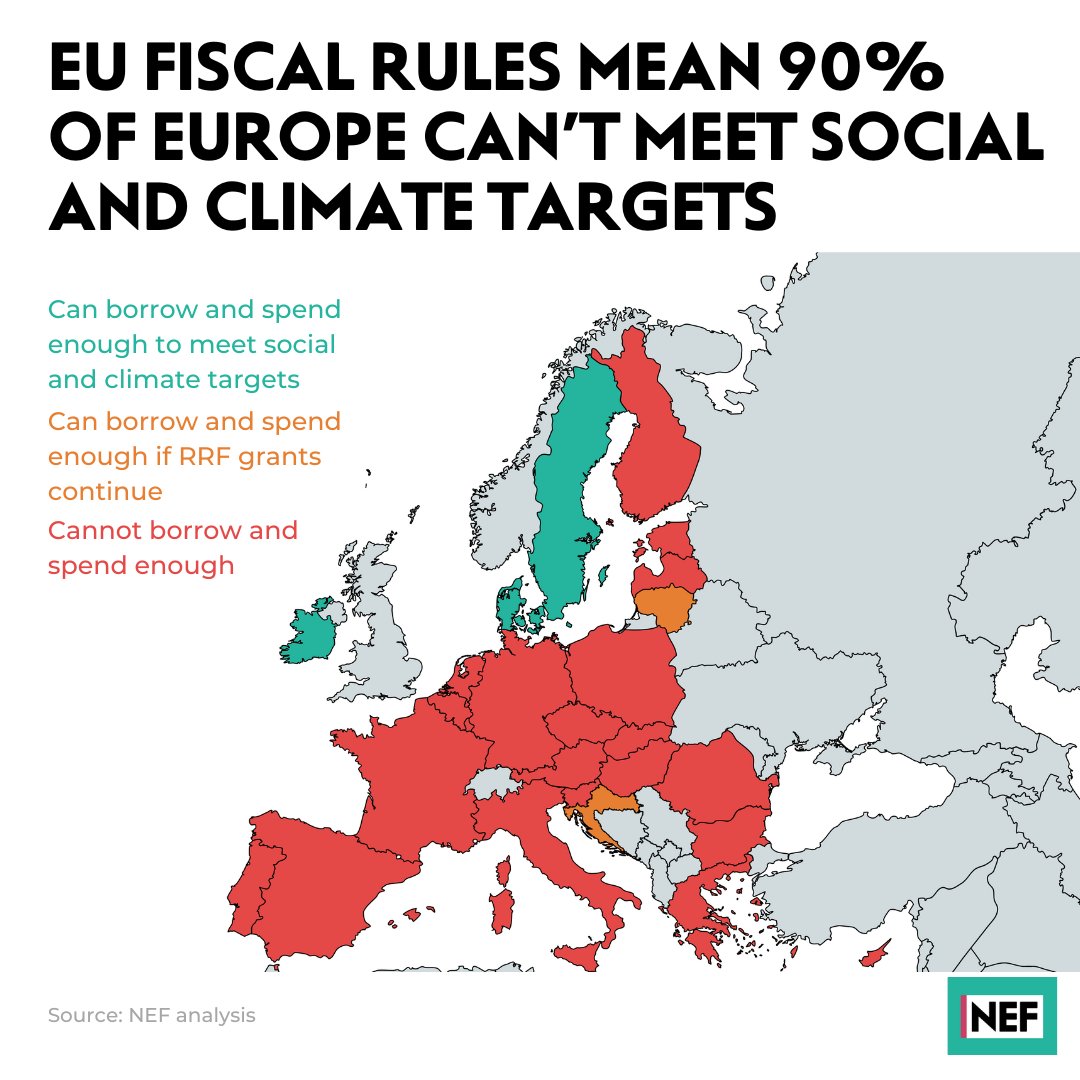
@NEF has been working on this issue for many years. For details on Europe's fiscal rules and the problems they are creating, please see our recent paper with @etuc_ces https://t.co/epzdbyCG5I
Great to see @GordonBrown highlighting how Europe's fiscal rules will trap the continent in stagnation by prohibiting urgent and vital investment [1/2] https://t.co/X0RnURBzDm
We're 75% of the way to meeting our fundraising target - but we still need your help to cut the carbon emissions from flying in a fair way! Donate in the next two days and your gift will have double the impact.💚
The guiding mantra of the DWP when supporting people into work - Any job, Better job, Career (ABC) - can trap people in low-paid, insecure work
My new @NEF blog explores how reforming ABC as part of a joint effort to help people find good jobs could unlock up to £4.2bn/year🧵
🚨18 EU member states will not be able to meet their targets for investment in schools, hospitals and housing under plans for new economic governance rules.
According to a new study by @NEF for @etuc_ces.