how to get AI to win work from government contractors:
(its one spreadsheet and 2 agents, the government already did the hard part)
step 1: pull the list
download the SBA directory of prime contractors with a subcontracting plan, its a free excel file
each row gives you:
- which agency awarded it
- the NAICS code
- contract number
- total contract value
- when the contract ends
step 2: cut it to your lane
hand claude code the file and your NAICS codes
it keeps the primes doing work you can sell into and bins everything else
step 3: find who is short
it runs every contract number through USAspending and pulls the subawards each prime has reported
big contract value with barely any subawards on record goes to the top of the sheet
(thats the prime sweating the october 30 report)
step 4: find the human
the person who owns that number is the small business liaison officer
an agent checks each primes supplier diversity page and linkedin for the name
step 5: write it
a second agent writes one first line per prime off the agency and the contract number
the angle stays the same as the post above, your email is their good faith paperwork
step 6: send it
inmail the liaison officer first, then email the supplier diversity inbox the same day
step 7: log everything
every send and every reply gets a timestamp in the sheet
thats the record a prime can hand the contracting officer to prove it tried
(you are doing their compliance homework and they still have to thank you)
step 8: sort the replies
an agent tags every reply by timing
anything that says next year gets re-queued for august, when the whole scramble starts again
step 9: loop it
SBA posts a new directory each fiscal year
new awards land on USAspending every week, so put both on a weekly claude code loop
the fiscal year closes september 30, set it up tonight
The LinkedIn metric I've found has the closest correlation with meetings booked isn't impressions, likes, comments or follower growth.
It's profile views.
Across the 100+ B2B accounts we've worked on, this is probably the metric I pay the most attention to because it sits directly between someone consuming your content and actually entering your funnel.
Someone seeing a post means almost nothing by itself. But when they stop reading, click your name and open your profile, they've taken an active step to figure out who you are, what you do and whether you're relevant to them.
That's why two posts with 100,000 impressions can have completely different business outcomes.
One might generate 300 profile views and zero meetings. Another might generate 2,000 profile views and 10 qualified conversations because the content created enough curiosity with the right audience to make them investigate further.
The funnel is basically:
Content → Profile View → Offer/Profile → DM or Website → Meeting
So if you want to generate more leads from LinkedIn, I'd spend less time trying to maximize impressions and more time trying to maximize qualified profile views.
A few things we've found consistently increase them:
1. Write about problems closely connected to what you sell. Broad industry news can get huge reach, but a specific breakdown of a problem your ICP deals with gives the right person a reason to check who wrote it.
2. Use proof that creates curiosity. Specific client results, revenue numbers, experiments and things you've actually done naturally make people want to understand who you are and how you did it.
3. Create an information gap between the post and your profile. Your content should demonstrate enough expertise to make someone interested without trying to explain your entire business in every post.
4. Make sure the right people are actually seeing it. 1,000 profile views from random creators are worth considerably less than 200 from founders who could realistically buy from you.
5. Fix what happens AFTER the profile view. Your headline, banner, featured section and recent posts should immediately explain what you do, who you do it for and why someone should trust you.
This is why I think optimizing LinkedIn purely around reach is backwards.
Reach gets someone into the top of the funnel, but profile views tell you how many people were interested enough to take the next step.
If my impressions stay flat but qualified profile views double, I'm usually much happier with the content because that's usually when the meetings tend to follow.
jason lemkin asked david sacks (billionaire) if he checked his email, and he said yes...
most executives do check their email and linkedin inbox.
a CTO at a fortune 100 company replied to our message and said it was what they'd been searching for.
i wrote out exactly how we book executives at that level:
- picking the right accounts
- finding the right person
- the routes in
- the 4 line message
- staying in touch
the full breakdown is in the article below:
Hormozi literally says you can have the tiniest following and still make the most money on LinkedIn.
But LinkedIn just changed what gets rewarded, and most people are still creating content for the old algorithm.
So I just broke down the 7 biggest LinkedIn algorithm changes + everything you need to know to win organic in 2026:
- LinkedIn’s crackdown on AI slop
- Why engagement bait is being suppressed
- How LinkedIn decides who should see your content
-Why saves, sends and dwell time beat likes
Why saves, sends and dwell time beat likes
- How artificial engagement is being detected
- Why posting more can now hurt your growth
- The new way to distribute lead magnets
- Etc
We’ve worked with 100+ B2B companies, generated $5M+ in tracked revenue through LinkedIn across all clients and driven 50M+ impressions in the last year.
Full breakdown is in the article below:
After sending 150M cold emails for 1,000+ total clients (currently sending 2M/mo for 300), there are 5 variables I just stopped caring about that I think people obsess over:
[1] Clever copy.
If the offer is strong and the person receiving it actually wants the outcome, the copy can be pretty average and still work.
Think about offers as simple as:
> "We'll send you 3 qualified candidates for the role you're hiring for."
> "We'll write you a few posts for free and you can decide if you like it"
> "We'll build the first version for free and you can decide if you want to keep going."
You really don't need to get that clever.
If the offer is weak, swapping a subject line or rewriting 3 words probably isn't saving it.
The biggest gains usually come from changing who you're targeting, what you're offering them or how the offer is framed.
[2] Tiny copy A/B tests.
A lot of outbound teams will test two emails and call one the winner because it got a 50% or 100% lift.
Then you look at the numbers:
> Variant A: 2 positive replies
> Variant B: 1 positive reply
Technically a 100% lift.
It tells you basically nothing about what happens if I send another 100,000 emails.
I've NEVER seen tiny syntax changes consistently reproduce at our scale.
When a test really moves, there's usually a bigger difference between the two versions (different angle, offer, proof, audience, etc).
[3] Huge case study numbers.
Say I have these two:
> We helped Leadbird grow to $6M/year.
> We helped Cleverly grow to $50M/year.
Outside lead gen, both names probably mean zero to an average prospect.
The extra $44M doesn't suddenly make the second line amazing.
Now say:
"We helped Apple with its rebrand."
No number at all, but everyone knows Apple, so the proof is much more effective.
[4] Branded domains.
Our old setup for a new client could look like:
> ~14 days warming domains
> ~14 more days ramping volume
> 30-day contract
So you could burn basically the entire first month just getting to full sending volume.
Today we keep pools of non-branded domains warming before the client signs.
Client comes on -> we pull the relevant domains -> create inboxes under their sender names and put them into the campaign.
This takes us from onboarding -> live in under 72 hours.
[5] The sender name.
Once the domain is warmed and healthy, we've been able to spin up new inbox names and put them into campaigns almost immediately without seeing a meaningful change in results.
I used to think the identity attached to the inbox mattered a lot more, but at this volume, I just haven't seen enough evidence that it does.
--
IF YOU SELL B2B - BOOKMARK THIS:
At the end of your B2B Discovery Calls - run this exact 7 minute closer and you'll 10x your chances of closing.
1. 10x more engagement via email (which closes deals)
2. The decision making maps no one else asks for
3. The review call booked before you hang up
4. A commitment to review the first scope
5. A prospect who knows exactly what to do next
6. A prospect who isn't confused on whats next
7. A prospect who gives you internal readings
8. More time to research accounts that are actually engaged
9. 100s of other peripheral benefits
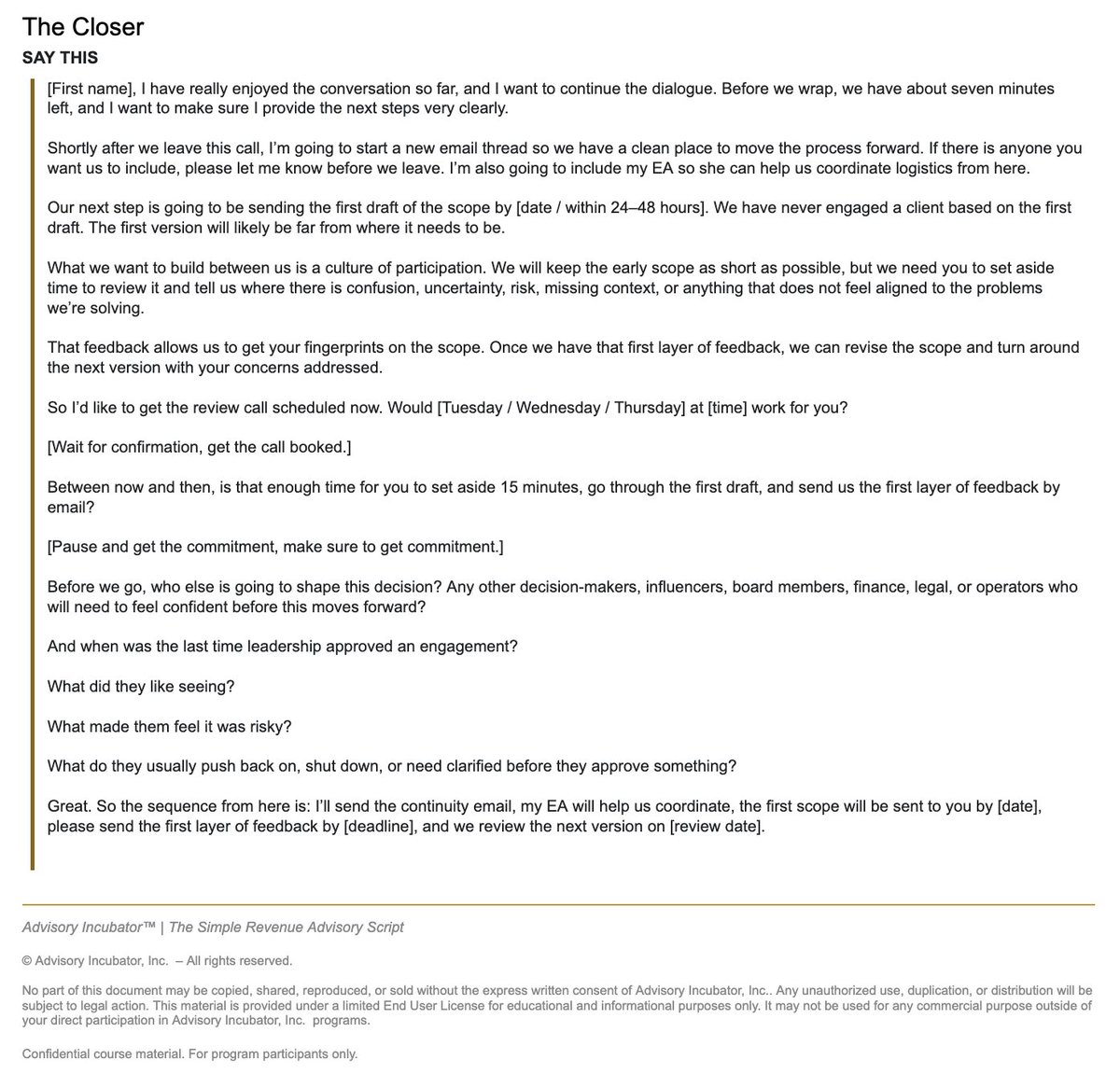
The closer is in the image attached.
You're using the final 7 minutes of discovery to tell them:
> a clean email thread is being opened immediately
> Draft 1 of the scope is coming within 24-48 hours
> Draft 1 is not supposed to be final
> you need their first layer of feedback
> the next review call is being booked right now
> they need to commit 15 minutes to reviewing the scope before that call
Then you ask:
> who else is going to shape this decision?
> when was the last time leadership approved an engagement?
> what did they like seeing?
> what made it feel risky?
> what do they normally push back on, shut down or need clarified?
you do this, and you'll 10x your engagement via email - which is where deals actually close - you gotta get them dancing with you in the emails, create a culture and environment between you and them that is easy to engage with and the best way to do that is clarity + micro step prescriptions
whether you're selling a retainer or charging 50k like we do, that's not a crazy amount but it's not tiny either - so you're usually in a 2-6 week sales cycle
not a lot of time - your only job in that window is to keep them dancing with you
that means getting responses, prescribing clear singular micro-steps, removing confusion, and baking in a culture of communication between you and the prospect
The first scope is not a final proposal they quietly take away and say yes or no to.
It is Draft 1.
You're telling them before it even exists that it will likely be far from where it needs to be and you need their feedback to fix it.
Now they know they're supposed to participate.
They review it, tell you where there's confusion, uncertainty, risk, missing context or something that does not feel aligned and then you turn around the next version with those concerns addressed.
Thats how you get their fingerprints on the scope.
We leave the call with our finger on the pulse of how their org approves engagements, who else glances at them, what leadership liked last time, what felt risky + what normally gets shut down internally.
Now you can build the first scope around the actual people who need to approve it instead of writing a beautiful document that your champion forwards into a room you know nothing about.
And since we charge ~50K we want to invest 80% of our time into the 20% of accounts that are hot. We can't put a prospect through a 3K/mo retainer sales process and expect to come out the other side with a 50K engagement.
You have to invest into that account when they're engaging, hours in deep research better understanding their industry, transcripts you have with them, decks they've sent, growth targets and stakeholders - everything and anything so you can walk them down the path and create a culture of investing time into each other until the finish line is crossed.
if I see even one real reply from a decision-maker, I'll sit in research for at least an hour.
I'll get to know their market, customers, bottlenecks, competitors - all of it. (All via Codex deep research skills)
I'll earn the deal and I only need to keep them engaged for 1-3 weeks.
Run the closer in the screenshot during the final 7 minutes.
Do not hang up without the review call booked, their feedback commitment + the decision map.
you apply this to your 5 digit model and you're 10x'ing your chances 100%
if youre buying intent data and not pulling the SBA loan file youre paying $2,000 a month for a worse version of a free spreadsheet
every 7(a) and 504 loan the US government backs is public
company name, city, lender, loan amount, approval date, NAICS code, updated every quarter on sba .gov
a company that just borrowed $1.4M has confirmed capital, a repayment schedule, and a growth plan someone signed for
- download the FOIA file, filter approval date to the last 90 days
- filter NAICS to the industries you sell into
- keep loans between $350k and $5M, thats expansion money, under that is a truck
- find the owner on sales nav, "posted in the last 30 days"
first line is the loan, second line is the question
"saw the SBA backed the expansion, whos running new business while you build it out"
hes spending that money in the next 6 months and every vendor who finds him first gets a piece of it
the file has been public since the 90s and the man running your outbound has never opened it because its a csv on a .gov site
I build software for blue-collar businesses and test AI agents to run them, so operators don't have to figure it out alone.
The top workflows I've automated at my plumbing company (all running now):