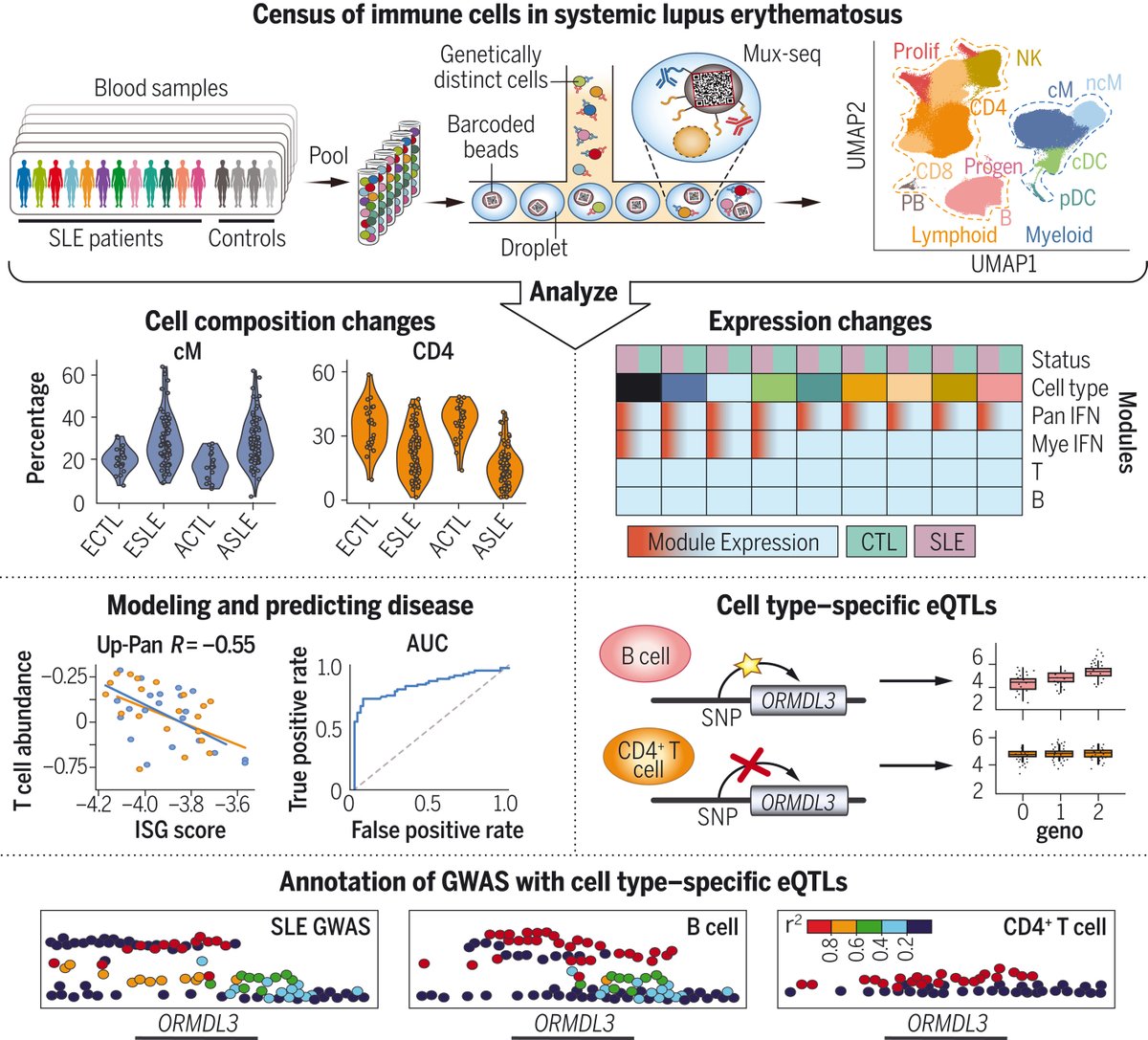
In 2018, we developed mux-seq and demuxlet to enable population-scale single-cell sequencing. Today, excited to share our paper in @ScienceMagazine where we deployed mux-seq to profile 1.2M immune cells from 162 lupus patients and 99 healthy controls: https://t.co/ITKGnuEsBl. 1/n
Excited to share our paper in @NatureComms where we present the 1M-scBloodNL study in which we profiled 1.3M immune cells from 120 healthy individuals, longitudinally exposed to 3 different pathogens https://t.co/ILsrHYnLwM @UMCGgenetica#scRNA 1/8
New @ScienceMagazine immunogenetics research from @UCLANeurology and @UCSFMedicine on how differences in ancestry explain the disparities in lupus susceptibility and severity. Congrats to Noah Zaitlen and @yimmieg !
👉🏼https://t.co/XMNyqS8g3v
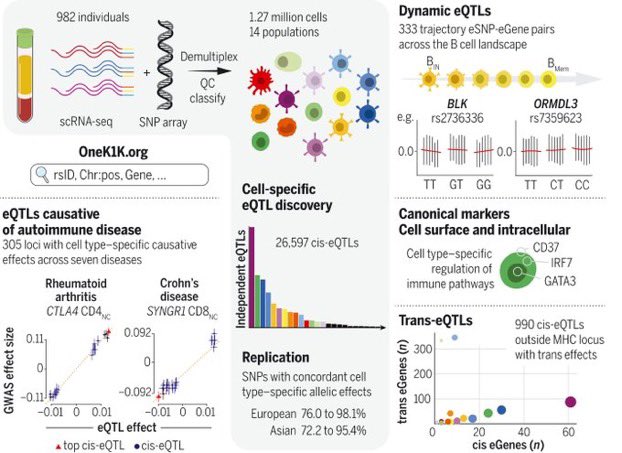
Our work “Single-cell eQTL mapping identifies cell type-specific genetic control of autoimmune disease” just published in @ScienceMagazine. The work started with the creation of the OneK1K cohort, consisting of scRNA-seq data on PBMCs from ~1000 donors https://t.co/Uzskay7TeM 🧵
To help solve this problem, we (Mike Thompson, Gracie Gordon, @andywdahl, @yimmieg, Noah Zaitlen, and @brunilda_balliu) introduce FastGxC - a powerful and fast way to map context-specific QTLs in multi-context genomic studies. 2/9
lentiMPRA protocol and MPRAflow a user-friendly tool for MPRA analyses. Great work by Gracie Gordon, @TakaInoue5, @bethkarenmartin, Max Schubach, @vagar112, and many others from Nir Yosef, Jimmie Ye, Katie Pollard, @JShendure, Martin Kircher labs.
https://t.co/rtWAJbOznx