In celebration of Jensen Huang's return and his commitment to open-source AI:
Today we’re releasing OCRia-nano-1, an extremely lightweight and open-weight OCR model that is just 8.1M parameters in size and can parse pages at 426 ms per page on your CPU ⚡️ - no GPU required!
OCRia-nano-1 is intended to be the first pass parsing for the billions of pages/petabytes of data that are locked up within any organization and unlock it for all agentic automation. Even at its size, it still has the following properties:
✅ it can parse complex tables and generate bounding boxes
✅ it is natively multilingual and can cover CJK, right-to-left, and other scripts
✅ is more accurate than Marker, PP-OCRv6, Tesseract while being up to 2-5x faster
It is perfect for ‘unlimited’ high-volume ingestion (e.g. indexing a petabyte scale RAG knowledge base) and ad-hoc uploaded files where the agent has additional tools to inspect the file more deeply. You can always use larger VLMs (like OCRia-1.5) for any document that requires higher visual accuracy.
Best of all, it’s a fully open-weight model available through liteparse. If you’re interested in using it for commercial use, come talk to us!
Blog: https://t.co/2woySeAtbz
Install OCRia-nano-1 through liteparse: https://t.co/Z5JFsCA7G3
Weights on @huggingface: https://t.co/1t6EZTO0fq
Full technical report:
The two best times to visit booth #155 at @AWSreInvent:
1. Monday
2. Every day after that
We’ll be on the expo floor at the Venetian, Nov 30 to Dec 3. Expect live parsing demos on your hardest docs, goodies every day including a raffle for a PS5 (!!), and the biggest after-party of the week.
Book a demo with our team to discuss your hardest document parsing needs: https://t.co/gVJYSUmBLk
We're co-hosting Agent Soundcheck on Tuesday, Dec 1: a karaoke night at On the Record with with @Braintrust, @Cartesia, @p0, @Modal and @turbopuffer. Link below to RSVP!
See you in Vegas soon :)
Today we’re introducing OCRia-1.5
It’s a new family of document parsing models that push the boundaries of accuracy and cost across multiple document parsing dimensions.
We had just released OCRia-1 a month ago, which set a new SOTA in unified document parsing, but we've only released even more improvements since then.
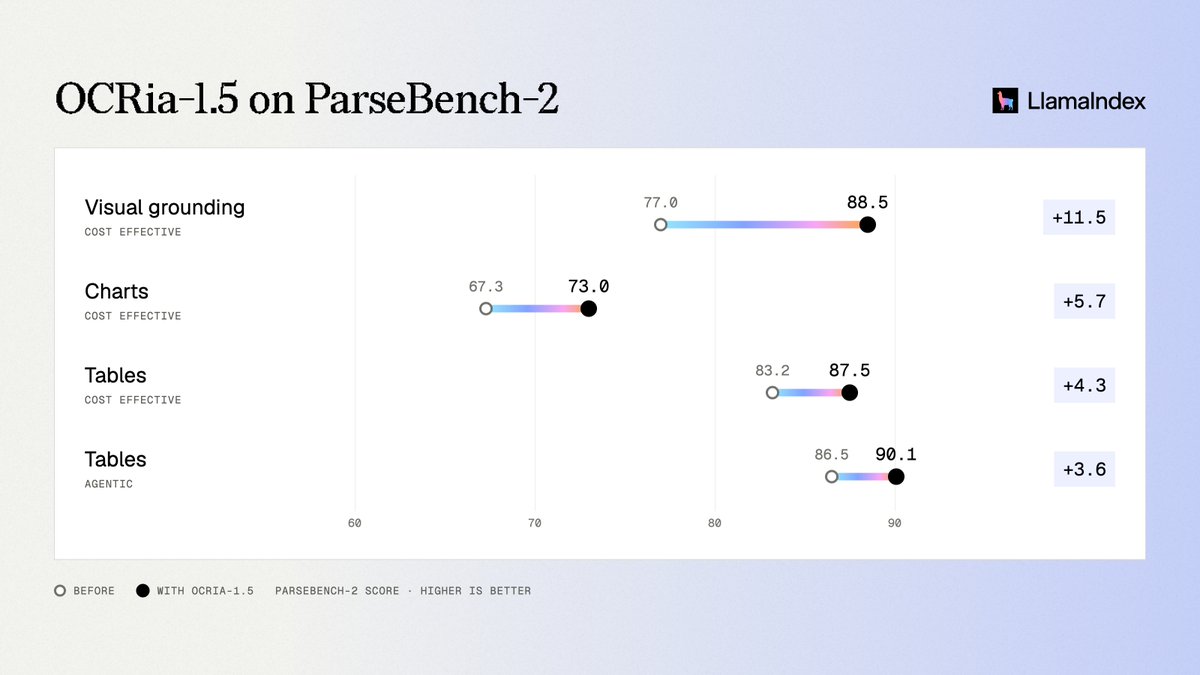
✅ Tables: Table scores rose from 86.5 -> 90.1 on agentic, 83.2 -> 87.5 on cost-effective
✅ Charts: 74.9->76.8 on agentic, 67.3 -> 73.0 on cost-effective
✅ Forms: +2.6 on agentic, +4.2 on cost-effective
✅ Visual Grounding: +4.1 on agentic, and +11 (!!) points on cost-effective
Together, these models set a new Pareto frontier for document parsing. Our cost-effective OCRia-1.5 is the cheapest and most accurate model for parsing all of tables, charts, forms, handwriting, with high-quality layout.
Blog: https://t.co/9NlhPd6E1s
These scores for all our modes (cost-effective, agentic, agentic plus) reflected within ParseBench-2: https://t.co/PWczfhp0OX
I agree with @jerryjliu0's sentiment.
[Rant on]
Some of the reactions to ParseBench 2 from competitors have been pretty disappointing.
We've seen personal attacks, bad-faith interpretations of the benchmark, and criticisms that suggest some people haven't actually taken the time to understand what we built.
One example that stood out:
"Look, there's underlined text in a table cell, and if our parser misses the underline, the benchmark penalizes us. This is scandalous!"
Well... yes? If the dataset evaluates underline preservation, missing underlines gets penalized. That's kind of the point.
Another interesting one: calling for an end to benchmarks, only to release two new closed benchmarks a few days later, while promoting a proprietary "LLM-as-a-judge" evaluation that conveniently ranks your own parser first.
(Surprise: vendor preferences can be embedded in evaluation prompts too!)
There have been dozens of takes like these, often from people who clearly haven't looked into how ParseBench 2 actually works. At times, it's felt more like a coordinated effort to discredit the benchmark than a genuine technical discussion.
[/Rant off]
Here's the thing: every vendor will continue publishing benchmarks. That's how this industry works.
And every benchmark, including ours, will have flaws and biases. We naturally measure the things we care about.
That's fine. It's worth discussing. It doesn't justify personal attacks.
I'll continue taking valid feedback seriously and improving and expanding ParseBench. I genuinely want us to get closer to a fairer, more useful benchmark.
Because ultimately, I care about the quality of what we ship, not winning a marketing argument.
And with ParseBench 2, we actually built some pretty cool things that I think deserve more attention:
1. User-defined evaluation policies
To our knowledge, ParseBench 2 is the first parsing benchmark that lets users define their own penalty policies, instead of blindly accepting the benchmark creator's preferences (including ours).
Try it: https://t.co/aExXILK3xM
We're working on making this easier to use, customize, and export.
2. Metrics designed to reflect what actually matters
We spent a lot of effort making sure different models get a fair evaluation, without unnecessarily penalizing formatting differences or model-specific quirks.
We also developed a technique to better align scoring metrics with the user's chosen evaluation policy.
This means we can distinguish between errors based on their actual severity, rather than relying purely on traditional edit-distance metrics that may treat very different mistakes similarly.
You can explore the metrics, different severity policies, and our analysis of dozens of other benchmarks here:
https://t.co/cNuyoE6RVd
I'm genuinely impressed by the technical work coming out of some of our competitors. Some teams are doing incredible things, and I have a lot of respect for that.
I'd love to see more technical discussions, more reproducible evaluations, and less high-school-level drama.
Anyway, back to building.
Last week we released ParseBench-2, our most comprehensive effort to benchmark various document OCR tools.
It drew quite a bit of ire among our peer document OCR vendors, who offered their own reactions:
---- “This is marketing slop” - vendor 1 who immediately goes and publishes lower-effort marketing slop (*cough benchbench cough*)
---- “everybody is number 1 on their benchmark” - vendor 2 who immediately shows their own benchmark where they’re #1
(also we’re not even #1 on some dimensions! No one actually cared about our efforts to be more fair)
there was some constructive feedback which we’re taking into account and iterating on a new release. But it was mostly masked by some (pretty funny) noise and posturing.
Unlike other vendors, our evals are completely open - no hidden judge prompt, no hidden test dataset, and we actively update the leaderboard from Github/Hugging Face submissions.
If you’re in the market for document OCR, I think ParseBench-2 is probably the most comprehensive resource for comparing different solutions. Even if you completely ignore our parsing solutions or overall score, there’s value in understanding the detailed taxonomy we’ve created over different failure types.
Come check it out! https://t.co/PWczfhp0OX
Also our tech report is extremely detailed and the result of incredible effort from our research team. Come check it out: https://t.co/qNlc5r0mss
me: leaves half the form blank on purpose
the parser: fills in the blanks, unchecks my checkbox and moves my phone number into the address field
glad ParseBench-2 finally made forms its own category
i lead marketing at a company that just shipped a benchmark, so you should be skeptical of this post
which is why everything is open: dataset, eval code, paper, leaderboard
think we rigged it? you can change the weights in the Metric Lab and see for yourself
Me: It’s better.
Them: How do you know?
Me: Several researchers have been expecting this question.
ParseBench 2 is out. A ridiculous amount of work behind those three words. Major props to our team!
Today we’re introducing ParseBench-2 - our most ambitious document parsing benchmark to date.
It is the only benchmark that provides both extreme granularity into every single type of production parsing error, while also making sure that metric scores are highly aligned with human judgment. We do this by painstakingly assigning severity scores to 330+ error types, and tuning each metric to match the severity scores.
Existing benchmarks either use brittle deterministic metrics (e.g. OmniDocBench) or LLM-as-a-judge (ParseArena), which can help recognize equivalent representations but are coarse/stochastic/subject to bias by the prompt+model.
ParseBench-2 also contains:
✅ 4.3k+ document pages (double from ParseBench-1).
✅ An extra dimension (forms)
✅ Much better ground-truth across all dimensions compared to ParseBench-1.
This is the next evolution of ParseBench, our hugely popular benchmark that has 50k+ monthly downloads, over 150+ OCR solutions benchmarked, and has been adopted by companies like NVIDIA, Cohere, Aleph Alpha, Perplexity, and others.
Alongside ParseBench-2, we are also releasing OCRia-1.5 - a new family of document parsing models that powers all our modes in LlamaParse. They represent a massive step up in capabilities from our latest release, and are state of the art in parsing complex tables, forms, charts, formatting, and assigning bounding boxes to complex layouts.
Come check out our blog post, technical report, and website.
Blog: https://t.co/TKbfCyTjht
Technical Report: https://t.co/eAu0s6ttA1
Website: https://t.co/PWczfhp0OX
If you’re interested in trying out our OCRia-1.5 capabilities, come sign up for LlamaParse: https://t.co/XYZmx5TFz8
we booked out an entire spa in SF for women in growth
tuesday nov 17, @llama_index is co-hosting with girls in growth
pick one, on us:
manicure
gua sha facial
30 min massage
the spa cannot massage all of SF at once, so spots are limited (and already almost full)
DM me 💆♀
I had my Muse agent put me on the National Do Not Call/Text Directory. By law telemarketers and other companies have 30 days to scrub my number from their lists. Otherwise Muse will automatically start logging every violation and will skip trace and go after every single one of the violations and hopefully collect between $500 and $1,500 per violation. Let's see how this goes.
We built a haunted house for doc parsers 🎃
Boo Bench is 179 pages that push parsers into repetition loops. One model saw 246 redaction x’s on a page and wrote 23,004 of them.
Results in thread!
Leaderboard + paper: https://t.co/2JmEpgpPbj
Dataset: https://t.co/eKEtyCmQOZ
@arunsingh_I@jerryjliu0@vercel Every value LlamaParse and LlamaExtract pull comes with a citation back to the page and bounding box it came from, plus confidence scores, so you can check any number against the source. You can also diff against the text layer and check that totals and subtotals add up.
@arunsingh_I@jerryjliu0@vercel They drop. Extract's confidence is grounded in whether the value actually traces back to the page. A made-up number has no real evidence behind it, so it scores low. https://t.co/syW7ETmgFO