Watch Mid-Kent Astronomical Society Twitter account for confirmed Canterbury Observing Sessions Friday nights and the latest news. See website for more info.
science 🤝 soccer
Engineers carefully design soccer balls so they fly smoothly whether they’re being kicked in your backyard or in the World Cup. @NASA astronaut Jessica Meir aboard the @Space_Station explains the science hidden inside every ball.
#Astronomy, NOW! 👀
Enjoy a picturesque scene of the crescent #Moon passing by #Venus and #Jupiter over the coming nights!
This simulated view is from the UK at around 10pm.
📷 Graphic: Astronomy Now/Greg Smye-Rumsby
#AstronomyForEveryone
The VLA in New Mexico is a surreal, inspiring place. Massive radio telescopes work hard through the night to bring us data from the stars.
Studying the other places in our universe teaches us more about ourselves.
May we never lose the courage to venture beyond Earth.
Looking to capture the cosmos but have no kit to capture it with?
Read through our astrophotography camera guide to help you find the right camera and begin capturing today! https://t.co/CDTwN7IjBe
JWST Strikes Again: “Impossible” Early Galaxies Are Shaking Up Cosmic History The James Webb Space Telescope keeps delivering headlines that sound like science fiction — and this one is no exception. Astronomers have found galaxies that appear shockingly big, bright, and chemically mature just 280–400 million years after the Big Bang, at a time when the universe was still a toddler by cosmic standards. These objects look more like fully formed galaxies from billions of years later than the tiny, chaotic protogalaxies theorists https://t.co/ijhDHPjU9T standout is JADES-GS-z14-0 (and similar record-holders like MoM-z14), observed when the universe was barely 2–3% of its current age. These galaxies are pumping out stars at furious rates, already enriched with heavy elements, and in some cases surprisingly massive. According to standard models, there simply hadn’t been enough time for gravity to assemble such structures or for generations of stars to forge and spread metals.Why This Challenges EverythingToo bright, too soon: Early galaxies were expected to be small, dim, and sparse. JWST is seeing far more luminous ones than simulations predicted.
Mature features: Signs of complex chemistry and organized star formation much earlier than thought possible.
Sheer numbers: Hundreds of these surprisingly advanced objects across deep fields.
This “cosmic dawn crisis” has sparked intense debate. Some possibilities include:Bursty star formation — Small galaxies forming stars in intense, short-lived bursts that make them temporarily appear much brighter and more massive.
Hidden supermassive black holes (especially in Little Red Dots) — Accreting material and outshining the stars, inflating mass estimates.
Faster-than-expected growth — Maybe dark matter, gas dynamics, or early star formation were more efficient right after the Big Bang.
Or… tweaks to cosmology — A few researchers even explore whether the universe itself is older or behaves differently at extreme redshifts, though most favor adjustments within the standard model.
Recent studies suggest many of the most “impossible” cases aren’t actually breaking physics once black hole light and bursty formation are properly accounted for — but the tension remains real. JWST is forcing us to refine (not necessarily abandon) our understanding of how structure formed in the infant universe.
The universe, it turns out, was far more efficient at building complexity than we gave it credit for.What do you think — are these galaxies telling us our models need a major upgrade, or is nature just more creative than our simulations?
Hubble captured Jupiter's north pole in a stunning electric blue aurora display.
These are 1000 times brighter than Earth's, powered by its giant magnetic field and sulfur ions from Io's volcanoes. Real NASA ESA Hubble STIS data.
It’s #SunDay! Here’s your space weather report for the week of May 8 - 14:
•1 M-class flare
•1 C-class flare
•31 coronal mass ejections
•0 geomagnetic storms
This video from NASA’s Solar Dynamics Observatory (SDO) shows the week’s activity.
The active region we spotted last week (which erupted with an M-class flare and a CME last Sunday) has moved across the Sun and is now center-disk. It’s right next to a coronal hole that unleashed a stream of fast solar wind to Earth. We’ll be watching both regions for continued activity this week.
Learn more about space weather: https://t.co/GRxOaTcMdD
It’s #SunDay! Here’s your space weather report for the week of April 17 - 23:
•6 M-class flares
•0 C-class flares
•34 coronal mass ejections
•1 geomagnetic storm
This video from NASA’s Solar Dynamics Observatory (SDO) shows the week’s activity. Two X-class flares erupted right after the end of this reporting period — they’ll be first up in next week’s space weather report!
Another thing we *don’t* see here: comet PANSTARRS (C/2025 R3)! The comet is currently passing between the Sun and Earth, and ESA/NASA’s SOHO spacecraft is watching the comet as it streaks across the view of its C3 coronagraph. We'll share more views of that comet later; in the meantime, check the latest imagery here: https://t.co/xuPARpKYlr
Learn more about space weather: https://t.co/GRxOaTcMdD
Nothing in the Universe is static.
Solar system moves at 800,000 km/h around the galactic center. The Earth, at 107,000 km/h around the Sun, and the Moon, at 3,700 km/h around the Earth.
Raising the bar.
NGC 4394 is a barred spiral galaxy, captured here by Hubble.
Bright spiral arms emerge from a central bar of stars. These arms sparkle with young blue stars, dark lanes of dust, and hazy regions of new star formation: https://t.co/2BOQMTKhEE
We are extremely sad to learn that deep sky expert and Astronomy Now columnist Owen Brazell has been killed in a traffic accident on his way to Kelling Heath Star Party. This is a tragic loss to the UK astronomy community. Our thoughts are with his family and all who knew him.
In 2026, March 14 and 21 are the best nights for the Messier marathon. Check out these expert tips, plus the order you should observe in. https://t.co/PuPXsczMCn
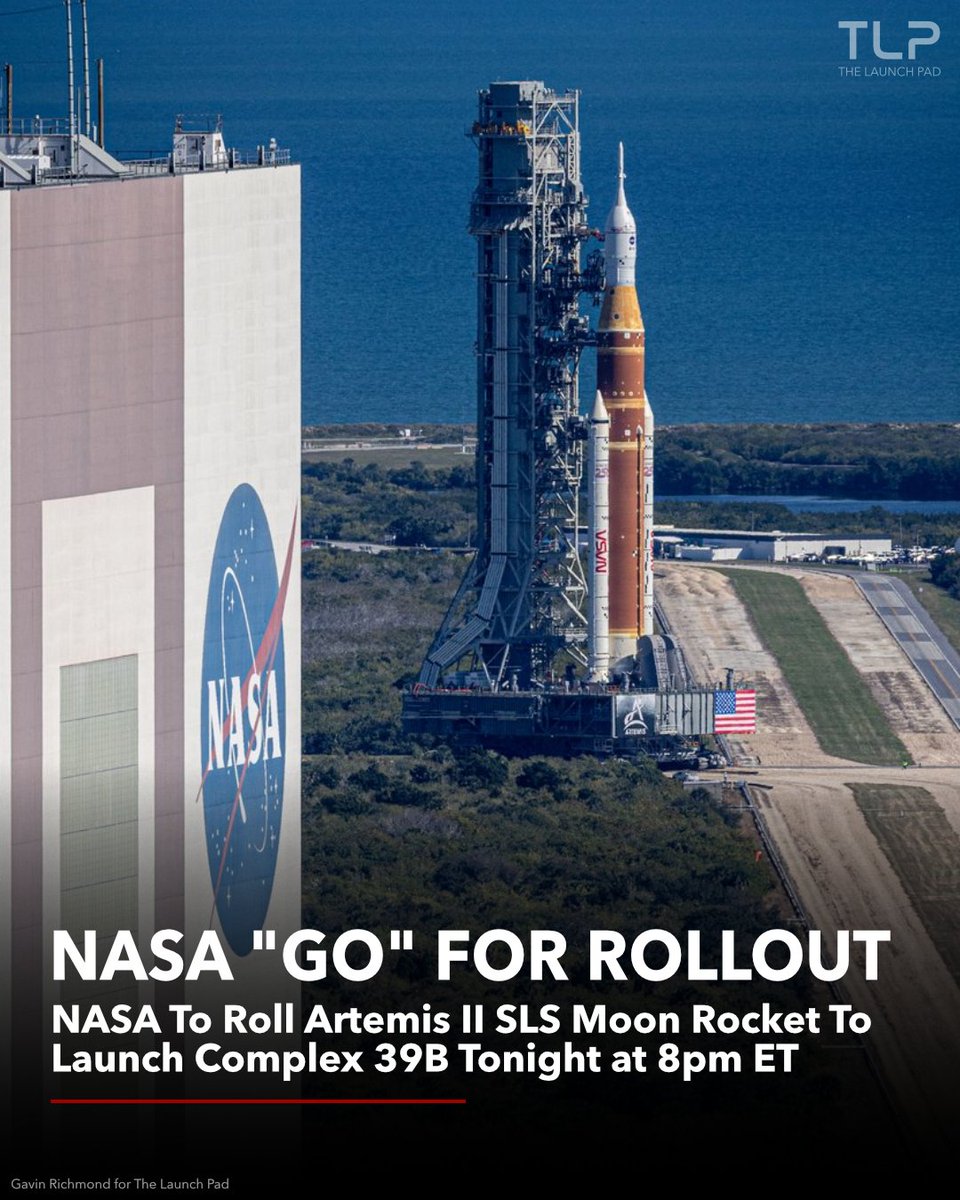
NASA "GO" FOR ROLLOUT
Tonight NASA will rollout the Artemis II SLS Moon rocket to Launch Complex 39B at NASA Kennedy Space Center. First movement is expected at 8pm ET
Watch the rollout LIVE on The Launch Pad!
The trip to the pad takes approx. 12 hours aboard the crawler transporter.
FOLLOW for latest Artemis II updates!