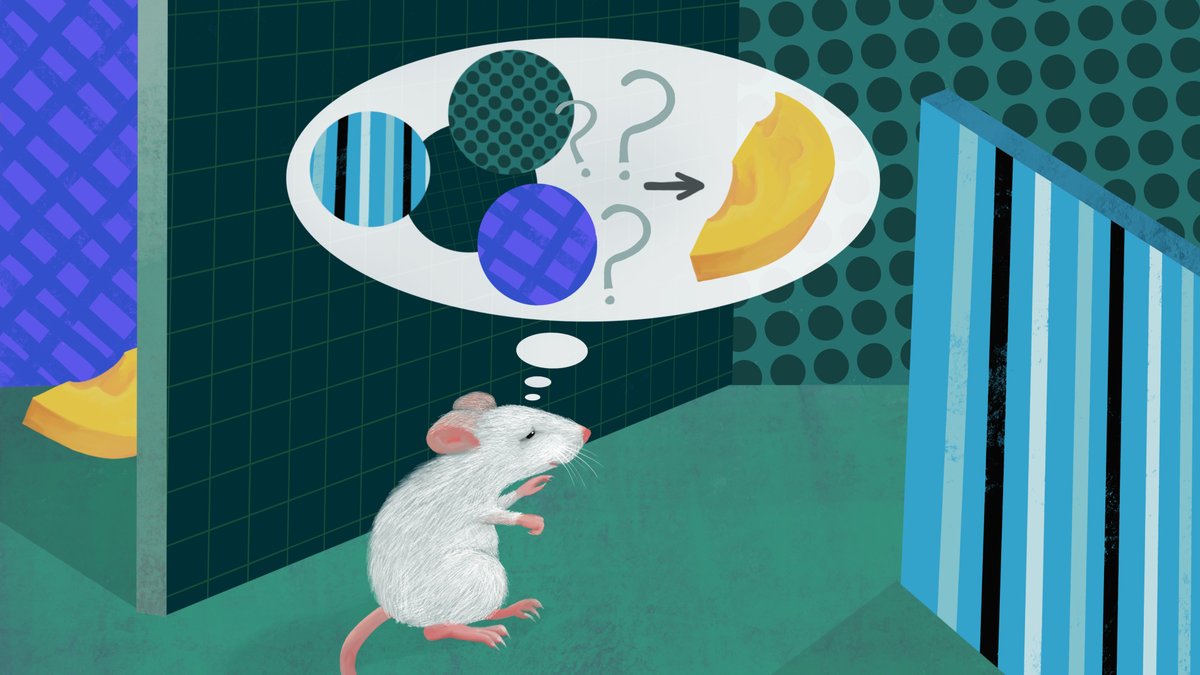
Happy to share our paper! In a setting where mice freely move and engage goal-oriented actions, we found that the activity of a subset of CeA cells predict the position of the animals in a context previously paired with food. Thanks to the reviewers for constructive feedback!
Researchers in Rüdiger Klein’s department identified two neuron subpopulations in the central amygdala that enable animals to associate environmental cues with foodavailability & remember them later. #JNeurosci: https://t.co/o9PM4Yn8jI @FermaniFederica@MPonserre art @mulesome
Interested in a wiring diagram between the insula and the main output streams of the central amygdala? Check out our paper published today in #JNeurosci.
How does sensory input route to output streams of the central #amygdala? The Klein lab team shows how the #InsulaCortex connects with motor, physiological, and autonomic amygdala outputs and uncovers a strong connection with the lateral #hypothalamus.
https://t.co/1gWRcGJm2h
New preprint from the Klein Lab! We recorded neuronal activity of central amygdala neurons in a semi-naturalistic foraging task and found that CeA cells can assign motivational properties to contextual cues and encode memory of goal location.
#Neuroscience
https://t.co/hqBFnprrqu
So happy to see our paper out today in @ScienceMagazine! ‘Facial expressions of emotion states and their neuronal correlates in mice’ https://t.co/NTGNBiWEOT congratulations especially to the heroic efforts of my outstanding PhD student and first author @NDolensek !!
Aljoscha Leonhardt and Georg Ammer from the Borst department have been awarded the Otto Hahn Medal for their outstanding research on processing of motion information in the #Drosophila visual system. Congratulations! https://t.co/cfwK5xxm13 @apl29@maxplanckpress
Multitasking with perfection: Alexander Borst and Matthias Meier show that #Drosophila amacrine cell CT1 works like 1400 individual cells. https://t.co/Me4Kqij7sl
#MotionVision@mmeier089