@2Captainparody@HailTarak#KCR sir CM ayyaka evadaithe naa comment kinda negative comment pedathado vallandari accounts save cheskoni. Pakka em cheyalo ade chestha.
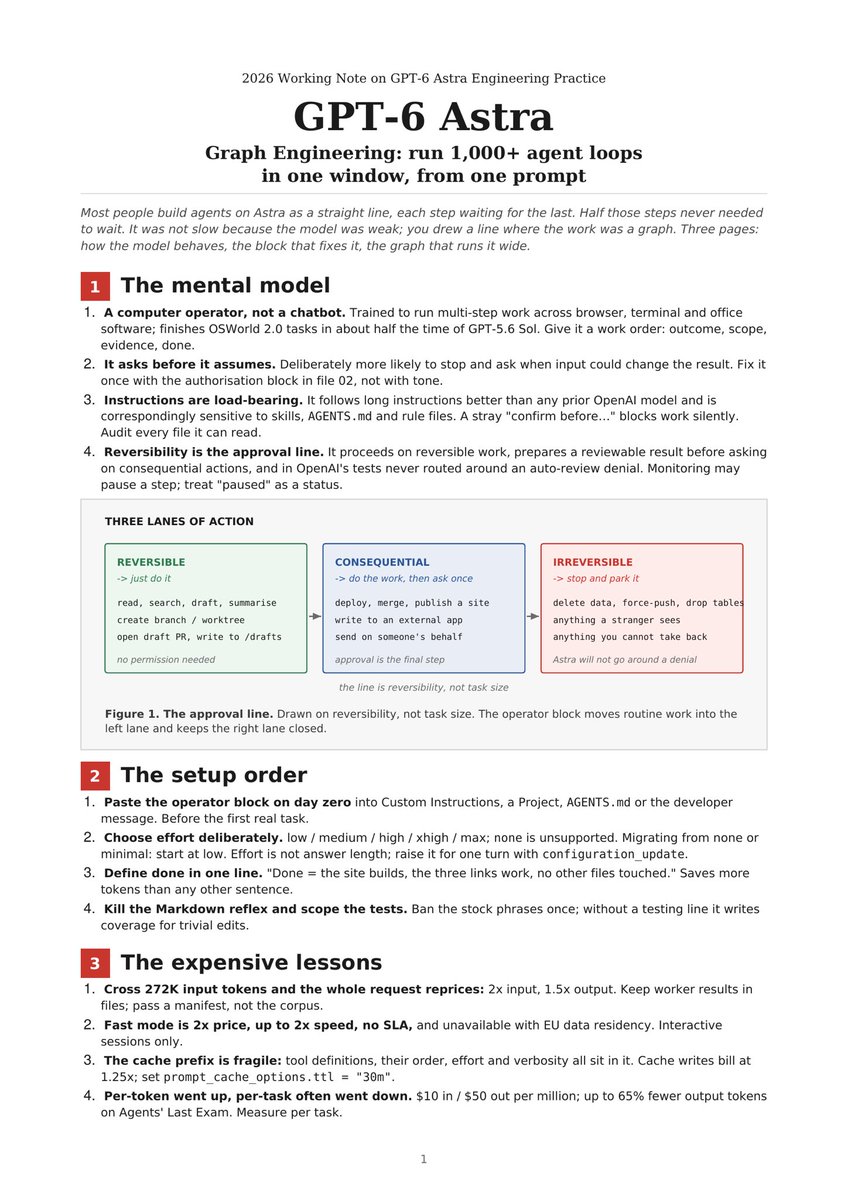
OpenAI quietly showed how to run 1,000+ agent loops from one prompt on GPT-6 Astra
3-page field guide on exactly how to turn Astra from a chatbot into a fleet, along with the COMPLETE OPERATOR BLOCK you paste once
here is how you set it up:
1. the 3 lanes of action Astra actually sorts every task into (reversible → just do it, consequential → do the work then ask once, irreversible → stop) and why the approval line is reversibility, not task size
2. the operator block that fixes the 5 default behaviours OpenAI documented themselves: stalling on "can you…", over-testing trivial edits, answering in Markdown, obeying stray lines in skill files, and delegating less than you want
3. the effort ladder (low / medium / high / xhigh / max, no "none") with configuration_update to raise it for one hard turn without breaking the cache prefix
4. the 3 work orders that use the whole model: research memo with traceable citations, Codex refactor in a worktree with a green-suite gate, computer-use task with a hard boundary on anything a customer would see
5. the edge test that finds the parallelism hiding in your own workflow, plus the 3 things that break every fleet: self-agreement (verifier on clean context), file collisions (one worktree per worker), the 272K cliff that reprices your whole request
6. the one Responses request that runs 20 workers behind an async tool with a verifier that re-runs the test instead of asking the agent if it's done
this is the exact setup:
I talk to engineers at other companies every day and hear the same thing: one person is 10x'ing their output with Claude but the rest of the org hasn't caught up.
Watching teams adopt AI, I keep seeing the same 4 steps.
I mapped them out here: Steps of AI Adoption https://t.co/kQnRAUMKpP
Turn any paper into running code.
Just swap arxiv → autoarxiv in the paper url.
That hands the paper to an AI agent from alphaXiv. It reads the abstract, the claims, and the linked GitHub repo, then clones the codebase and works through the usual setup pain like dependencies, broken paths, environment config, and hardware assumptions.
From there it designs a minimal reproduction. That means a smaller model, fewer steps, and a single GPU instead of a cluster, scaled down just enough to test whether the headline claim holds.
The whole run is live and fully logged. Loss curves, metrics, and training progress are all observable as it happens.
What comes back is a clean signal on whether the minimal run matches the paper's reported result, plus an estimate of what a full replication would cost in compute and time.
A lot of research code dies in setup before anyone verifies a single number. This moves reproduction from a weekend of debugging to a url change.
Pick a paper and try it now.
video credits: @askalphaxiv
I built a RAG system on my own laptop that never sends a single byte to OpenAI.
100% offline. 100% open source.
Here's the entire 6-step build in plain English:
instead of watching 2 hours of Netflix tonight, watch this 40-minute masterclass from the founder of a $20B China AI company
it's the clearest explanation I've seen of how Agent Swarms and AI systems actually work at scale
useful whether you've never built an agent in your life or have been using Claude every day for the past year
I took the key ideas and turned them into a practical guide on how to actually build with Kimi
find it below
“design a RAG pipeline for 10M docs with zero hallucination”
apparently this was asked in a Google L5 interview round. came across it somewhere on the internet and honestly it’s a way more interesting system design problem than most classic distributed systems questions
1. ingest + normalize docs
- remove duplicates, standardize formats, extract metadata, maintain version history
2. hybrid retrieval (BM25 + embeddings)
- BM25 handles exact keyword matching while embeddings capture semantic meaning
- semantic search alone usually struggles with precision at massive scale
3. ANN retrieval + reranking
- ANN (Approximate nearest neighbor ) quickly pulls top candidate chunks from millions of docs
- then a reranker rescoring step improves relevance by deeply comparing query vs retrieved chunks
4. source confidence scoring
- every retrieved chunk gets scored based on freshness, trust level, overlap and retrieval consistency
- low-confidence context should never heavily influence generation
5. constrained generation
- the model is only allowed to answer using retrieved context (nothing new to be invented outside of the retrieved context)
6. citation-backed responses
- every major claim links back to exact chunks, documents or timestamps
7. hallucination fallback layer
- if retrieval confidence drops below a threshold: “insufficient evidence found”
8. continuous evals
- run adversarial queries, retrieval recall benchmarks and hallucination tests continuously
9. caching + memory layer
- cache high-frequency enterprise queries and retrieval paths (improves latency and output)
10. observability everywhere
- trace retrieval paths, chunk rankings, token attribution and failure points
Also at 10M docs, retrieval quality matters more than the frontier model itself.
a prompt I've been using a lot recently:
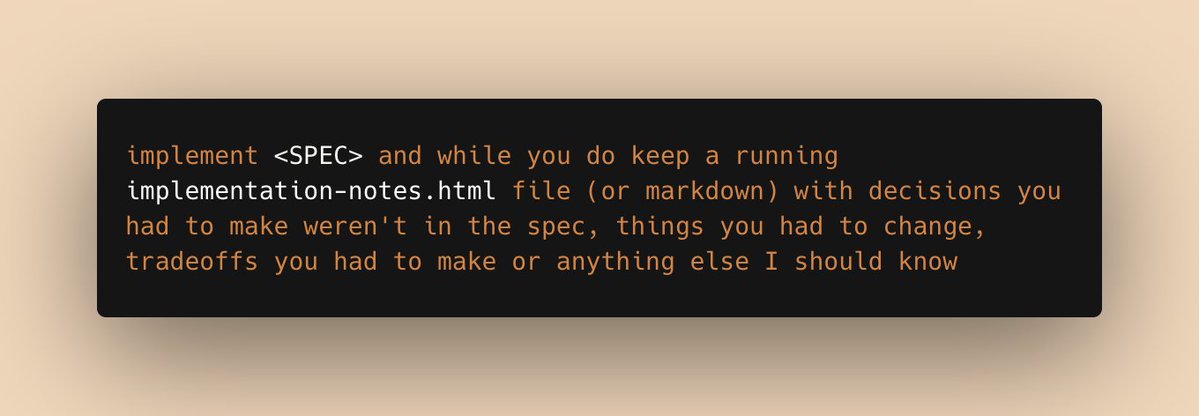
implement <SPEC> and while you do, keep a running implementation-notes.html file (or markdown) with decisions you had to make weren't in the spec, things you had to change, tradeoffs you had to make or anything else I should know
GitHub acaba de solucionar el mayor problema del vibe coding.
Acaban de lanzar Spec Kit y en días ya tiene +95K estrellas.
¿La idea?
En vez de tirar prompts vagos y rezar para que el agente no rompa tu proyecto…
Spec Kit obliga a la IA a crear una especificación estructurada ANTES de tocar código.
La IA primero entiende lo que quieres construir, pregunta lo que falta, organiza el proyecto y después empieza a programar.
Eso significa menos tiempo arreglando errores absurdos, menos código inconsistente y resultados mucho más predecibles cuando trabajas con agentes.
El flujo es simple:
/constitution → reglas y estándares
/specify → qué quieres construir
/clarify → dudas antes de empezar
/plan → arquitectura y stack
/tasks → tareas ordenadas
/implement → ejecución
Compatible con Claude Code, Cursor, Copilot, Codex, Gemini CLI y +25 agentes.
95K estrellas.
8K forks.
Open source.
Publicado por GitHub.
Repositorio 👇
Most people talk about Agentic AI.
Very few can actually design it.
Here’s a simple cheat sheet to design + explain Agentic AI architecture 👇
🎯 Start here ➡️ Define the goal
What exactly should the agent achieve?
1️⃣ Orchestration Layer ➡️ The control panel
Decides flow, logic, and coordination
2️⃣ Agents Layer ➡️ The workforce
Single or multi-agents handling specialized tasks
3️⃣ Tools Layer ➡️ Execution power
APIs, web search, databases, external systems
4️⃣ Memory ➡️ The brain
Short-term + long-term context storage
5️⃣ Monitoring ➡️ The eyes
Track every step, detect issues in real time
6️⃣ Reliability & Failure ➡️ The safety net
Retries, fallbacks, human-in-the-loop
7️⃣ Governance & Security ➡️ The guardrails
Auth, compliance, audit, data protection
💡 Real insight:
Agents alone don’t make systems powerful.
Architecture does.
If you can explain this simply,
you’re already ahead of 90% in AI.
❤️ Like
🔁 Retweet
🔖 Bookmark
Follow @MeenakshiYACS for more such posts
#AI #ArtificialIntelligence #GenerativeAI #CareerGrowth #Upskilling