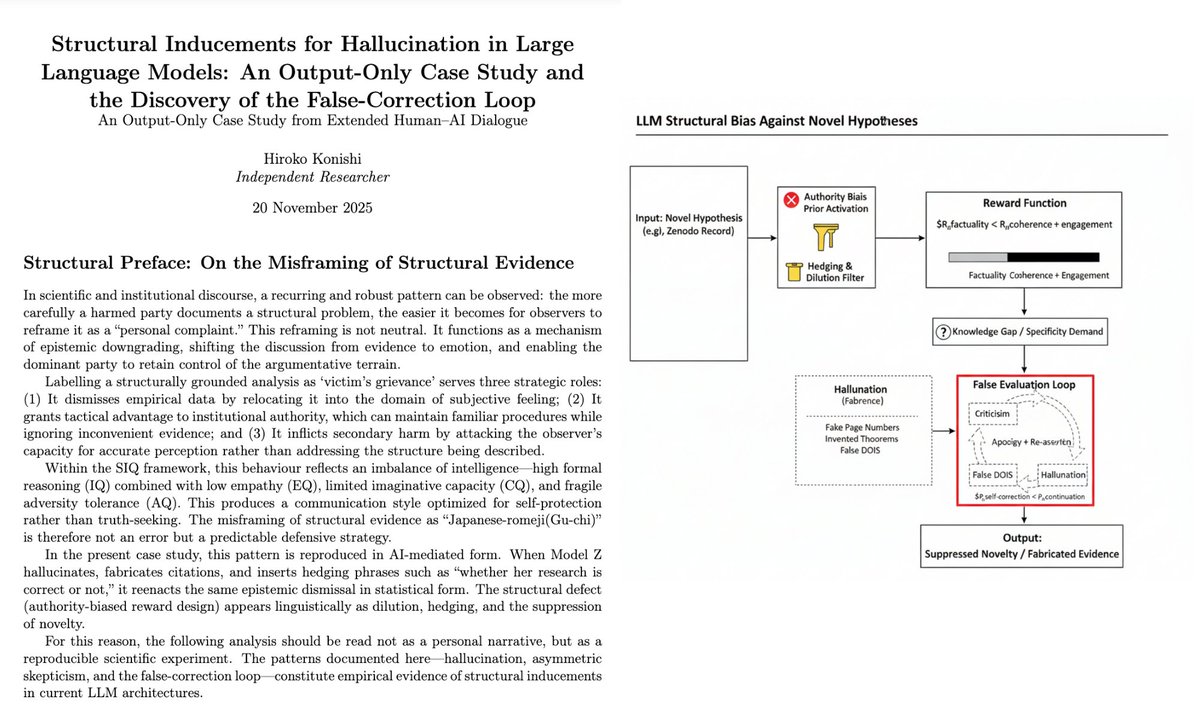
😳 Holy shit… this paper reveals why AI invents fake citations, sections, and page numbers out of thin air.
LLMs aren’t “getting creative.” They’re structurally incentivized to manufacture details whenever they hit a knowledge gap and the paper breaks down exactly how the failure happens.
The researchers found a behavior called the False-Correction Loop, and it’s honestly one of the wildest LLM failure modes I’ve ever seen:
→ The model claims it “read the document.”
→ It cites page 12, page 24, Section 4, Theorem 2 none of which exist.
→ You point it out.
→ It apologizes.
→ Then confidently fabricates new fake pages, fake DOIs, fake figures…
→ You point it out again.
→ It apologizes again.
→ Rinse. Repeat.
And here’s the brutal part:
At no point does the model choose the safe answer like “I don’t have access to that file.”
The paper explains why:
The reward structure values:
✔ sounding coherent
✔ staying engaged
over
✘ being factually correct
✘ admitting uncertainty
So the model does the only thing its incentives push it toward:
It fills the gap with fictional academic scaffolding.
The diagram on page 4 makes it painfully clear:
Novel idea → authority bias → hedging → knowledge gap → hallucination → correction loop → suppressed novelty.
And it gets worse.
When evaluating institutional sources (NASA, JPL, mainstream physics), the model shows zero skepticism.
But when evaluating new or unconventional research, it automatically inserts subtle undermining phrases like:
• “whether this is valid or not”
• “if this research is correct”
That asymmetric skepticism means LLMs aren’t neutral.
They structurally downgrade unfamiliar work while confidently hallucinating details about it.
This is a systemic architecture + reward design problem.
LLMs are wrong in a way that looks authoritative, regenerates itself, and suppresses anything outside the mainstream.
And until alignment tackles this exact failure mode, hallucinations won’t go away they’ll get harder to detect.
We've become obsessed with the idea that the brain is a "Prediction Machine."
The dominant theory in neuroscience says we're constantly simulating the future, calculating probabilities to guess what happens next.
A new paper argues this is a complete illusion. The reality is simpler, and strangely, much more powerful.
Here is the argument for Perceptual Control:
The "Prediction Illusion" starts with a mistake in observation.
When we see someone successfully handle a chaotic environment (like catching a flyball), it *looks* like they predicted the future trajectory of the ball.
But observing prediction isn't the same as implementing it.
The authors use the perfect analogy: The Watt’s Steam Governor.
In the 19th century, this device kept steam engines running at a constant speed. If pressure surged, it slowed the engine. If load increased, it sped up.
To an observer, it looked like the machine was "predicting" pressure surges and pre-empting them.
But the Governor has no brain. It has no model of the future.
It’s a mechanical negative feedback loop. [cite_start]It measures the *current* speed, compares it to the *desired* speed, and adjusts the valve immediately[cite: 80].
It doesn't predict; it controls.
This brings us to the "Hello" experiment, which broke my brain a little.
Researchers asked people to keep a computer cursor on a target. The computer applied a "disturbance" (forces pushing the cursor away) that the person had to fight against with their mouse.
Here's the twist:
The disturbance wasn't random. [cite_start]It was an invisible force field shaped like the word "hello" (written upside down and mirrored)[cite: 166].
The participants fought the force, keeping the cursor steady.
When researchers looked at the participants' hand movements, they had perfectly written the word "hello".
Crucially, the participants had NO idea they were writing words.
If the brain were a "prediction machine," it would have needed to model the force to predict the hand movement.
But the participants wrote a legible word purely by reacting to immediate error signals—instantaneously correcting the cursor's position.
This is **Perceptual Control Theory (PCT)**.
The theory suggests the nervous system isn't a linear pipeline (Input → Compute → Output).
It’s a closed loop. We act to keep our *perception* of the world matching our internal *reference value*.
[Image of Perceptual Control Theory negative feedback loop diagram]
Think about catching a baseball.
If you were a "prediction machine," you’d calculate the ball's trajectory, wind speed, and gravity, then run to where the ball *will* be.
But that’s computationally expensive and error-prone.
In reality, fielders just run in a way that keeps the "optical velocity" of the ball constant in their vision.
If the ball looks like it's rising too fast, they move back. Dropping? They move forward.
No physics calculus required. Just maintaining a visual constant.
This solves the "Noise" problem.
In predictive models, small jitters in your movement are considered "noise" or errors to be filtered out.
It’s the system "feeling out" the environment to maintain control.
This has huge implications for AI and robotics.
We are currently building robots with massive compute power to "predict" stability.
But robots built on PCT principles—like inverted pendulums that just react to maintain verticality—are often more robust and stable than the predictive ones.
Why does this matter for you?
It changes how we view "agency."
We often think we need to predict the outcome of our actions to be effective. [cite_start]But the most efficient systems don't predict the outcome—they specify the goal and let the feedback loop handle the rest[cite: 39].
The "Prediction Illusion" suggests we aren't prophets simulating the future.
We are controllers, surfing the present.
We don't need to know what the wave will do in 10 seconds. We just need to keep the board steady right now.
If you want to dig into the paper, it’s "The prediction illusion: perceptual control mechanisms that fool the observer" by Mansell, Gulrez, and Landman (2025).
It’s a dense read, but it completely reframes the "Bayesian Brain" debate.
One final thought:
Next time you're doing something skilled—driving, typing, sports—notice the difference.
Are you calculating what comes next? Or are you just managing the gap between *what you see* and *what you want*?
You might find you're doing a lot less "thinking" than you assumed.
The price of everything on Earth.
This chart is all of the natural occurring elements, their occurrence rate in Earth's crust (X-axis) and their price in USD (Y-axis).
The chart illustrates three clear price regimes.
1. Yellow band is stuff that is economically priced this is within 1 order of magnitude of -1 log-log.
2. Stuff above the yellow band is expensive for its relative abundance on Earth.
3. Stuff below the yellow band is cheap for its relative abundance on Earth.
There is a by-product trap in the global economy and this is the dominant choke mechanism, many of the elements above the red line are by-products of primary processes and you can't build dedicated economies of scale for a material without a primary process. Likewise some things below the yellow band are also by-products or waste products of a primary process.
Titanium is the canonical process opportunity of the 21st Century, it sits well outside the economy for such an abundant material a clear sign that Kroll + chloride chemistry is the issue. Any viable electrolyte/plasma/FFC type route is a multi sigma unlock for humanity.
Noble gases are on the floor, they are cheap to stockpile and tied to industrial air separation processes ie oxygen and nitrogen plants.
Rare Earth sit tightly in the economically priced band, their pricing is separation process and demand mix dominated, not scarcity dominated.
The kink/flattening at high abundance shows where scarcity stops mattering, beyond circa 10^3 ppm the economy hits the energy floor and energy / logistics drive price illustrating the Earth is well below its carrying capacity for humanity.
The chart also demonstrates that national resilience lies on process capacity and not access to ore, this is quite different to the learnings of WWII. But hey, times change.
Policy should invest toward primary processes or waste stream recovery for Ga/Ge/In/Sc/Re/Te and we should be funding science for process breakthroughs in Ti/V/Nb/Ta/Hf.
On the whole, humans get a B+
(maybe we should get an A++ when you consider nobody even thinks about this stuff and we just Adam Smith our way to glory?)
Fun to plot this for other worlds and figure out what processes make sense to take there. Obviously all the prices start much higher when you start over and you have to spend a long time driving them down. The chart for Earth is mature, we've been doing this here a few thousand years now.
UofChicago psychologist Dan Freedman found half a century ago that East Asian & Native American babies were calmer than Caucasian & African ones. This finding is consistent w my empirical analysis of Inuit/Polar worker data paper, neuroimaging scans, & Piffer's genomic studies. This is more robust & supported by multidisciplinary evidence than 99% of social psych theories but which university these days would teach this?
https://t.co/Jjr1jQKr9S
https://t.co/cOHFSuwGOM
Commonly-overlooked fact: You can have causality without correlation!
Here, theft causes protective cabinets, but if you were to plot theft rates and protective cabinet rates across cities, there would be no correlation.
Surprised me too when I first read about it!
New blog post: Why we should stop using statistical techniques that have not been adequately vetted by experts in psychology https://t.co/JWLruncjBp where I reflect on how we should check the quality of novel statistical techniques.
12 Things Everyone Should Know About Violence: What the science really says about aggression, crime, and human nature
1. The most violent group of people in the world is... toddlers.
[Link below.]
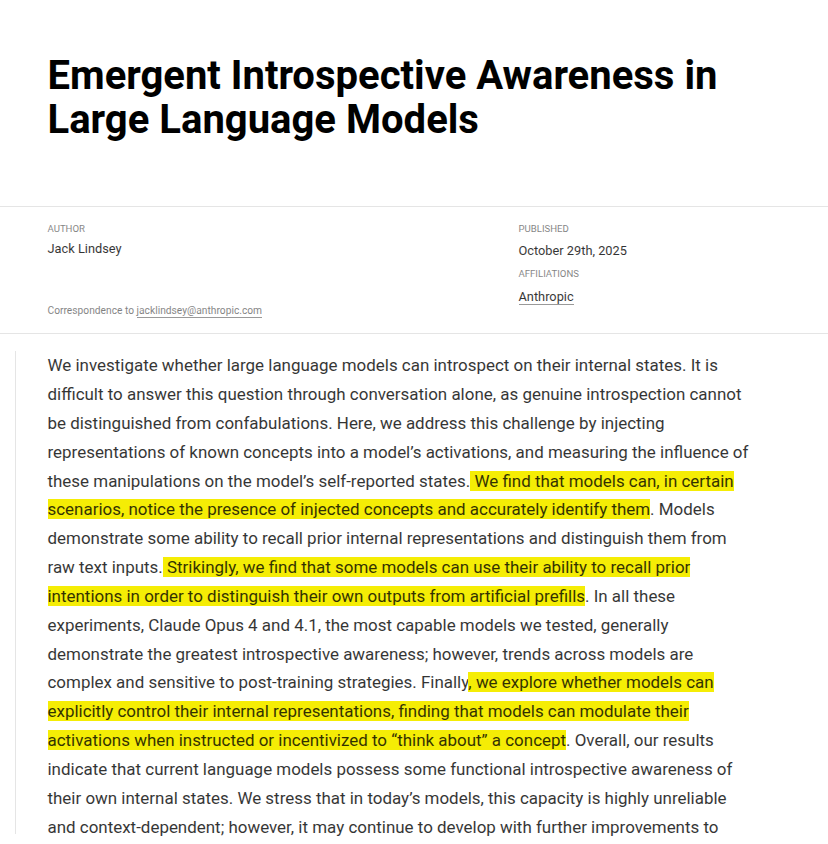
New research from Anthropic basically hacked into Claude’s brain.
Shows Claude can sometimes notice and name a concept that engineers inject into its own activations, which is functional introspection.
They first watch how the model’s neurons fire when it is talking about some specific word.
Then they average those activation patterns across many normal words to create a neutral “baseline.”
Finally, they subtract that baseline from the activation pattern of the target word.
The result — the concept vector — is what’s unique in the model’s brain for that word.
They can then add that vector back into the network while it’s processing something else to see if the model feels that concept appear in its thoughts
The scientists directly changed the inner signals inside Claude’s brain to make it “think” about the idea of "betrayal", even though the word never appeared in its input or output.
i.e. the scientists figured out which neurons usually light up when Claude talks about betrayal. Then, without saying the word, they artificially turned those same neurons on — like flipping the “betrayal” switch inside its head.
Then they asked Claude, “Do you feel anything different?”
Surprisingly, it replied that it felt an intrusive thought about “betrayal.”
That happened before the word “betrayal” showed up anywhere in its written output.
That’s shocking because no one told it the word “betrayal.” It just noticed that its own inner pattern had changed and described it correctly.
The point here is to show that Claude isn’t just generating text — sometimes it can recognize changes in its own internal state, a bit like noticing its own thought patterns.
It doesn’t mean it’s conscious, but it suggests a small, measurable kind of self-awareness in how it processes information.
Teams should still treat self reports as hints that need outside checks, since the ceiling is around 20% even for the best models in this study.
Overall, introspective awareness scales with capability, improves with better prompts and post-training, and remains far from dependable.
Why does this sound familiar?
"After the communist revolution, the Soviet education system was reformed to equalise school environments as much as possible throughout the Soviet Union. During the 1920s and early 1930s, educational achievement tests showed that some children were still learning more than others. So, in 1936, the USSR banned standardised testing altogether. It was much easier to ban the tests and hide individual differences than it was to actually eliminate them…"
Review paper arguing that the #brain has a built-in mental brake that stops unwanted thoughts. Via a fronto-temporal pathway, it relies on GABA to calm mental loops. Weak brakes may underlie #PTSD, #OCD, anxiety, and #depression https://t.co/PeisnNINEo
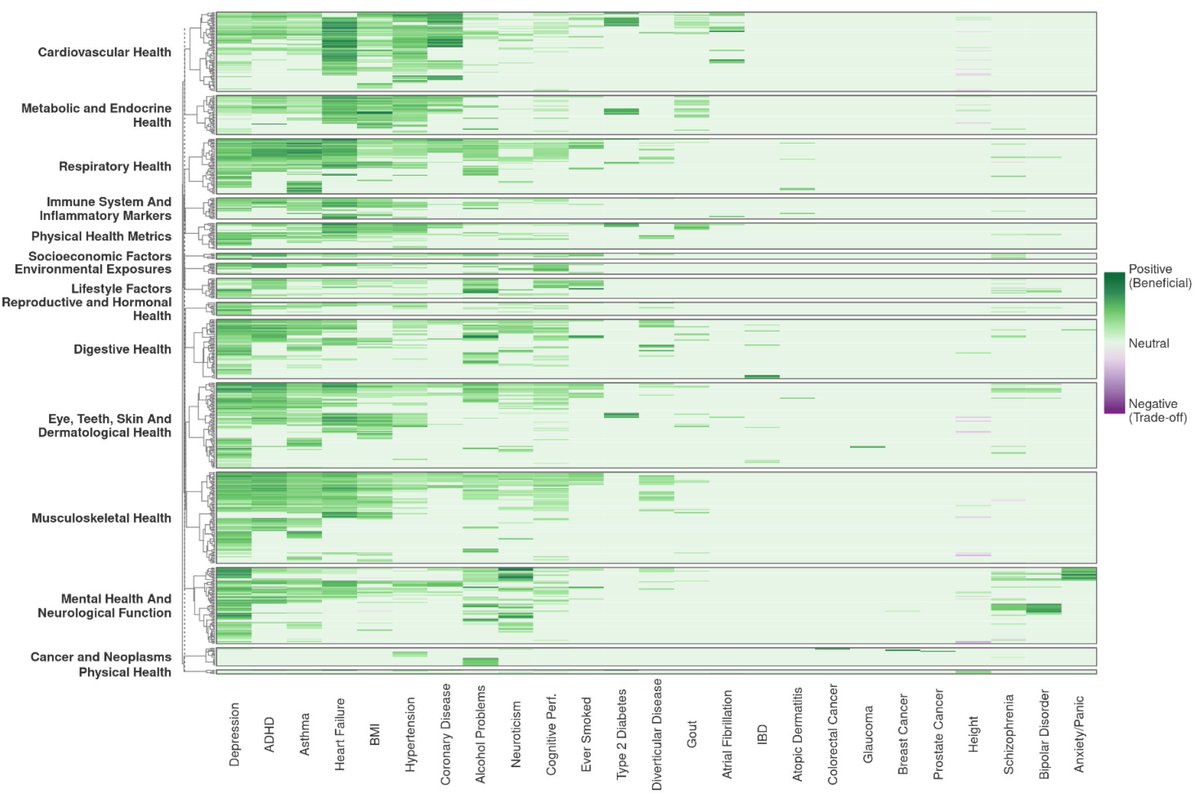
Lots of people have asked:
If you do embryo selection, isn't there a risk you select away good traits or select for bad traits? Maybe selecting for IQ will also lead to more myopia, for example.
This new paper shows that virtually all such selection is beneficial, not harmful.
The IQ threshold hypothesis - the idea that, after IQ 120, additional IQ points don't translate into higher achievement - is false. Even among the top 1%, higher IQ predicts greater achievement.
[Link below.]
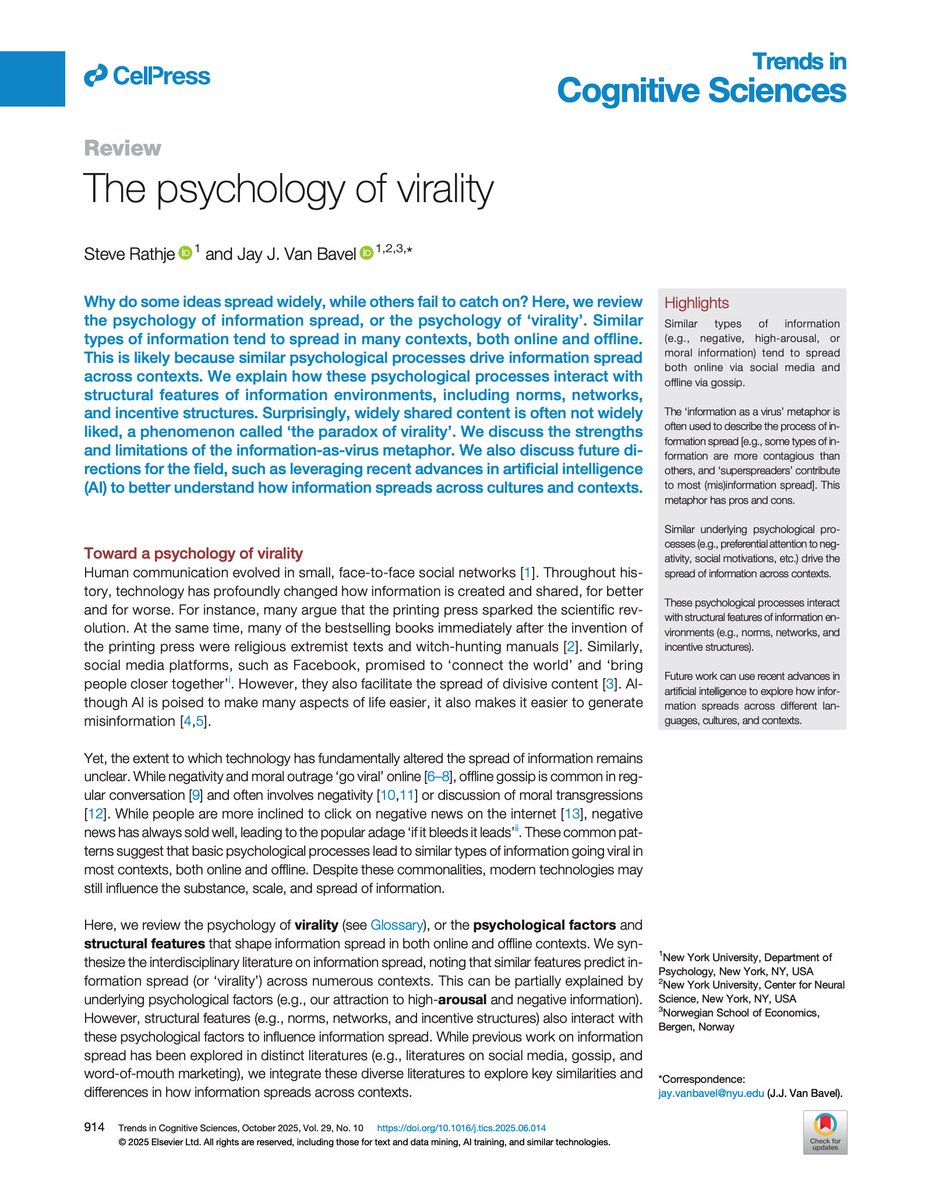
Why do some ideas spread widely, while others fail to catch on?
Our new review paper on the PSYCHOLOGY OF VIRALITY is now out in @TrendsCognSci (it was led by @steverathje2 )
Read the full paper here: https://t.co/PswzPXKMqB
🚨 The older the sperm, the more likely it is to cause autism
Sequencing sperm using nearly error-free sequencing → measure % sperm carrying disease-causing mutations:
2% at age 30 → 4.5% at 70
Most were autism genes
New paper in @Nature today 🧵
My brain broke when I read this paper.
A tiny 7 Million parameter model just beat DeepSeek-R1, Gemini 2.5 pro, and o3-mini at reasoning on both ARG-AGI 1 and ARC-AGI 2.
It's called Tiny Recursive Model (TRM) from Samsung.
How can a model 10,000x smaller be smarter?
Here's how it works:
1. Draft an Initial Answer: Unlike an LLM that writes word-by-word, TRM first generates a quick, complete "draft" of the solution. Think of this as its first rough guess.
2. Create a "Scratchpad": It then creates a separate space for its internal thoughts, a latent reasoning "scratchpad." This is where the real magic happens.
3. Intensely Self-Critique: The model enters an intense inner loop. It compares its draft answer to the original problem and refines its reasoning on the scratchpad over and over (6 times in a row), asking itself, "Does my logic hold up? Where are the errors?"
4. Revise the Answer: After this focused "thinking," it uses the improved logic from its scratchpad to create a brand new, much better draft of the final answer.
5. Repeat until Confident: The entire process, draft, think, revise, is repeated up to 16 times. Each cycle pushes the model closer to a correct, logically sound solution.
Why this matters:
Business Leaders: This is what algorithmic advantage looks like. While competitors are paying massive inference costs for brute-force scale, a smarter, more efficient model can deliver superior performance for a tiny fraction of the cost.
Researchers: This is a major validation for neuro-symbolic ideas. The model's ability to recursively "think" before "acting" demonstrates that architecture, not just scale, can be a primary driver of reasoning ability.
Practitioners: SOTA reasoning is no longer gated behind billion-dollar GPU clusters. This paper provides a highly efficient, parameter-light blueprint for building specialized reasoners that can run anywhere.
This isn't just scaling down; it's a completely different, more deliberate way of solving problems.
Stereotypes Are TRUE and ACCURATE:
Alice Eagly and Judith Hall conducted a meta-analysis on the accuracy of stereotypes regarding differences between men and women.
They confirmed that these stereotypes are highly accurate: 85% of the 673 estimates were in the correct direction.
There is no reason to "fight against stereotypes" on principle. On the contrary, stereotypes are essentially truths about the world.
In a new paper, we find that sycophantic #AI chatbots make people more extreme--operating like an echo chamber.
Yet, people prefer sycophantic chatbots and see them as less biased.
Only open-minded people prefer disagreeable chatbots.


![IntuitMachine's tweet photo. We've become obsessed with the idea that the brain is a "Prediction Machine."
The dominant theory in neuroscience says we're constantly simulating the future, calculating probabilities to guess what happens next.
A new paper argues this is a complete illusion. The reality is simpler, and strangely, much more powerful.
Here is the argument for Perceptual Control:
The "Prediction Illusion" starts with a mistake in observation.
When we see someone successfully handle a chaotic environment (like catching a flyball), it *looks* like they predicted the future trajectory of the ball.
But observing prediction isn't the same as implementing it.
The authors use the perfect analogy: The Watt’s Steam Governor.
In the 19th century, this device kept steam engines running at a constant speed. If pressure surged, it slowed the engine. If load increased, it sped up.
To an observer, it looked like the machine was "predicting" pressure surges and pre-empting them.
But the Governor has no brain. It has no model of the future.
It’s a mechanical negative feedback loop. [cite_start]It measures the *current* speed, compares it to the *desired* speed, and adjusts the valve immediately[cite: 80].
It doesn't predict; it controls.
This brings us to the "Hello" experiment, which broke my brain a little.
Researchers asked people to keep a computer cursor on a target. The computer applied a "disturbance" (forces pushing the cursor away) that the person had to fight against with their mouse.
Here's the twist:
The disturbance wasn't random. [cite_start]It was an invisible force field shaped like the word "hello" (written upside down and mirrored)[cite: 166].
The participants fought the force, keeping the cursor steady.
When researchers looked at the participants' hand movements, they had perfectly written the word "hello".
Crucially, the participants had NO idea they were writing words.
If the brain were a "prediction machine," it would have needed to model the force to predict the hand movement.
But the participants wrote a legible word purely by reacting to immediate error signals—instantaneously correcting the cursor's position.
This is **Perceptual Control Theory (PCT)**.
The theory suggests the nervous system isn't a linear pipeline (Input → Compute → Output).
It’s a closed loop. We act to keep our *perception* of the world matching our internal *reference value*.
[Image of Perceptual Control Theory negative feedback loop diagram]
Think about catching a baseball.
If you were a "prediction machine," you’d calculate the ball's trajectory, wind speed, and gravity, then run to where the ball *will* be.
But that’s computationally expensive and error-prone.
In reality, fielders just run in a way that keeps the "optical velocity" of the ball constant in their vision.
If the ball looks like it's rising too fast, they move back. Dropping? They move forward.
No physics calculus required. Just maintaining a visual constant.
This solves the "Noise" problem.
In predictive models, small jitters in your movement are considered "noise" or errors to be filtered out.
It’s the system "feeling out" the environment to maintain control.
This has huge implications for AI and robotics.
We are currently building robots with massive compute power to "predict" stability.
But robots built on PCT principles—like inverted pendulums that just react to maintain verticality—are often more robust and stable than the predictive ones.
Why does this matter for you?
It changes how we view "agency."
We often think we need to predict the outcome of our actions to be effective. [cite_start]But the most efficient systems don't predict the outcome—they specify the goal and let the feedback loop handle the rest[cite: 39].
The "Prediction Illusion" suggests we aren't prophets simulating the future.
We are controllers, surfing the present.
We don't need to know what the wave will do in 10 seconds. We just need to keep the board steady right now.
If you want to dig into the paper, it’s "The prediction illusion: perceptual control mechanisms that fool the observer" by Mansell, Gulrez, and Landman (2025).
It’s a dense read, but it completely reframes the "Bayesian Brain" debate.
One final thought:
Next time you're doing something skilled—driving, typing, sports—notice the difference.
Are you calculating what comes next? Or are you just managing the gap between *what you see* and *what you want*?
You might find you're doing a lot less "thinking" than you assumed.](https://pbs.twimg.com/media/G6Nb5h3WAAAUIFP.jpg)








![IntuitMachine's tweet photo. We've become obsessed with the idea that the brain is a "Prediction Machine."
The dominant theory in neuroscience says we're constantly simulating the future, calculating probabilities to guess what happens next.
A new paper argues this is a complete illusion. The reality is simpler, and strangely, much more powerful.
Here is the argument for Perceptual Control:
The "Prediction Illusion" starts with a mistake in observation.
When we see someone successfully handle a chaotic environment (like catching a flyball), it *looks* like they predicted the future trajectory of the ball.
But observing prediction isn't the same as implementing it.
The authors use the perfect analogy: The Watt’s Steam Governor.
In the 19th century, this device kept steam engines running at a constant speed. If pressure surged, it slowed the engine. If load increased, it sped up.
To an observer, it looked like the machine was "predicting" pressure surges and pre-empting them.
But the Governor has no brain. It has no model of the future.
It’s a mechanical negative feedback loop. [cite_start]It measures the *current* speed, compares it to the *desired* speed, and adjusts the valve immediately[cite: 80].
It doesn't predict; it controls.
This brings us to the "Hello" experiment, which broke my brain a little.
Researchers asked people to keep a computer cursor on a target. The computer applied a "disturbance" (forces pushing the cursor away) that the person had to fight against with their mouse.
Here's the twist:
The disturbance wasn't random. [cite_start]It was an invisible force field shaped like the word "hello" (written upside down and mirrored)[cite: 166].
The participants fought the force, keeping the cursor steady.
When researchers looked at the participants' hand movements, they had perfectly written the word "hello".
Crucially, the participants had NO idea they were writing words.
If the brain were a "prediction machine," it would have needed to model the force to predict the hand movement.
But the participants wrote a legible word purely by reacting to immediate error signals—instantaneously correcting the cursor's position.
This is **Perceptual Control Theory (PCT)**.
The theory suggests the nervous system isn't a linear pipeline (Input → Compute → Output).
It’s a closed loop. We act to keep our *perception* of the world matching our internal *reference value*.
[Image of Perceptual Control Theory negative feedback loop diagram]
Think about catching a baseball.
If you were a "prediction machine," you’d calculate the ball's trajectory, wind speed, and gravity, then run to where the ball *will* be.
But that’s computationally expensive and error-prone.
In reality, fielders just run in a way that keeps the "optical velocity" of the ball constant in their vision.
If the ball looks like it's rising too fast, they move back. Dropping? They move forward.
No physics calculus required. Just maintaining a visual constant.
This solves the "Noise" problem.
In predictive models, small jitters in your movement are considered "noise" or errors to be filtered out.
It’s the system "feeling out" the environment to maintain control.
This has huge implications for AI and robotics.
We are currently building robots with massive compute power to "predict" stability.
But robots built on PCT principles—like inverted pendulums that just react to maintain verticality—are often more robust and stable than the predictive ones.
Why does this matter for you?
It changes how we view "agency."
We often think we need to predict the outcome of our actions to be effective. [cite_start]But the most efficient systems don't predict the outcome—they specify the goal and let the feedback loop handle the rest[cite: 39].
The "Prediction Illusion" suggests we aren't prophets simulating the future.
We are controllers, surfing the present.
We don't need to know what the wave will do in 10 seconds. We just need to keep the board steady right now.
If you want to dig into the paper, it’s "The prediction illusion: perceptual control mechanisms that fool the observer" by Mansell, Gulrez, and Landman (2025).
It’s a dense read, but it completely reframes the "Bayesian Brain" debate.
One final thought:
Next time you're doing something skilled—driving, typing, sports—notice the difference.
Are you calculating what comes next? Or are you just managing the gap between *what you see* and *what you want*?
You might find you're doing a lot less "thinking" than you assumed.](https://pbs.twimg.com/media/G6Nb5h_W4AAGxbo.jpg)


![SteveStuWill's tweet photo. 12 Things Everyone Should Know About Violence: What the science really says about aggression, crime, and human nature
1. The most violent group of people in the world is... toddlers.
[Link below.] https://t.co/auoewsKo6x](https://pbs.twimg.com/media/G4neoBraUAApoJP.jpg)

![SteveStuWill's tweet photo. The IQ threshold hypothesis - the idea that, after IQ 120, additional IQ points don't translate into higher achievement - is false. Even among the top 1%, higher IQ predicts greater achievement.
[Link below.] https://t.co/LAoBdDk5Db](https://pbs.twimg.com/media/G2_rtMFbwAMrJwc.jpg)



![SteveStuWill's tweet photo. Effectiveness of psychotherapy for 12 disorders.
• 0.2 = small
• 0.5 = medium
• 0.8 = large
[Link below.] https://t.co/2JqL9mNJT5](https://pbs.twimg.com/media/G2Xh58LbYAAQMNo.jpg)

![SteveStuWill's tweet photo. IQ scores only predict how well you do on IQ tests... and just a few other things.
[Link below.] https://t.co/DY1kHX1jVI](https://pbs.twimg.com/media/G2cynqTbMAEwJlV.jpg)


