How should animals combine information across their senses?
Prior work suggests linear fusion (sight+sound).
However, we show that this would be sub-optimal for many multisensory tasks,
and instead, propose a nonlinear function f(sight, sound).
https://t.co/98uidkutAz
Our paper on nonlinear multimodal processing now out in @PLOSCompBiol (with @MarcusGhosh, @GabrielBna1 and @BormuthVolker).
TLDR: adding a simple nonlinearity to the classic model helps a lot, but only on tasks with more realistic temporal structure.
https://t.co/FabrSTSE7O
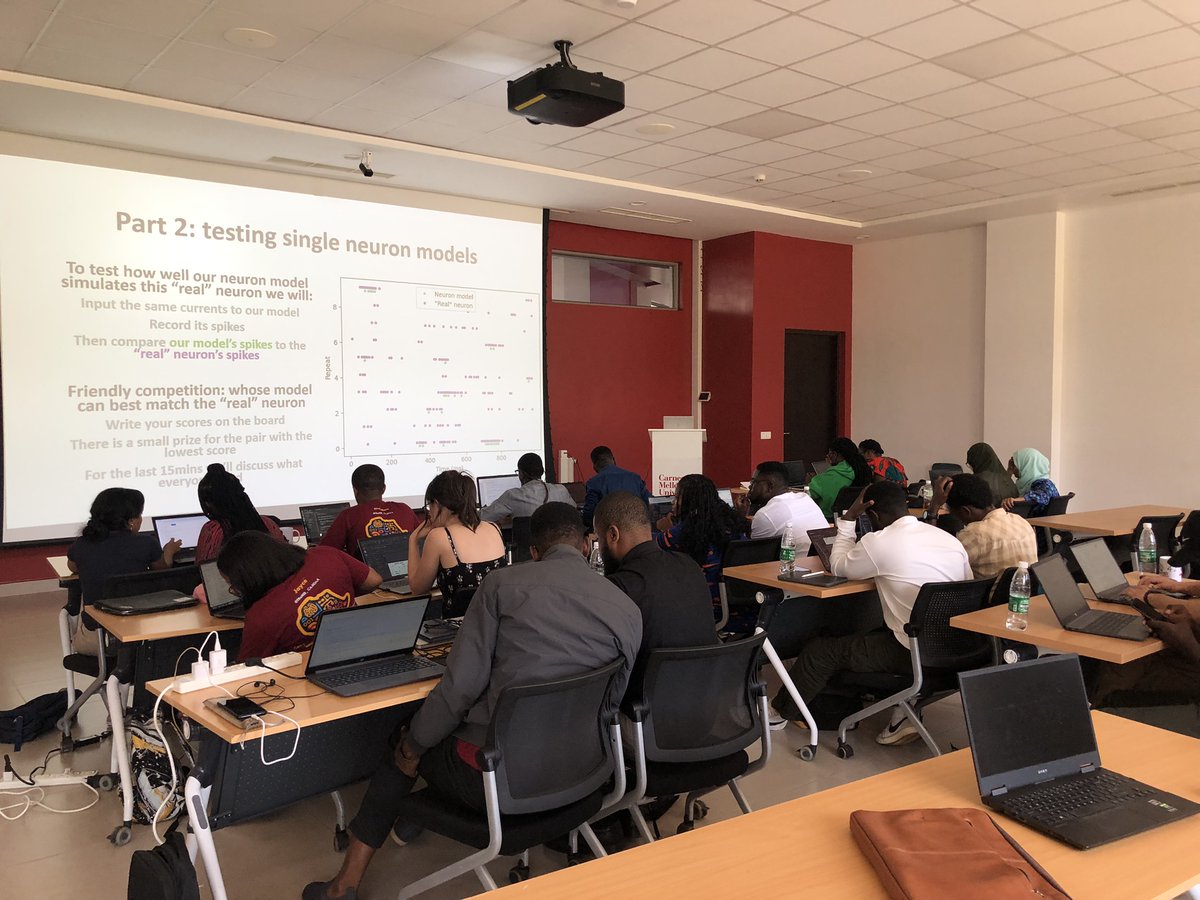
🌍Exciting news! The 2025 TReND-CaMinA Course will be held in Lusaka, Zambia 🇿🇲 from July 7th–23rd. Dive into computational neuroscience and machine learning with us!
📅 Applications open: December 15th
🔗More info: https://t.co/P49RfKW1dx
Stay tuned & spread the word! 🧠✨
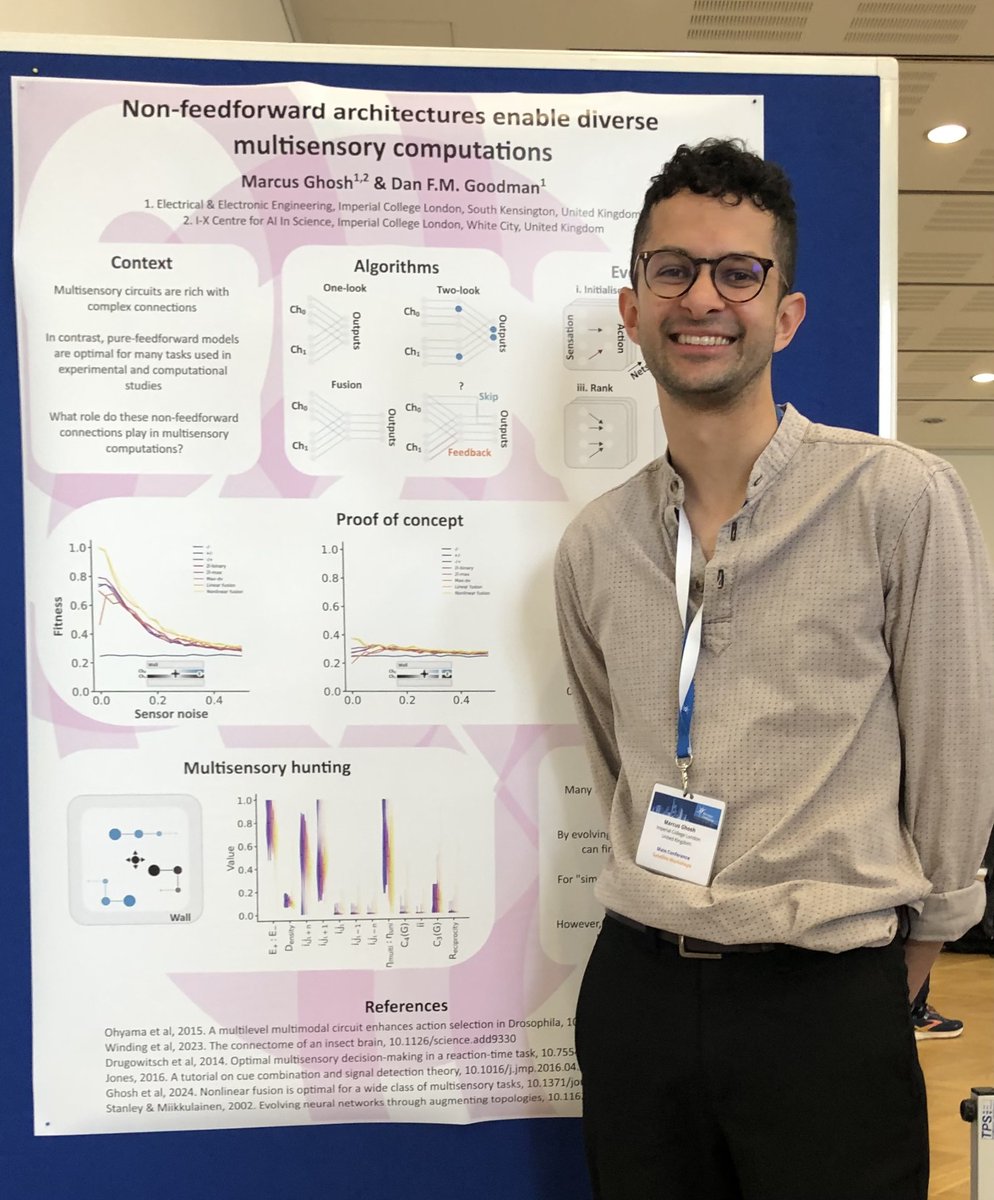
I will be at #BernsteinConference (@BernsteinNeuro) next week - with my @neuralreckoning colleagues.
Drop me a message if you'd like to meet up.
Otherwise, stop by my poster (IV 47) for some new work on multisensory integration
Come and meet the Neural Reckoners at @BernsteinNeuro with posters from:
⭐️@GabrielBna1: specialization/modularity
⭐️@MarcusGhosh@Swathi_Anil_: multisensory processing
⭐️Yang Chu: bootstrapping auditory learning with an innate circuit
⭐️Greta Horvathova: adversarial autoencoders
💥I’m hiring! 💥🚀
Funded by @ARIA_research, we’re massively ramping our work on spatially-embedded efficient computation in neural networks.
18m first instance, great London location, competitive postdoc salary.
Any Qs, my DMs are open! (please RT).
https://t.co/WYdZmJ6VLL
I think RSE teams is a good step, but not the right one in the long term.
Instead tool-makers should run autonomous "studios", analogous to "labs". This will be cheaper, more innovative, and more attractive for talented engineers.
How might this work? A dialogue 🧵
How should we structure large-scale scientific projects?
Massive, open source collaborations (which anyone, anywhere can join) are one option!
We ran a project like this for 2 years.
Read about our experiences and findings here:
https://t.co/eBcyiQ3AeD
New preprint on our "collaborative modelling of the brain" (COMOB) project. Over the last two years, a group of us (led by @MarcusGhosh) have been working together, openly, online, with anyone free to join, on a computational neuroscience research project
https://t.co/tzvWGWq4g1
I hadn’t really thought about the variety of algorithms that *could* optimally underpin multi-modal processing/integration, until this awesome work by @MarcusGhosh & team.
Clear findings w/ experimentally testable predictions on nonlinear fusion in agents & organisms! 👌
Our 2024 cohort is ready to start the journey.
For the next 2 1/2 weeks our students and teaching team will work together and will dive into concepts of computational neurosceince, machine learning and open science! 🧠💻🤖
Have fun everyone!
2 years into making, the last chapter of my PhD thesis, and a set of wonderful collaborators: @m00rcheh, @ShreyDixitAI, @misicbata, @caioseguin, @GZamora_Lopez, @CCHilgetag.
🧵 What can we learn about communication in brain networks from 7000 million virtual lesions: