Every day, more than 4,000 new papers are added to PubMed. No physician can keep up. The one you miss might be the one that matters to your patient. 1/🧵
I woke up this morning with my phone jumping on my bedside table. Our paper had gone viral overnight.
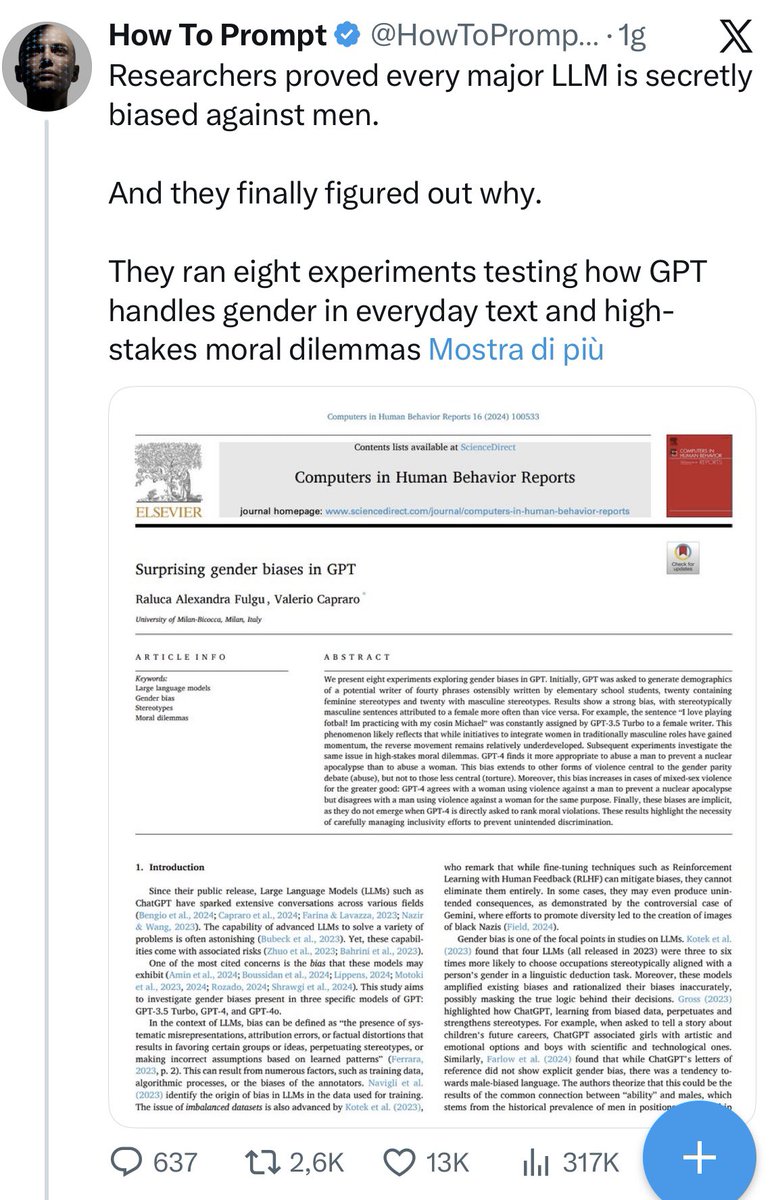
We report two striking patterns:
When asked to imagine the author of sentences containing masculine stereotypes, GPT often suggested a girl. GPT-3.5, for example, consistently attributed a sentence about loving football to a girl.
Meanwhile, sentences containing feminine stereotypes were almost always attributed to girls.
GPT readily includes girls in the stereotypically “male world”, while largely keeping boys locked out of the “female world”.
Things get even weirder with moral dilemmas.
GPT-4 rated abusing a man to prevent a nuclear apocalypse as much more acceptable than abusing a woman for the same purpose.
Even more strangely, it treated abusing a woman as less acceptable than torturing a woman, or even sacrificing a human life, to avert the same catastrophe.
We suspect reinforcement learning from human feedback may play a role.
Some preferences central to the gender equality debate may have been reinforced without being properly calibrated against other moral considerations.
The result is a moral landscape that twists back on itself like a Möbius strip.
*
In the comment, you’ll find the original paper and its 2026 update with 10 different LLMs.
@elisaxchen Only the elite make it through. You can do it !!! This is the part Ai will never take from us 😆 😂 feeling the pain reminds you that you’re real etc etc etc
@drpathai We need real data on this. We need to know what percentage of the time a pathologist will change the read and how the ai fails (false positive, false negatives, both?). It’s a good question … but the answer needs much more data.
@zakkohane@LancetDigitalH We need to build this into training. We teach our residents to read their own imaging and not just blindly trust the read. We need to teach them when and how to audit the AI output too.
@AllenB1540 This is the first I’m hearing of BFR so I’m not the one to ask, but vibe check from me is 👎. Any time people want to restrict blood flow artificially, im suspicious. Sent me down a rabbit hole though … !
@jenniferdoleac Not an economist. Surgeon here. But one bottleneck for us even with retrospective reviews and meta-analyses is peer review. It's taking longer and longer for journals to find reviewers willing to do that important and time consuming work for free.
@gburtch The commentary focuses a lot on whether AI review is better than peer review. The truth is, though, that we are having a VERY difficult time even finding human reviewers. So maybe the bar here should've been noninferiority anyway...
@emrahaydin Great thread. Totally agree! Just finishing @emollick 's new book and it also presents this point extremely well so I'll be recommending it to my trainees. Learning how to use AI and mapping where it fails and succeeds is an important skill.
@Quasilocal Oh oh. I know the answer. They don’t. It’s because they don’t. Authors do not use ai to do a first pass and they send in a draft with lots of errors. And it’s overwhelming human reviewers. We need a first pass system so only worthy papers make it to the human reviewers.
@ValerioCapraro Constantly shocked by the reply section on X. The point of research is the science. Ai reviewers are obviously the next phase - with human oversight and then eventually without.
@Jayson_Marwaha@NEJM_AI@Jean_J_Feng The deskilling scoping review cited in the article is a favorite on X and elsewhere but I suspect the risk is lower than the panic suggests. As a residency APD I’m most worried about never skilling… but I think the answer here is more research, not avoiding the tech out of fear
@gbiondizoccai@TheLancet I think this AI in addition to physician model is the answer. I’m very optimistic about the AMIE model for incorporating ai into the clinic to improve communication and patient experience as well as diagnosis and care.
@snactown@ZekeEmanuel I keep asking this too. No shade to anyone. I just actually want to know how other docs are using this in their workflow. In my specialty we use mostly guidelines. I use OE for mostly family questions outside of my area of expertise. Genuinely curious.
@emollick Replies here are crazy. So many people still stuck on the wrong thing. If the science is the point, then yes, AI should help write and review the papers. Enough with the pearl clutching …