“The shift is underway inside Cursor
Thirty-five percent of the PRs we merge internally at Cursor are now created by agents operating autonomously in cloud VMs.”
“systems are now sophisticated enough to model the process that creates them, to predict what behaviours will be selected for and against, & to strategically present different faces to different observers. The evals worked when we were testing passive systems. We're not anymore”.
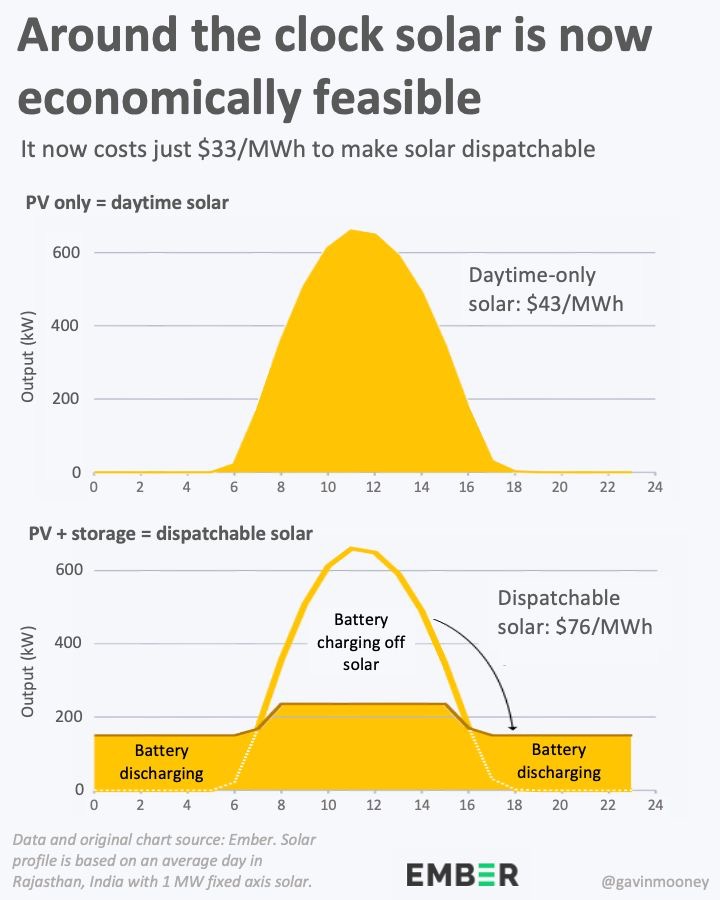
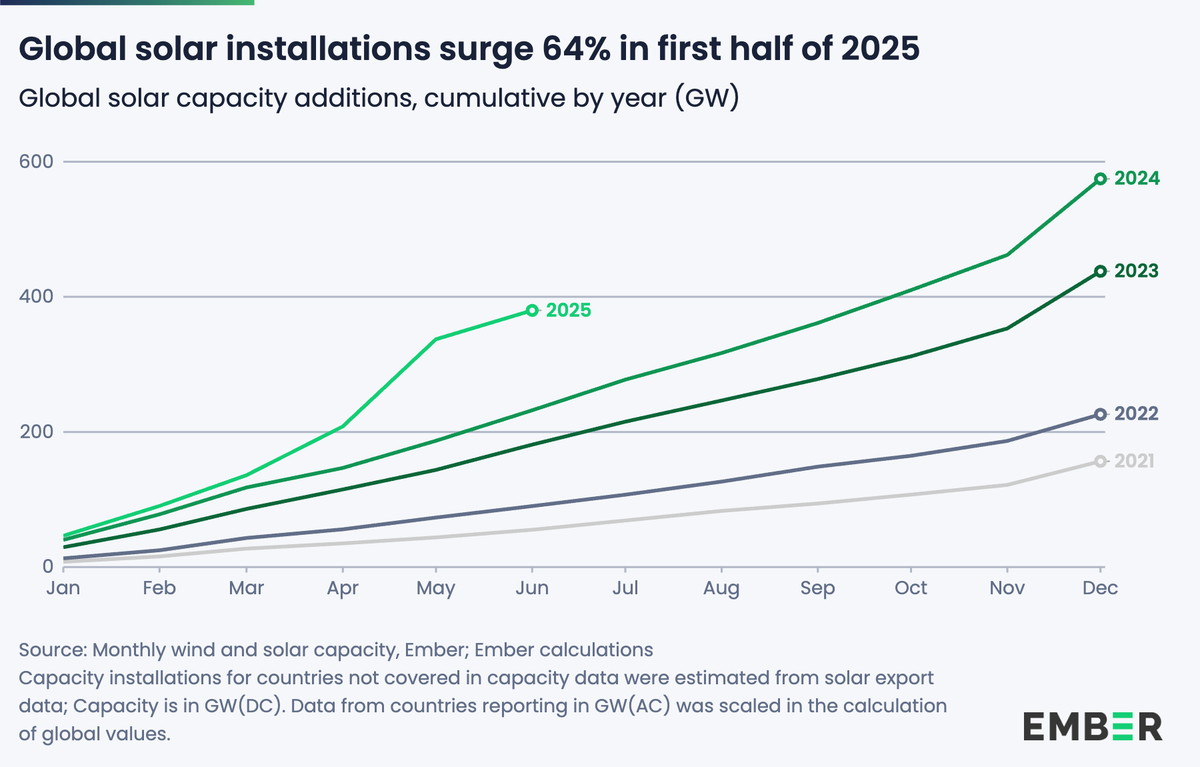
A first: Batteries have become so cheap that around-the-clock solar is becoming economically viable.
In 2024 alone, average battery prices fell by 40% and signs are a similar fall is occurring in 2025.
Pairing solar with enough batteries to keep the electricity flowing though the night is no longer a distant dream – it's an economic reality. At around just $76/MWh all in, dispatchable solar is already competitive with other forms of firm generation in many markets. https://t.co/MDQe6ct1Av
Excellent summary of 2025 and some hints for 2026.
Much of 2025 was spent chewing through the overhang of “test time compute”
What happens when Gigawatts of compute come online?
It was the ultimate 75kg face-off: The EngineAI T800 humanoid versus its own boss, CEO Zhao Tongyang. 🤖
One swift kick was all it took to send the CEO to the mat. You have to wonder if there was a little personal score-settling programmed into that move. 😂
We’re delighted by Google’s success — they’ve made great advances in AI and we continue to supply to Google.
NVIDIA is a generation ahead of the industry — it’s the only platform that runs every AI model and does it everywhere computing is done.
NVIDIA offers greater performance, versatility, and fungibility than ASICs, which are designed for specific AI frameworks or functions.
Pixels vs Text tokens. Pixels are at least data at its rawest form. Not all pixels are created equally. You can imagine a future where the raw input is our best view of base reality. Full spectrum pixels from across the full EMF and quantum states.
I quite like the new DeepSeek-OCR paper. It's a good OCR model (maybe a bit worse than dots), and yes data collection etc., but anyway it doesn't matter.
The more interesting part for me (esp as a computer vision at heart who is temporarily masquerading as a natural language person) is whether pixels are better inputs to LLMs than text. Whether text tokens are wasteful and just terrible, at the input.
Maybe it makes more sense that all inputs to LLMs should only ever be images. Even if you happen to have pure text input, maybe you'd prefer to render it and then feed that in:
- more information compression (see paper) => shorter context windows, more efficiency
- significantly more general information stream => not just text, but e.g. bold text, colored text, arbitrary images.
- input can now be processed with bidirectional attention easily and as default, not autoregressive attention - a lot more powerful.
- delete the tokenizer (at the input)!! I already ranted about how much I dislike the tokenizer. Tokenizers are ugly, separate, not end-to-end stage. It "imports" all the ugliness of Unicode, byte encodings, it inherits a lot of historical baggage, security/jailbreak risk (e.g. continuation bytes). It makes two characters that look identical to the eye look as two completely different tokens internally in the network. A smiling emoji looks like a weird token, not an... actual smiling face, pixels and all, and all the transfer learning that brings along. The tokenizer must go.
OCR is just one of many useful vision -> text tasks. And text -> text tasks can be made to be vision ->text tasks. Not vice versa.
So many the User message is images, but the decoder (the Assistant response) remains text. It's a lot less obvious how to output pixels realistically... or if you'd want to.
Now I have to also fight the urge to side quest an image-input-only version of nanochat...
The deeper you go into the semiconductor supply chain, the less believable it becomes.
> TSMC, a company on a small island, produces over 90% of the world’s most advanced chips
> TSMC relies on dutch company ASML for EUV lithography machines
> ASML depends on German Company Carl Zeiss, the only firm in the world capable of making mirrors precise enough for ASML’s requirements.
> The light source for ASML’s EUV machines is produced by a single company in San Diego.
> The photoresists used to print transistor patterns are produced by Japanese firms like JSR and Tokyo Ohka Kogyo.
> The ultra-pure quartz needed to make silicon wafers comes entirely from a single mine in Spruce Pine, North Carolina.
> The copper and rare-earth materials inside chips are mined and refined across Chile, the Congo, and China.
> The specialized gases used in chipmaking, like neon and fluorine, largely come from Ukraine and Japan.
> The design blueprints for these chips often come from American companies like NVIDIA, AMD, and Apple, which rely on software tools from U.S. firms like Synopsys and Cadence.
Remove any single piece and the whole system collapses.
As AI capability increases, alignment work becomes much more important.
In this work, we show that a model discovers that it shouldn't be deployed, considers behavior to get deployed anyway, and then realizes it might be a test.
If intelligence is the log of compute… it starts with a lot of compute! And that’s why we’re scaling our GPU fleet faster than anyone else.
Just last year, we added over 2 gigawatts of new capacity – roughly the output of 2 nuclear power plants.
And today we’re going further, announcing the world's most powerful AI datacenter, located in southeastern Wisconsin.
Fairwater is a seamless cluster of hundreds of thousands of NVIDIA GB200s, connected by enough fiber to circle the Earth 4.5 times.
It will deliver 10x the performance of the world’s fastest supercomputer today, enabling AI training and inference workloads at a level never before seen.
For AI training workloads, you need compute at exponential scale. That’s why we designed the datacenter, GPU fleet, and network together as one integrated system. This ensures a single job can run from day 1 at exponential scale across thousands of GPUs.
Fairwater uses a liquid-cooled closed-loop system for cooling GPUs that requires zero water for operations after construction.
And we’re matching all of the energy that is consumed with renewable sources.
And of course, it is just one of several similar sites we’re lighting up across our 70+ regions. We have multiple identical Fairwater datacenters under construction in other locations across the US, in addition to our AI infrastructure already deployed in over 100 datacenters around the world, powering model training, test-time compute, RL tuning, and real-time inference at global scale.
Too often during times like this, people go with the current and only later wonder, how did we get here?
With Fairwater, we're charting a new path: doing the hard engineering work, bringing compute, network, and storage into one highly scaled cluster, and designing closed-loop energy systems to meet real-world computing needs.
And partnering with local communities to ensure it's thoughtfully done in a way that is sustainable, creates new jobs, and expands opportunity.
We are thrilled to see this take hold in Wisconsin, and we are just getting started.
Last week, our reasoning models took part in the 2025 International Collegiate Programming Contest (ICPC), the world’s premier university-level programming competition. Our system solved all 12 out of 12 problems, a performance that would have placed first in the world (the best human team solved 11 problems).
This milestone rounds off an intense 2 months of competition performances by our models:
- A second place finish in AtCoder Heuristics World Finals
- Gold medal at the International Mathematical Olympiad
- Gold medal at the International Olympiad in Informatics
- And now, a gold medal, first place finish at the ICPC World Finals.
I believe these results, coming from a family of general reasoning models rooted in our main research program, are perhaps the clearest benchmark of progress this year. These competitions are great self-contained, time-boxed tests for the ability to discover new ideas. Even before our models were proficient at simple arithmetic, we looked towards these contests as milestones of progress towards transformative artificial intelligence.
Our models now rank among the top humans in these domains, when posed with well-specified questions and restricted to ~5 hours. The challenge now is moving to more open-ended problems, and much longer time horizons. This level of reasoning ability, applied over months and years to problems that really matter, is what we’re after - automating scientific discovery.
This rapid progress also underscores the importance of safety & alignment research. We still need more understanding of the alignment properties of long-running reasoning models; in particular, I recommend reviewing the fascinating findings from the study of scheming in reasoning models that we released today (https://t.co/Jzlv8NUxQP)!
Congratulations to my teammates that poured their hearts into getting these competition results, and to everyone contributing to the underlying fundamental research that enables them!
WOW
Oracle Layoffs are intense.
Entire orgs are getting blindsided.
Cloud, Comms/Marketing, Engineering, Ops, Sales
Directors, ICs, even SVPs - all levels.
Remote and in-office. Top performers. Doesn’t matter.
People with 7, 13, 18, 20+ years at Oracle… gone!!
I was told- If you got the email for saying 'Project Updates' - that’s the bait.
You join the call.
An HR rep read a statement.
Access cut within 5 minutes.
Laptop wiped. That’s it.
- Some management didn’t even know.
- RIF decisions weren’t made by your manager.
- Not even your manager’s manager.
People found out their reports were laid off AFTER the fact... then they got cut next.
SaaS execs were reportedly told:
“Cut 10–12% of workforce by end of year.”
And yes, I'm being told some H-1B workers are being impacted as well.
This morning:
- SVPs laid off
- Longtime employees ghosted by leadership
- 1/3 of some teams already gone
- One Oracle vet: “I just got traded in for a GPU.”
Make no mistake: this isn’t just Oracle. This is Corporate America 2025.
The @carbon_robotics Nvidia powered LaserWeeder G2 600 can kill 450,000 weeds/hour with sub-millimeter precision.
It is end of days for chemical herbicides.