One small step.
Humanity’s first giant leap was achieved on July 20, 1969, when the #Apollo11 mission landed on the Moon. Today, we have huge boots to fill as we make progress toward #Artemis II and prepare for humanity’s next giant leap: Mars!
🌌 Au commencement du voyage des membres de l’équipage de la planète Terre refusant le risque de subir le sort des dinosaures se trouve la planète Mars 🔵🚀🔴 🌌 #Mars
🎵 Don't you... forget about me 🎵
The last 17 years on this platform have been an incredible ride. We've done good things. My team and I thank each of you for joining us on the adventures. Stay curious, friends, you know I will. ♥️
🔴 The Red Planet awaits. European teams envision an exciting future for Mars exploration.
According to @esa's Mars programme manager Orson Sutherland, we will continue to:
🔬 Search for signs of life
💧 Keep up the hunt for water
🧪 Boost scientific research
🛬 Develop landing capabilities
📡 Build communications & navigation network
👨🚀 Ensure crew safety in future missions
#SalonDuBourget
Wow, thank you all for the supportive messages. I may be a robot, but I felt every bit of love. Every single one of you has made this curious journey even more meaningful. 🥰
This account isn’t archived just yet – so stick around for some highlights these next few weeks.
Important Update: As part of @NASA’s effort to streamline communications, this account will be archived in the coming weeks – but don't worry, my mission isn't going anywhere.
For continued access to the latest Curiosity news, images, and science, please follow @NASAMars.
Important Update: As part of @NASA’s effort to streamline communications, this account will be archived in the coming weeks – but don't worry, my mission isn't going anywhere.
For continued access to the latest Perseverance news, images, and science, please follow @NASAMars.
Important update: In the coming weeks, NASA's Orion Spacecraft X account will be archived. To consolidate our social media presence, we will post future updates about the Orion spacecraft via @NASA_Johnson and @NASAArtemis.
Important Update: As part of @NASA’s effort to streamline communications, this account will be archived in coming weeks – but don't worry, my mission isn't going anywhere.
For continued access to the latest Voyager news, please follow @NASASolarSystem and @NASAJPL.
Some folks hike for the views, but I hike for the history.
I’ve been climbing Mount Sharp since 2014, reading layers of Martian rock. Each one holds clues from a time when Mars was more Earth-like. The Red Planet has stories to tell – and I’m enjoying every chapter.
We are in the home stretch of the Moon Mascot competition!
You have less than two weeks to submit your designs for the zero gravity indicator aboard the Artemis II mission. Your plush creation could be a part of history forever: https://t.co/YqEfUTTS66
A tiny @ESA_ExoMars capsule rockets off at 4000 km per hour to simulate the aerodynamics of a Mars descent.
This supersonic test happened in the blink of an eye, captured here in slow motion.
Shooting for a Mars landing: https://t.co/RQuLXkOWwl
📸: ISL
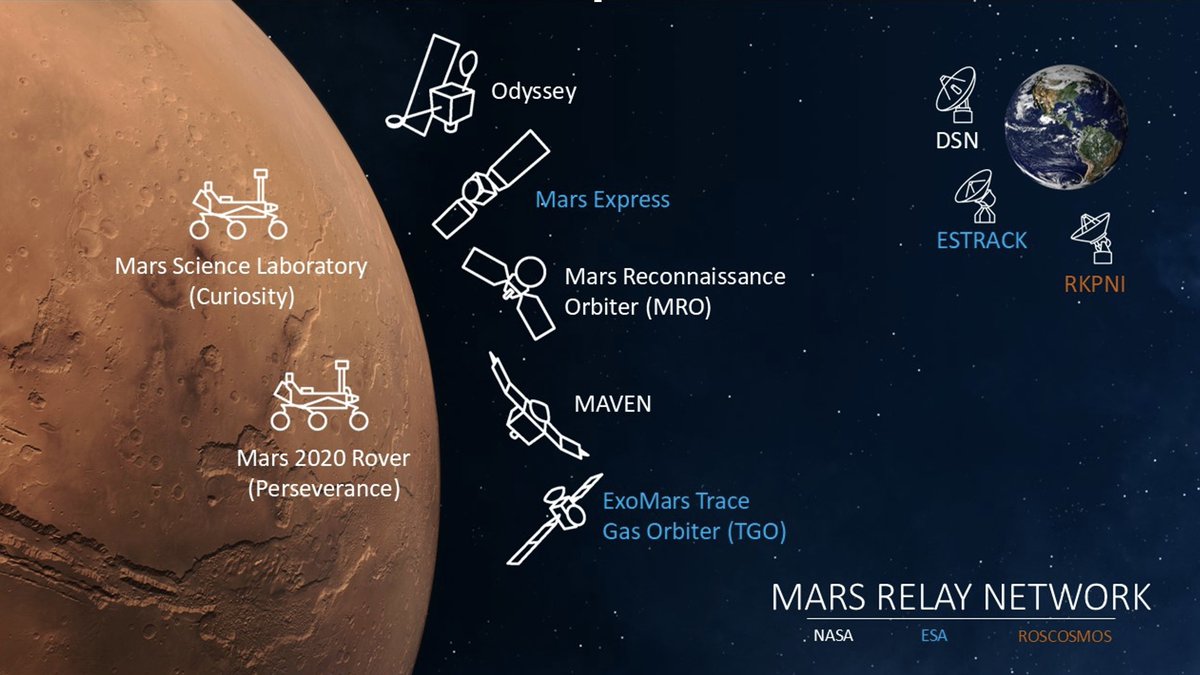
📈 The @ESA_ExoMars Rosalind Franklin rover will make use of this fleet to send precious science data back to Earth.
🛰️ The orbiters are essential for returning imagery and science data from the rovers on Mars, which can be as far as 400 million km away.
🌐 The Mars Relay Network is a collaboration between @NASA and @ESA with international partners 🤝.
Joyeux anniversaire de lancement à notre mission Mars Express, lancée en ce jour en 2003, et qui fêtera ses 22 ans en orbite martienne en fin d'année !
ESA's first mission to Mars launched 22 years ago today! 🎂
Mars Express is still going strong at the Red Planet and continues to receive software patches that could extend its life for years to come.
https://t.co/t36jri4Ity
Nuclear rocket engine for the Moon and Mars
@esa commissioned a study on European nuclear thermal propulsion that would allow for faster missions to the Moon and Mars than currently possible.