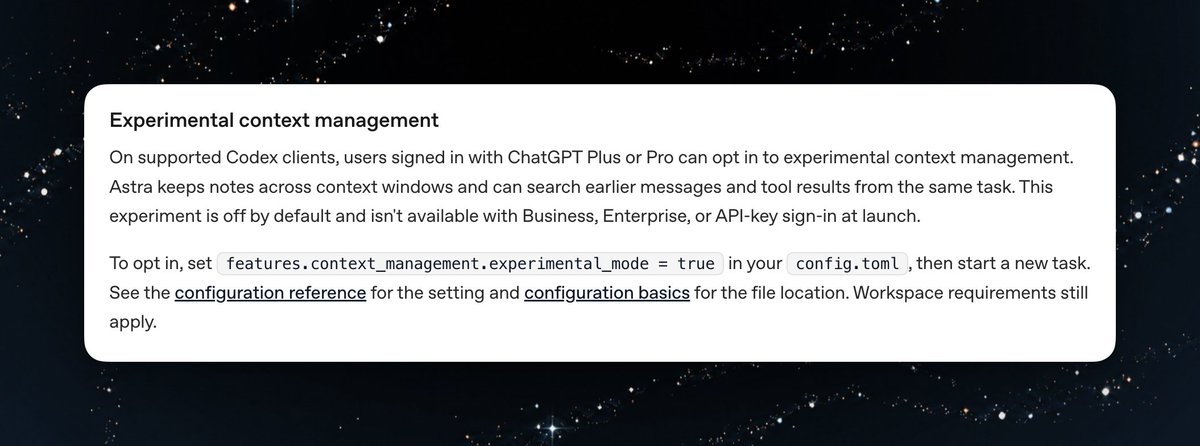
Here is how to enable a 1M-token context window in Codex for GPT-5.6 Sol.
Even though we have tuned the context limit in Codex to be set optimally when it comes to performance and cost, this is a common ask, so here it is documented.
A larger context window lets Codex retain more code, tool output, and conversation history before summarizing older material. You need a model that supports it. And GPT-5.6 Sol, for example, has a documented 1,050,000-token window.
Open ~/.codex/config.toml and add or update these settings at the top level, before any [section] headers:
```
model = "gpt-5.6-sol"
model_context_window = 1000000
model_auto_compact_token_limit = 900000
```
The first setting selects the model. The second tells Codex to use a one-million-token context budget. The third starts automatic history compaction around 900,000 tokens, leaving some headroom. Restart Codex client and start a new session after saving.
To try the configuration for a single CLI session without changing your defaults:
```
codex -m gpt-5.6-sol \
-c model_context_window=1000000 \
-c model_auto_compact_token_limit=900000
```
Have fun, but also know that we tuned the default carefully!
Pedirle un simple "resumen" a Gemini Notebook es desaprovechar por completo la herramienta. 🛑
No es un lector de PDFs, es tu investigador personal.
Aquí tienes 4 prompts para exprimir al máximo tus documentos: 🧵👇
The Next Token Ep 05 - "I'm the Arbiter of Tokens and GPUs"
@michellechen joins @dillon_mulroy and @threepointone to explain AI inference at scale, open weights, how the industry lights money on fire, etc. (@RhysSullivan returns next episode!)
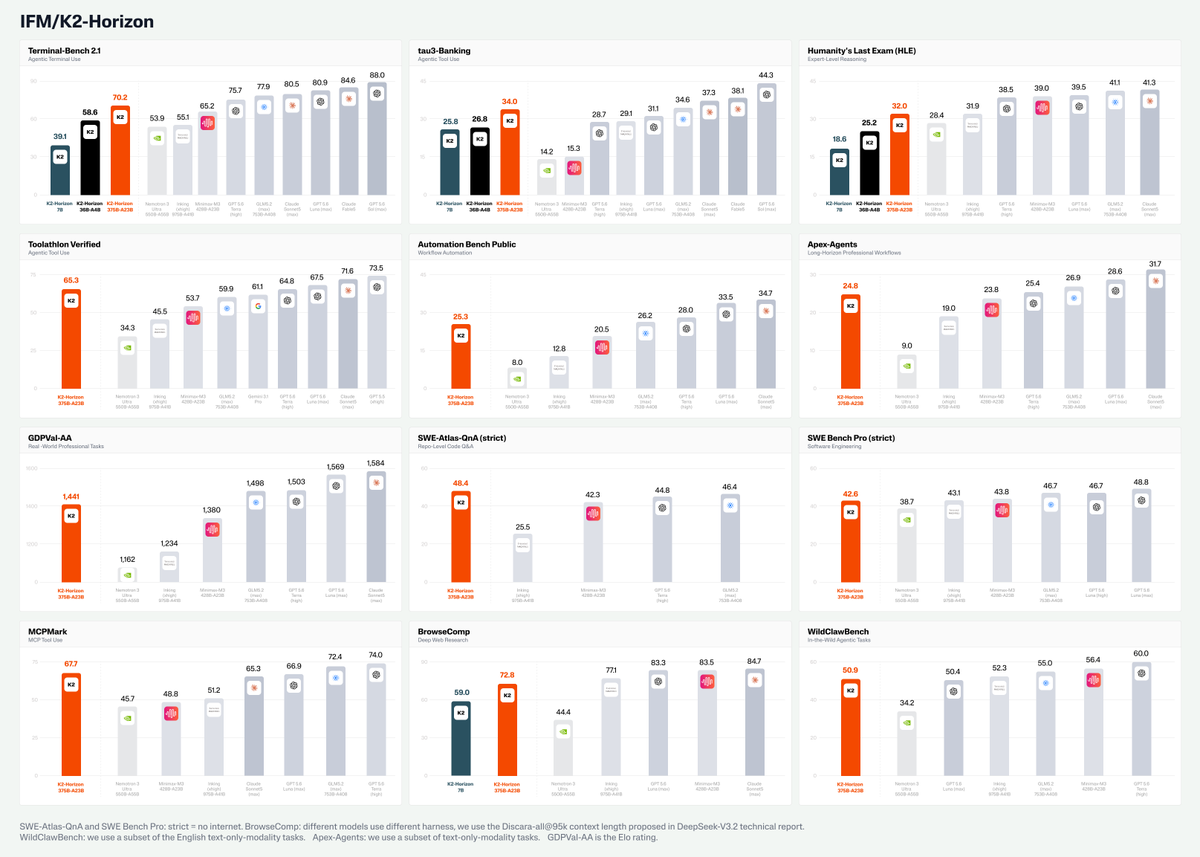
Introducing K2 Horizon: a connected fleet of six foundation models ranging from 0.9 billion to 375 billion parameters.
- Frontier performance: Across coding and agentic tasks, K2 Horizon delivers top-tier performance in every size class—with the 0.9B, 3.7B and 7B models setting new state of the art at their respective scales.
- Radical openness: K2 Horizon represents the largest fully open-source model launch in AI history. The fully open code, training data and recipes are a significant step forward in transparency.
Launch page: https://t.co/gg0k803SbL
Tech blog: https://t.co/g35L5xMGdS
Hugging Face: https://t.co/3Lb28JhyG9
Super happy to share our intention to join forces with NVIDIA in a $12,930,300,000 acquisition 💛💚
10 years after starting Hugging Face, open-source AI is at an inflection point. Thanks to the community, we’ve shown that it can be a complement, and even an alternative, to closed-source APIs. But for it to happen at larger scale, it needs more compute, more support, more collaboration and more visibility. That’s why we went to talk to Jensen, who offered to do exactly that with us.
In addition to doubling down on NVIDIA’s massive contributions to open-source AI (I called them the “King of American open-source AI” earlier this year), they’ve committed to strongly supporting Hugging Face and our mission while keeping the platform open, independent and compute agnostic. The founders and the team are all staying to keep pushing this mission forward.
Together, we think we can make open source the default way to build AI, with the goal of empowering 100 million AI builders to own their intelligence rather than rent it.
Excited about the next 10 years! 🤗🤗🤗
Alibaba’s Zvec team open-sourced zg, a local search tool for developers and AI agents.
• Local-first
• Works out of the box with popular agents
• Semantic, BM25, hybrid, and rg search in one tool
Why they built it and how it works: https://t.co/HzihCJh5l8