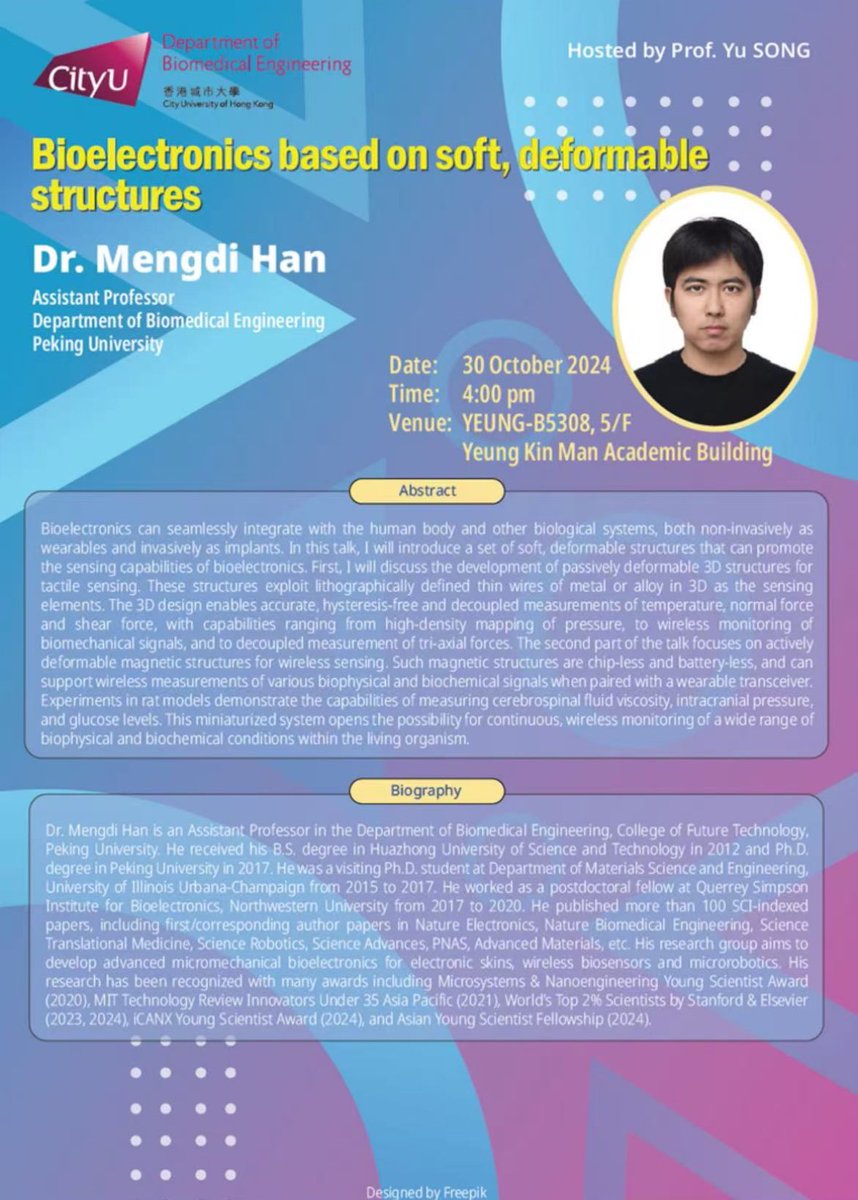
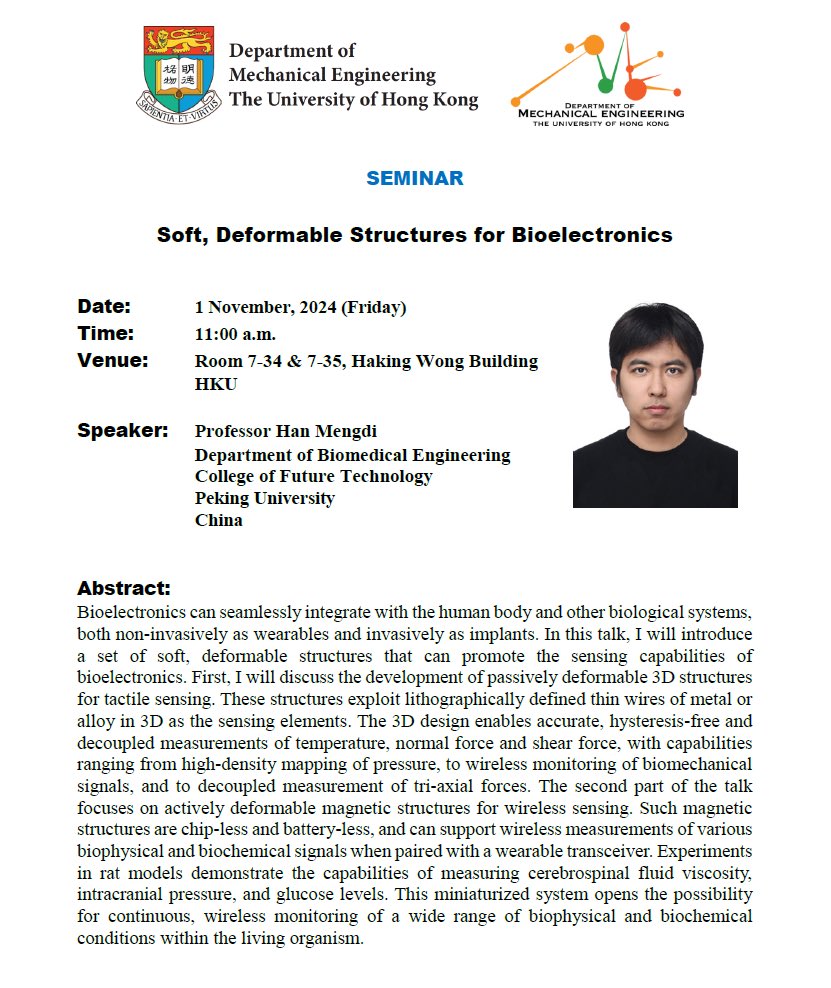
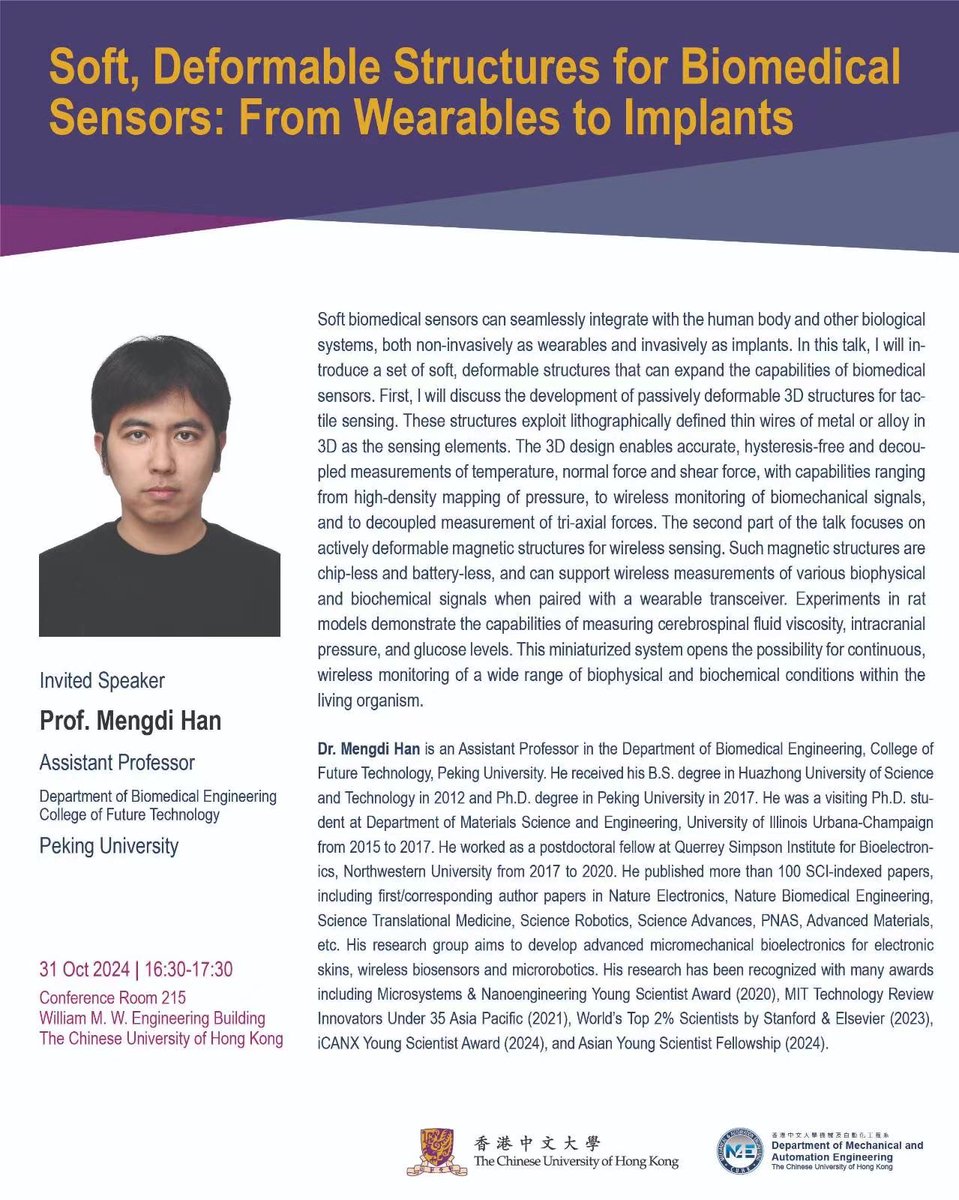
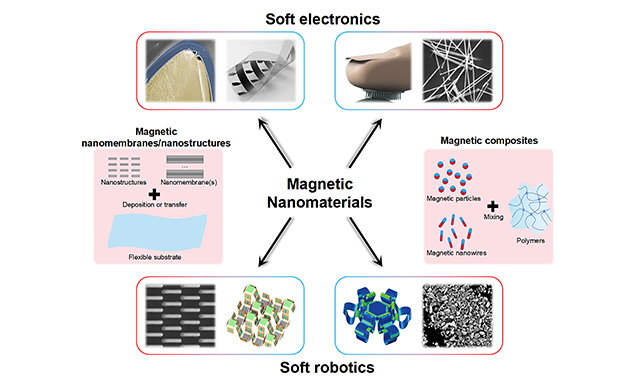
It's a great honor to have been awarded the 2024 Asian Young Scientist Fellowship. I will be in Hong Kong this week to present our work at four different venues: the AYSF Annual Conference, CityU, CUHK, and HKU. Looking forward to seeing you there.
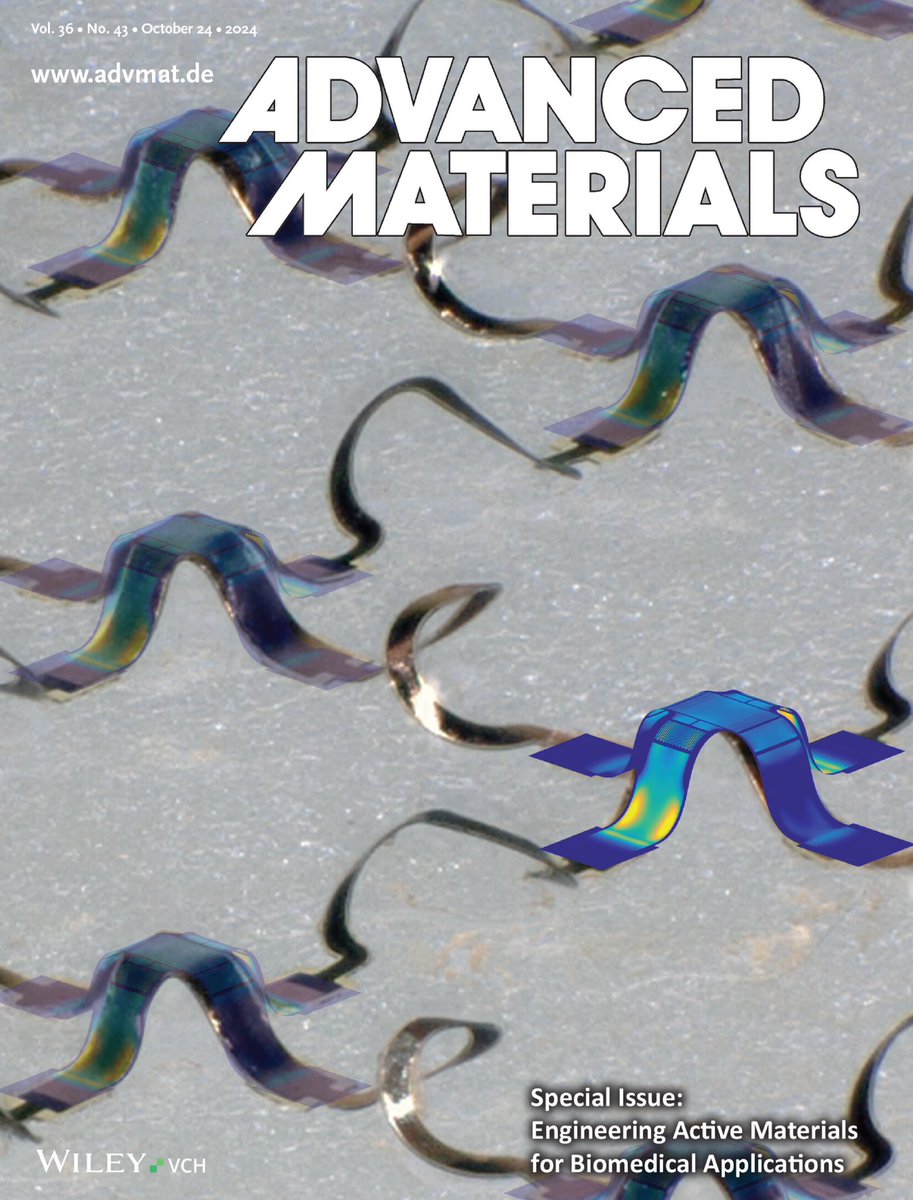
Happy to share our review article on bio-interfaced pressure sensors is featured as the cover in Advanced Materials. Thanks @ProfJohnARogers, Zhongyi and @JeanPKwak. Link to the paper: https://t.co/4HF48abzpg
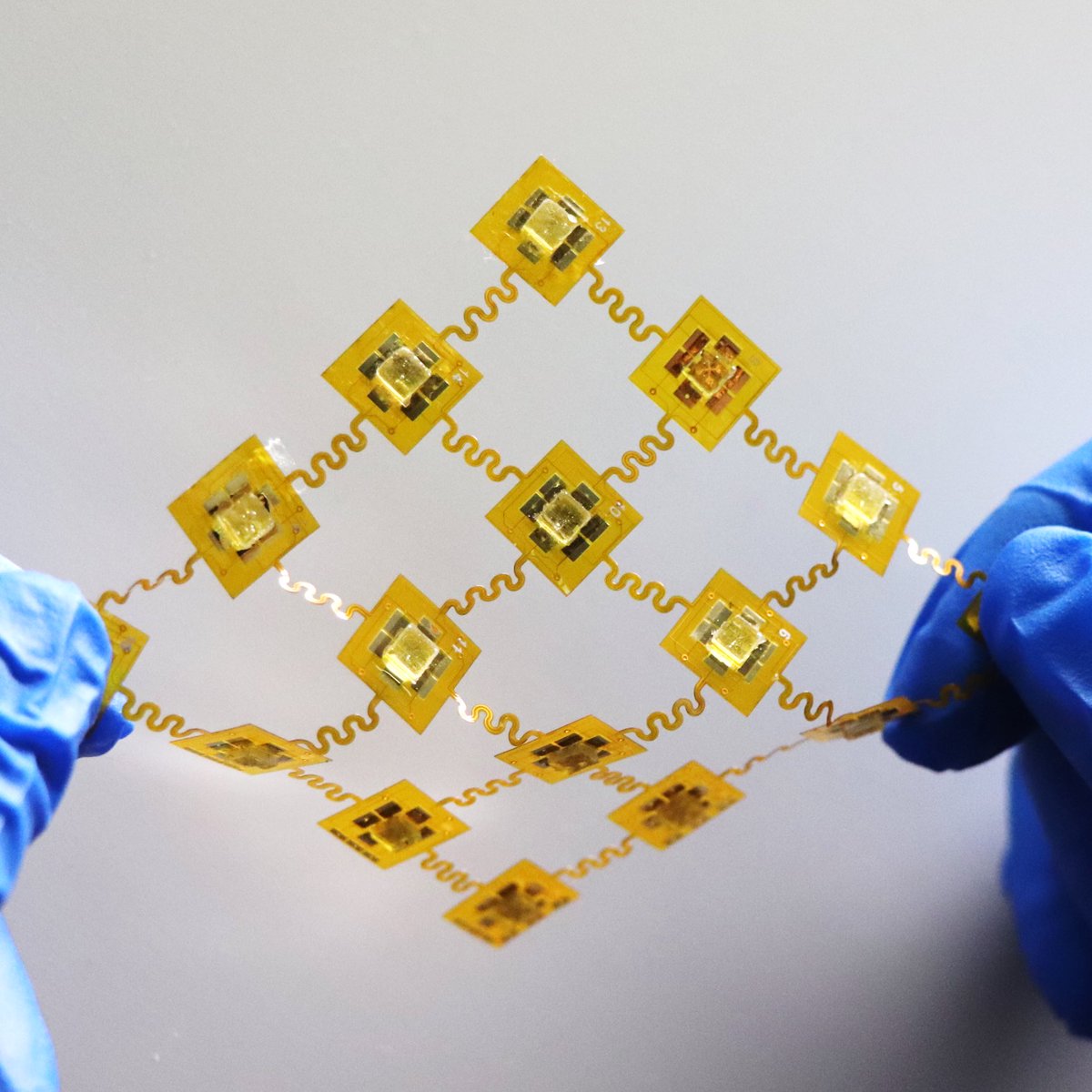
At long last, our review article for Advanced Materials, titled ‘Mechanically Active Materials and Devices for Bio-Interfaced Pressure Sensors’, appeared in print today, featured on the front cover of the journal. The paper is a comprehensive summary of work in this important, emerging area. The cover image features a high resolution optical image of one of our arrays of 3D microscale pressure sensors with overlaid color renderings of distributions of strain, determined by finite element modeling. These systems serve as the basis for sensing contact between functional ‘instrumented’ balloon catheters and endocardial surfaces, as we described in a paper in Nature Biomedical Engineering (https://t.co/RZMfUUnle3). We’ve also reported on the use of these types of 3D structures for pressure sensing across a range of applications in medical monitoring, from patients that use lower limb prostheses (https://t.co/ZYUQSVHCkG) to those confined to intensive care units (https://t.co/GA5aCtvwkr), to those engaged in compression therapy (https://t.co/A4MCJbpzBr). Thanks to Zhongyi and @JeanPKwak, junior co-authors, and to @MengdiHan, a senior co-author and former postdoc in the group who is currently on the faculty in biomedical engineering at @PKU1898, for their hard work on this article!
https://t.co/BrzHF0ejST
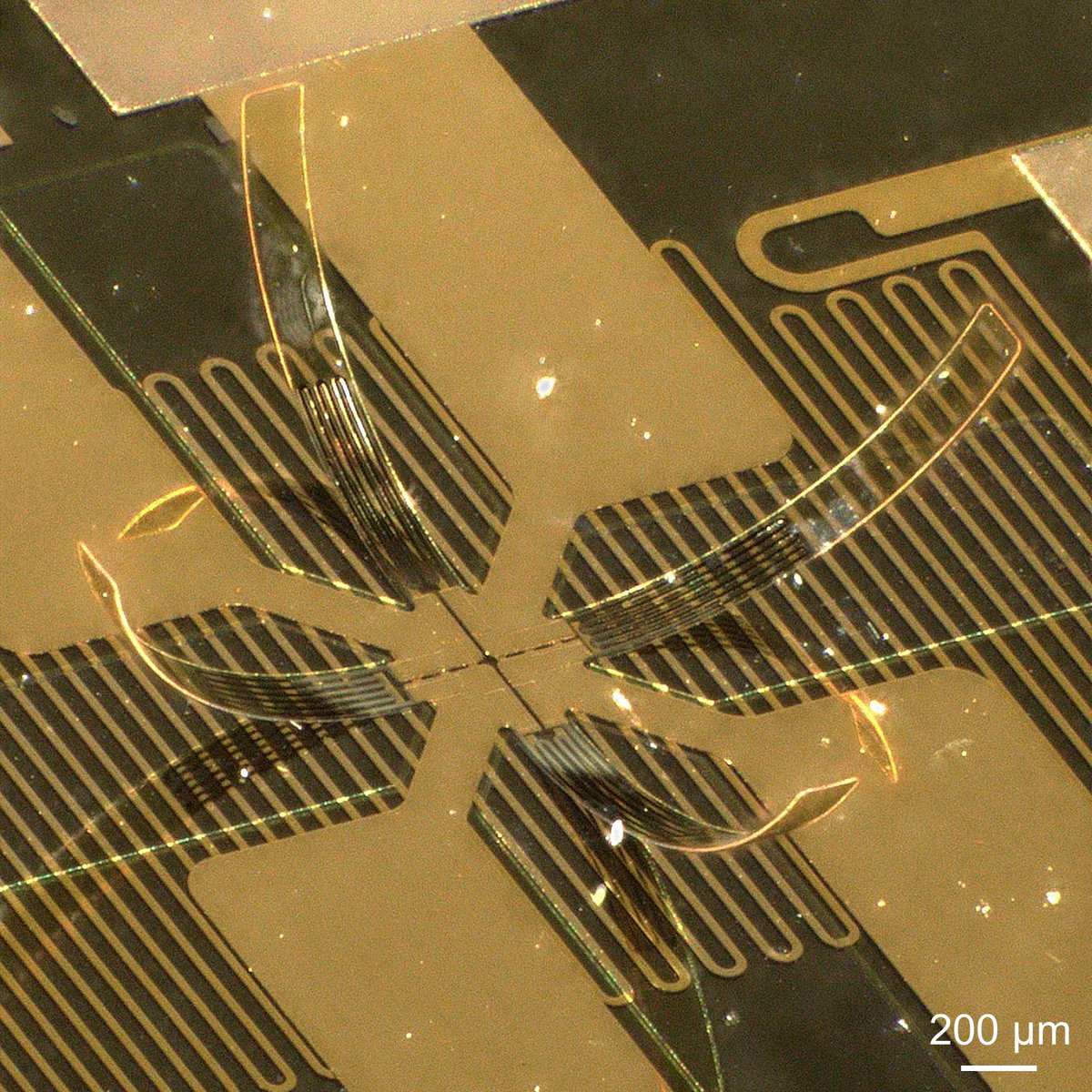
Excited to share our #ElectronicSkin published in @ScienceAdvances. We use 3D strain gauges for tactile sensing. The fab process is compatible with micro- and macroelectronics. We can solder the sensors onto FPCBs or fabricate them atop ICs. https://t.co/qhPSmjWH5g
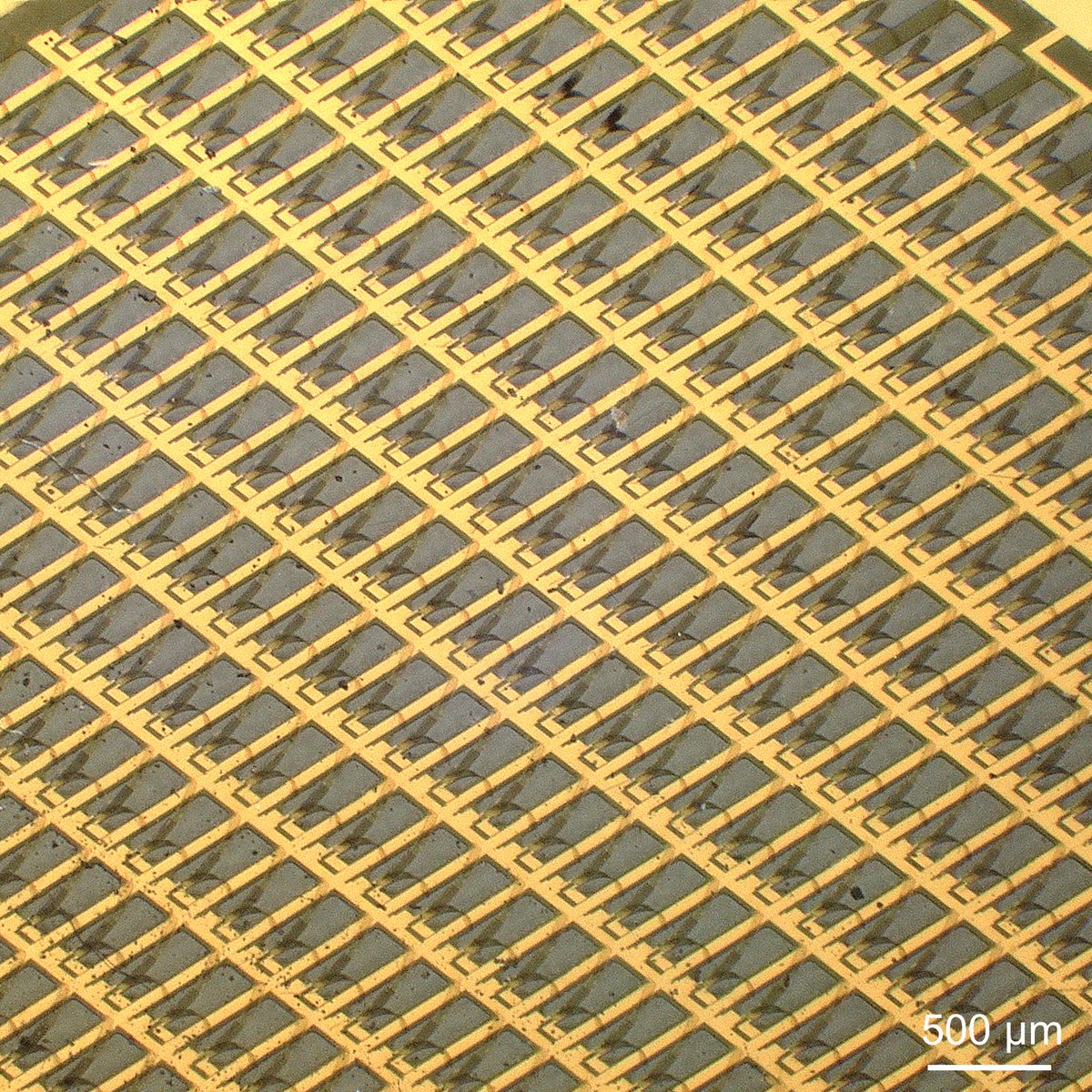
Some more images showing that these sensors can be constructed into high-density arrays (left), soldered onto flexible substrates across large areas (middle), and configured with adjustable spatial density to mimic our human hand (right).
Some images showing that these tactile sensors can be produced at wafer scale (left), and fabricated together with other thin film devices (middle) or integrated circuits (right).
Without chips, wires, or batteries, this simple prototype implantable biosensor—essentially a tiny drum with a magnet on the drumhead—can signal to an external reader device a range of physiological parameters including glucose levels. https://t.co/o2YihmrjgS
Researchers have developed a millimeter-scale implant sensor that pairs with a wearable device and monitors health status, including intracranial pressure and glucose levels. @MengdiHan@PKU1898 https://t.co/DJG2KFhInB
Happy to share our recent work published today in @ScienceAdvances ! We introduce a set of chip-less, battery-less magnetic implants, paired with a mini wearable device, for wireless monitoring of biophysical & biochemical conditions.
https://t.co/DJMBaXjM9l
A battery-less and wireless integrated sensor implanted in the heart or in a blood vessel can measure blood pressure, flow rate and temperature simultaneously and in real time, as shown in large animal models.
https://t.co/gJyVwgyAuz
The first paper from our lab is now online. We create programmable surface that can learn to morph. Thanks to all the collaborators! https://t.co/7tjKIskIU1
Please have a look at our new paper! Our results stand on the shoulders of several achievements in our group in the past few years and we are lucky to be the first to demonstrate eco/bioresorbable MEMS!!!
https://t.co/USniW9yCcH
An implantable device designed to “cool” nerves can provide targeted, on-demand pain relief, according to new Science research in rats, which could become "a game changer for long-term pain management."
📄: https://t.co/iKW2z08E0t
#SciencePerspective: https://t.co/Qf74cbyC57
Watch @TheDailyShow's coverage of tiny robotic crabs, the smallest-ever remote controlled-robot, then check out the original research study published in @SciRobotics. @Trevornoah https://t.co/dkWsTeE4up