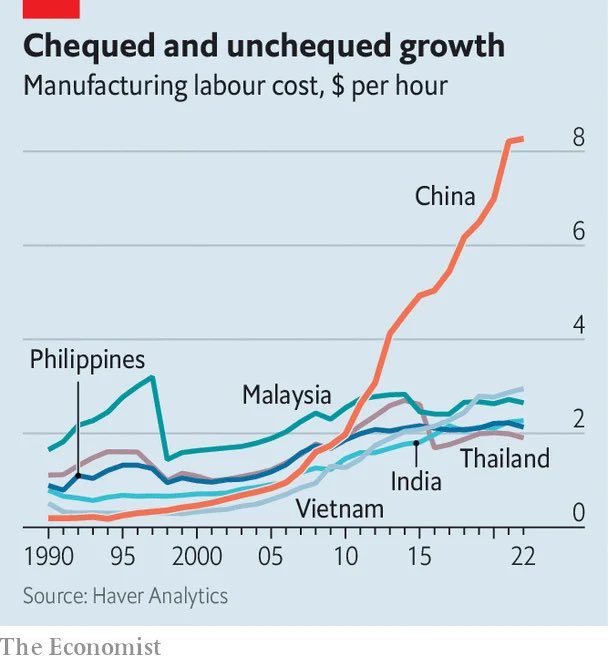
I cannot count the number of articles over the past 20 years (including from Nobel prize winners) that I read about how China cannot innovate b/c it is not a free market economy.
But now I have to read the articles from the same people telling me how a state-directed economy innovates much more efficiently than a market economy & how we have to fight against that.
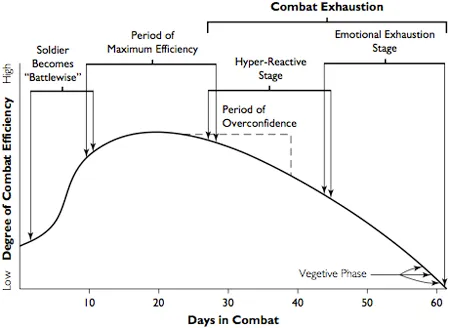
This largely aligns with the US studies from WW2 which posit that a soldiers combat capability starts to suffer after 30 days of continuous frontline combat and after 60 they were essentially emotionally exhausted.
Total possible frontline days with rotations was 140-240.
BYD just unveiled an electric car that can charge from 10 to 70 percent in five minutes, and all the way in nine
More proof that EVs are going to dominate the future, just a question of how long it takes — and who will build them
Via @WIRED https://t.co/Ct5KRaNC8c
China’s cheaper services (incl. healthcare, education etc) come down to two things:
1- Rentier interests are largely subordinated to the working class’
2- Surplus from labor is continuously steered toward reinvestment to improve the means of production at every level
@adam_tooze Their main point is Iran has lost hard power in the region but, so has the US? Not to mention coalition building capabilities. The article barely touches the Gulf, Hormuz/economic aspect, diplomatic sabotage, regime reconstitution, or civilian deaths.
This is bigger news than most might think, as in the past, China played a key mediation role in the partial, now likely defunct, rapprochement process between Saudi Arabia and Iran. Should China realize success in such a role, it’s highly likely that, at the behest of U.S. regional influence, they will use such successes to support their characterization of themselves as a stabilizing force in the geopolitical world order.
SCOOP: US is “stonewalling” requests by some Gulf states who came under attack from Iran to replenish air defence interceptors, Western official and Fmr. US official tell me.
"We have shot several years' worth of production in the last few days"
https://t.co/tPn8IUHwZX
Iran’s new swarm shielded missiles seem to be massively over-performing. US allies wasting 6 or 7 interceptors per missile. At what point does it become realistic to think Iran has the tech to hit an aircraft carrier? These are truly insane times.
America has an attrition problem. We are likely looking at a roughly two-week operational window; after that, the math changes dramatically. In that time, the United States would need to destroy every missile depot and installation within Iranian territory. 👇🏽
Unlike the 12 Day War in which Iran used a certain segment of its missile force to retaliate in distinguishable waves, this is complete chaos. Many missiles across many fronts, potentially with units acting without centralized authority.
Global carrier Maersk suspends all vessel transits via the Strait of Hormuz until further notice.
Maersk controls ~14–15% of global containerized trade capacity.
These casualties are likely the result of Iranian ballistic missile and one-way attack drone strikes on bases in Bahrain, Kuwait, and the United Arab Emirates, with some bases suffering much more serious damage than had been previously announced by CENTCOM.
Name one time airpower alone produced regime change. I'll wait. Strikes can degrade, destroy, and deny. They cannot govern. Whatever comes after this, the U.S. has no plan for it
How are the American people supposed to vote against regime change wars in the Middle East? The candidate who ran against them is launching them. The Congress debates whether to hold a vote after the fact.
The Trump trade is dead. Long live the anti-Trump trade. Wherever you look in financial markets, you see signs that global investors are going out of their way to avoid Donald Trump’s America. More on this in the Chartbook Top Links today.
During last June's war, by the 10th day of fighting, Israel was already running short on interceptors, fuel and air munitions were scarce.
Almost all the munitions used in Gaza last year, against Iran last year, and again now have been supplied by the United States, more than 1,500 airlift sorties and at least 300 cargo ships full.
Last year the Pentagon issued a statement saying stockpiles were low and that this was already limiting supplies to several allies.
There are already sufficient short-range bombs, as these can be manufactured relatively quickly, but the same does not apply to long-range munitions, interceptors, or Tomahawks, which take much longer to produce.
It means that US-Israel must get air superiority to next few days and be able to short range strikes.
Although Israel has resolved the tanker issue, several other bottlenecks remain and will soon start to weigh heavily on operations.
I would say that if, within the next 3-4 days, the number of Iranian missile launches is not substantially reduced, the munitions situation will begin to seriously concern the US–Israel coalition.
There is no American operation against Iran today. Israel remains the protagonist in the action, employing far more aircraft and intelligence assets and getting support from US.