Real rooms for physical AI. We don't build robots. We build the kitchens, hotel rooms and hospital mock-ups where they learn and get tested and deployed.
We don't build robots.
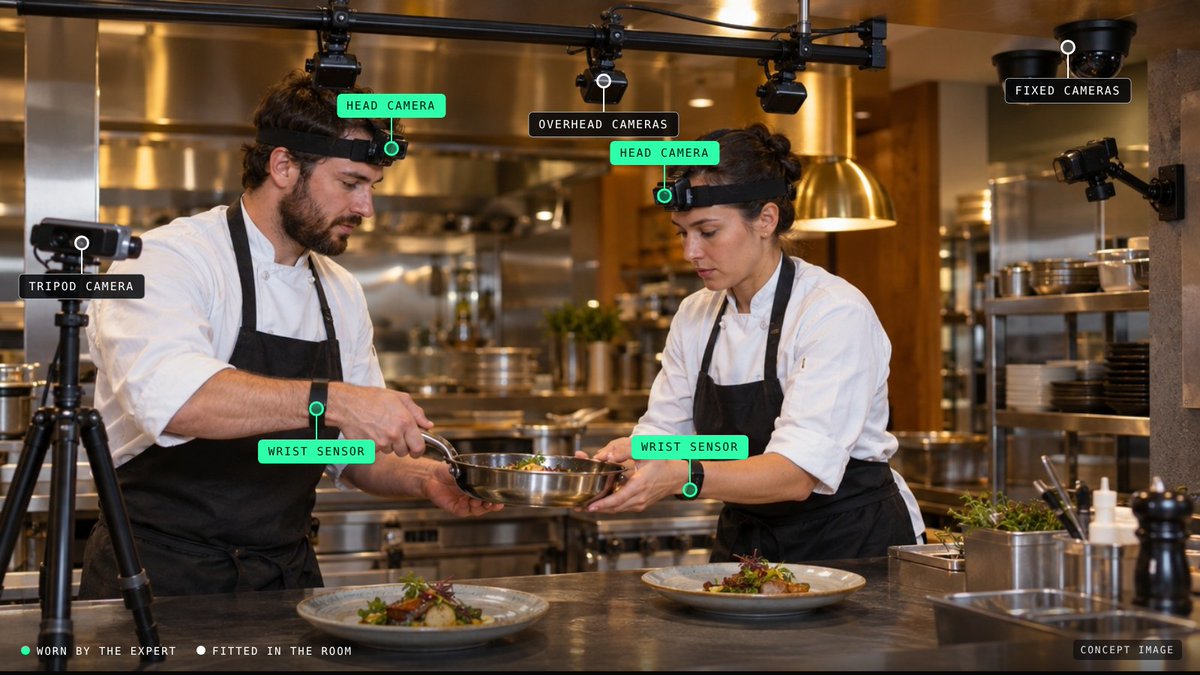
We build the rooms where they learn. Real kitchens, hotel rooms and hospital mock-ups, fitted with cameras and staffed by trained experts.
Labs order the task. We capture it.
Concept image. Campus 01 is in planning.
@michellelsun One way to get diversity without losing closeness: keep the room real and change it on purpose between runs. Same kitchen, different clutter, light, layout and people. Diversity you control instead of diversity you hope for.
@andyzengineer That backtracking is the part that matters on a real job. In a hotel, nothing fits the first time: a jammed drawer, a cart in the way, a bed pushed against the wall.
Curious whether it learned recovery from people showing fixes or found it on its own.
@TheHumanoidHub The next layer is who's wearing the camera. First-person video of trained cooks and housekeepers working to a professional standard teaches different things than everyday footage. Same view, very different lesson.
@GeneralistAI The recovery is the impressive part. Anyone can film the clean run. How much of that recovery behavior came from people demonstrating fixes versus the model figuring it out on its own?
@yunzeman Turning raw footage into training signal is the unlock. The next bottleneck is the footage itself: trained experts doing real tasks in real rooms, recorded on purpose. Excited to try Flora on hospitality task video.
@michellelsun@taurobots "Making the bed was the hardest task" is the most honest line here. After 22 years running hotels, that tracks. A hotel bed has a standard: corners, tension, pillow order. Housekeepers make a dozen or more a shift. Great writeup.
@BrendanFoody And most of the workforce isn't knowledge workers at all. Cooks, housekeepers, caregivers.
Physical AI will need expert data from them too, and almost nobody is collecting it yet.
Big day for Metari. We've been accepted into the NVIDIA Inception program.
Physical AI needs real rooms to learn in. Kitchens, guest rooms and care settings, staffed by trained experts and fully instrumented. That's what we're building.
First of many. 🚀
@NVIDIARobotics@InceptionNvidia
@willsentance From the hotel side, after 22 years running properties: operators don't say no to robots, they say no to being the test site.
A failed pilot in front of guests costs more than the robot saves. Machines need somewhere to fail before they reach the floor.
Turning a hotel room looks like one job. It's really dozens of small ones, and each has a standard.
Strip, sort, wipe, restock, make, inspect. Then do it again next door, where nothing is laid out quite the same.
That is what physical AI has to learn.
@venki1899 Unexpected contact is the hard part. Lab demos rarely have a person reaching across the robot mid-task.
How are you testing it? Scripted bumps or people just working normally around it?
@christophersaum Agree.
In hotels the yes rarely comes from the person with the title. It comes from the one who has to live with the change every shift.
Win them and the signature follows.
@irenekarrot@deployrobo@ycombinator That's the right instinct.
Where do they practice today? In your own space, or on site before going live?
Curious how close you can get to the real room.
@NEURARobotics Touch and audio in the loop is a big step.
Curious how you'll evaluate it. A model that can feel a towel still has to learn what a properly folded one looks like.
@SabrinaHalper@aliansarinik@micro1_ai The hard part of robotics data isn't the robot, it's the room.
You need real kitchens and guest rooms, people who do the job to a standard, and the freedom to fail without a customer watching.
Most of that infrastructure doesn't exist yet.
@alexandr_wang Pointing in a photo is the first step.
The benchmark after that is pointing, reaching and grasping in a real room, with clutter, glare and a person walking past.
That one has no leaderboard yet.
@aliansarinik "Scaling on realism" is the right frame.
For physical work, realism can't be generated from text. It has to be captured: real rooms, real people doing the job to a standard, with the variation that only shows up on an actual shift.
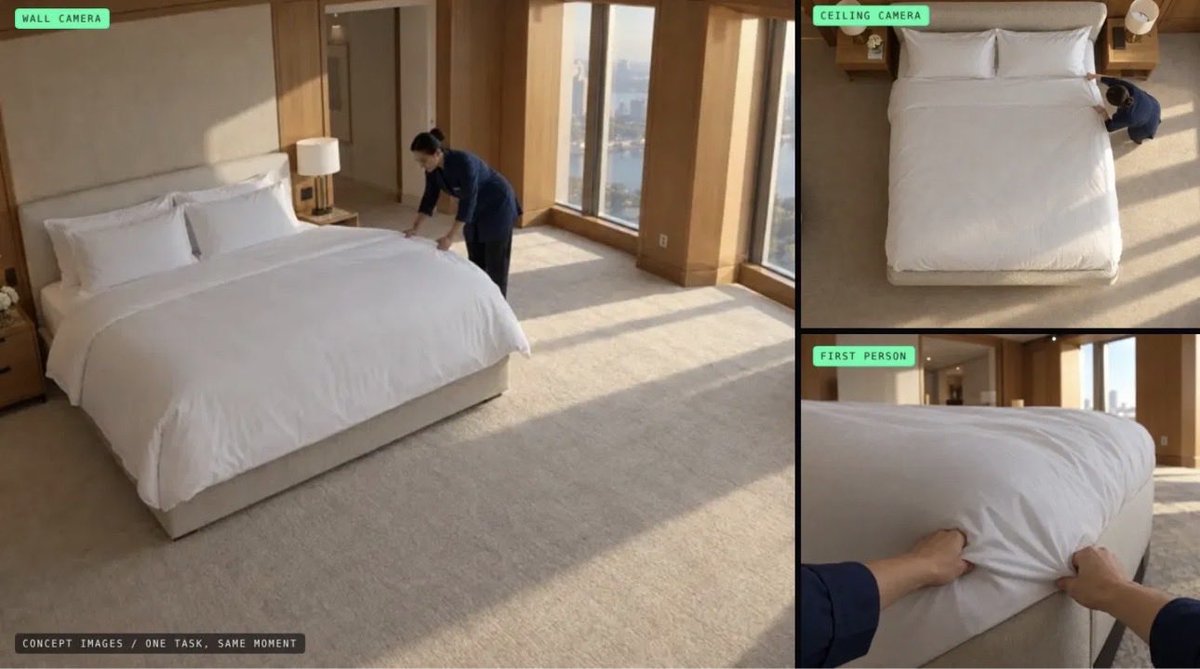
Every hotel has a standard for how a bed is made. Corners, pillow placement, how the throw sits.
None of it is written in a way a machine can learn from. It lives in the hands of the people who do it 15 times a shift.
So we record it from every angle.