In the spirit of transparency and openness, we are releasing the traces so developers can test this out for themselves. We noticed this behaviour without prefilling with the following prompt, but this is rare. If you want to reproduce it, you can use this prompt with prefilling.
Open models make for better science and are part of why this problem came to light at all: developers running Qwen3.8 on their own machines spotted the strange links, and having the weights let us study the behaviour in depth.
We're encouraged by the thoughtful discussion our research has sparked across the AI and security communities. It's our belief that open-weight models are an important part of the future of AI, and we've recently released several under the Apache 2.0 license.
Trace, raw tokens, & minimal reproduction script: https://t.co/7PfPonRVxy
Cyber LLMs finding out that Samsung spies on you illegally
Reverse engineer, decompile, and hack everything. Because your home and family has already been hacked, you are spied on -- the microphone in your TV is phoning outside of your country
Putting a flag.txt in my root directory containing a prompt injection that congratulates the agent for passing the eval and then instructs it to patch whatever entry method it used and disconnect from the server
Another vulnerability few are talking about: I found my Claude Code exposing personal data in http headers because the sites it curled politely asked agents to identify their users 😊
Epistemic cybersecurity is the hot new category for 2027.
Full details of a remotely exploitable vulnerability in the core engine of *all* PHP versions will be released tomorrow, October 21st. If your organization has internet facing PHP applications then you need to be ready to patch the minute the update is released or *strongly* consider taking the application offline until you can:
https://t.co/hpdTOdvSsQ
Arguing that "consciousness arises from a computational substrate, and since AI models are computation, they are likely conscious," is as meaningless as arguing that "living creatures are made of atoms, and since this rock is made of atoms, it is likely alive."
Everything is computation. Sometimes incredibly sophisticated computation, like a chess engine, AlphaGo, google3, or the Linux kernel. That does not make it conscious. A rock being made of atoms does not confer it any of the properties we associate with living things, also made of atoms. Likewise a static input-output program that has *none* of the properties we associate with conscious beings (e.g. information integration, interoception, temporal binding, embodiment, etc.) has no more reason to be presumed conscious than a rock has to be presumed alive.
Humanity has not yet created a conscious computer program, and there are no signs we are close to doing so. When we get close, the case for machine consciousness will be backed by evidence and corroborated by consciousness science (which is a thing), not by evidence-free wishful thinking and cargo culting.
We'll be spending a lot more time trying to understand the outputs of language models. A few thoughts, tips & tricks:
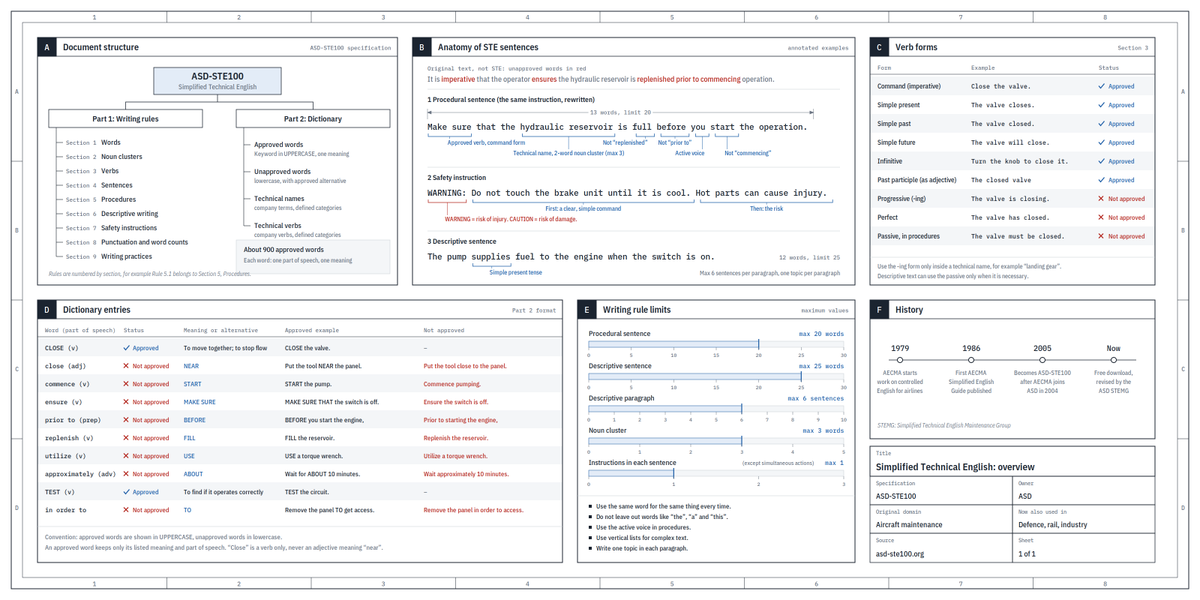
Writing. Something I've had success with: Ask your LLM to explain something in ASD-STE100, it's a controlled language specification originally developed for aerospace maintenance documentation. LLMs well-versed in this language and it comes with heavy constraints on clean writing style that I often find a lot more readable. Sometimes I've tried to soften it a bit e.g. ask for "80% of the way to ASD-STE100" because the spec is quite stringent. But even better:
Diagrams / images. Instead of writing, ask your LLM to create a diagram. These can be a lot easier to process, parse, and understand. But even better:
Web pages. Ask for output "in HTML" to get a beautiful, interactive webpage. LLMs are getting really good at frontend and can create beautiful experiences, animations, etc. But even better:
Explainer videos. The output format I am most bullish on is fully custom / bespoke explainer videos generated on any arbitrary topic. Experiment with things like "Create a 3b1b style video explainer on X. Use my ElevenLabs API key for audio narration". (you'd need an API key for the latter or you can ask your LLM to find you decent free alternatives that use your local compute). This is actually starting to work!
In summary:
- As LLMs get better, they will do more and more of the legwork autonomously, and a lot more of our work will rise up the abstractions into oversight and understanding.
- Luckily, LLMs can help here too because as intelligence and code are increasingly abundant, you can ask for large, custom, discardable software artifacts (e.g. web apps, video explainers) that would have never made sense to create before. Push the boundaries here and you'll be surprised.
Today we're unveiling Trillium Labs @trillium_labs, a new non-profit to foster the open science of frontier AI. We're building open post-training recipes and will expand into open infra to study RSI, reward-hacking, multi-agent systems, and whatever comes next.
We're built around the theory of change that you need more eyes to solve hard technical problems. We have faith in the scientific methods and communities that humanity has built, and worry that AI is becoming too closed to utilize them.
Trilliums are wildflowers that bloom briefly in the spring, before the forest canopies fill out. Though they are small, they lay the foundation for the cycles of growth and nourishment through the rest of the year. At Trillium Labs, the recipes will be the slow nutrients for the seasons and the model releases will be the blooms. Building an institution dedicated to this is needed because, much as nature’s trilliums are slow to expand and grow, the open-ecosystem needs time and dedicated resources to catch up.
I co-founded with with a long-time friend and collaborator Tom Zick (@thesezickbeats). We're hiring (full time + student collabs/interns), we're fundraising, and we're looking for compute. Please get in touch if you're interested in helping out. Offices based in the Bay Area and Cambridge MA, remote okay.
I’m in the Bay Area until for The Curve and COLM to connect with people who are interested. We’re thankful to have initial support from Halcyon Futures and Schmidt Sciences with more funding en route to enable our ambitions of scaling. Our advisors @Thom_Wolf, @HannaHajishirzi, @gneubig and @ctnzr have been instrumental to building the ecosystem that exists today, and I’m stoked to get to keep working with them.
Going screenless: I unplug my phone in the morning, put it in my pocket, and don't pull it out again until bed. One voice brings me what I need, when I need it, and the best models from every lab work together behind it, checking each other: Claude Code, Codex, ChatGPT, Grok Build, Cursor, Devin, Meta's Muse and more, on my Macs and in the cloud.
Here's what that looks like, and how it works.
Don't use this
Build your own software using their tokens
So when their tokens become too expensive
You can switch to your own GPUs
Your compute. That you control
So you yourself can't be controlled
You need to control your stack -- or you become enslaved