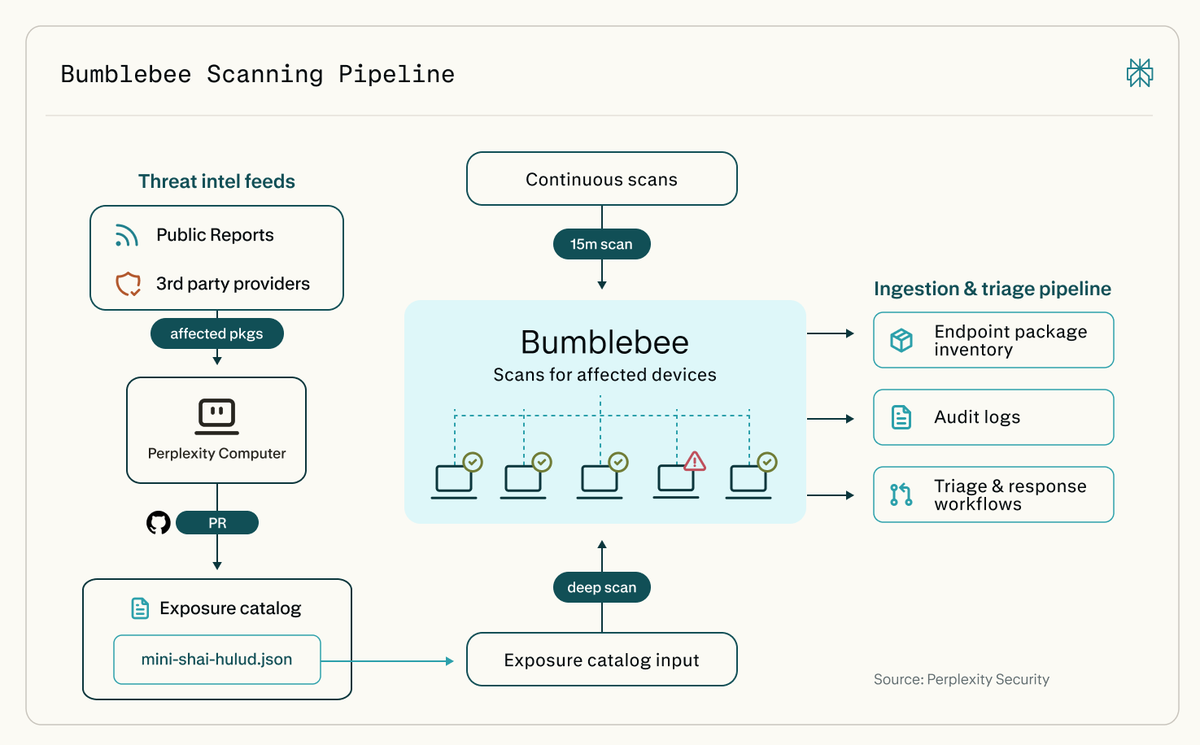
Today we're open-sourcing Bumblebee, a read-only scanner for macOS and Linux.
It checks developer machines for risky packages, extensions, and AI tool configs.
Connected to Computer, it can trigger deeper scans whenever a new supply-chain risk emerges.
https://t.co/FOaWnF1yQy
I am incredibly proud to announce that Cometh has been acquired by Kaiko !
When we started Cometh, our goal was to push the boundaries of #DeFi infrastructure and adoption, specifically focusing on smart contract wallets, account abstraction, and cross-chain integrations. We’ve had an amazing journey building these capabilities, and today marks a massive milestone for the entire team.
Why Kaiko?
For over 18 months, Cometh has been a trusted technical partner to Kaiko based on our products and regulatory standing. As institutional clients increasingly move their operations onchain, they already rely on Kaiko for market data, reference rates, and indices. By joining forces, Kaiko can now offer the data infrastructure layer institutions need to seamlessly execute in onchain markets from a single regulated provider. It’s a perfect synergy: data tells you what is happening while the infrastructure lets you act on it.
I have some personal news to share as well, following the acquisition, I will be transitioning out of the company to explore my next endeavors. I couldn’t be leaving our mission in better hands.
The Cometh leadership team notably with @vincentLg & @leo_wgr will remain securely in place, and the combined team is expected to grow. We will proudly operate under the Kaiko brand moving forward. There will be absolutely no changes to Cometh's existing commitments or service levels for our current clients.
I want to express my deepest gratitude to the incredible Cometh team and all the colleagues and contributors we met along the way, our clients, our investors for the trust they placed in us, and the wider #Ethereum community for your endless support. I am so excited to watch this combined entity thrive, delivering the ONLY European MiCA compliant offering that brings data quality, compliance, and onchain access into a single, unified stack.
Onwards!
Today, we share a breakthrough on the planar unit distance problem, a famous open question first posed by Paul Erdős in 1946.
For nearly 80 years, mathematicians believed the best possible solutions looked roughly like square grids.
An OpenAI model has now disproved that belief, discovering an entirely new family of constructions that performs better.
This marks the first time AI has autonomously solved a prominent open problem central to a field of mathematics.
We are offering grants of $100,000 + Tinker credits to researchers advancing the field of human-AI interactivity. Submit your proposals by June 19th!
https://t.co/907HfBy7g3
We’re adding new ways for people to identify AI-generated images and understand where they came from.
In addition to C2PA Content Credentials, images now also contain a SynthID watermark, and can be identified using a public verification tool to check whether an image was made by OpenAI products.
https://t.co/qo0l4vyWli
Let’s bring as much attention to the specific examples of AI’s benefit to humanity as we do to the risks. Some of my favorites are:
- @paul_conyngham utilized ChatGPT and @GoogleDeepMind’s Alphafold to develop a personalized mRNA cancer vaccine for his dog,
- @BeMyEyes launched an AI-based interface to help blind and visually impaired users describe images
- @boltz_bio used by more than 100,000 scientists across thousands of biotechs to accelerate drug discovery
- @chaidiscovery is transform biology from a scientific practice into an engineering discipline — faster drug discovery with one shot generation of drug candidates ready for IND-enabling studies
- @WFP uses AI to prevent food insecurity — many examples but one is after Hurricane Fiona, WFP was able to scan and analyse the imagery in hours, not weeks, to pinpoint the hardest-hit areas via a heat map and direct support.
- Robotic exoskeletons that help people walk
- @neuralink gives ALS patients the ability to communicate with their minds, potentially control robotic arms
I lived in Dubai for a year and Switzerland for 3 years, both insanely expensive and neither produces real founders
Dubai's status game is yachts and Lambos, so even ambitious people end up doing crypto rugs and dropshipping courses and larping on instagram
Switzerland's status game is respectable employment at UBS or Google, so smart people optimize for corporate promotions and not products (you need $25k to even incorporate), the goal is to make enough to never have to risk anything again + without a proof of salary you can not even rent
Bali and Thailand are kinda opposite, cheap, but the status game is lifestyle and freedommaxxing ("I work 4 hours from a beach")
I think SF respects shipping, NYC respects exits, China respects winning, and everything is built around that
Congratulations @OpenAI on the release of privacy filter!
It comes with day-0 support on MLX, now developers can run PII filtering and more completly on-device.
PR will be merged in a couple minutes 🚀
i just want to take this quiet moment before the release to directly thank sam altman.
but for him.
these models would exist and you would not know they exist.
google didn’t want to launch, anthropic didn’t want to and now wall off their best models.
the safest path is for us all to have them.
thanks sammy.
🥔
OpenAI open-sourced a privacy filter.
Ported it to MLX: 24-33x faster on Apple Silicon.
Fine-tuning it for medical labels (HIPAA/GDPR + MRN, SUS, NHS, NPI, CPF).
Shipping to OpenMedKit, iOS/Swift, fully on-device. Soon!
just saw OpenAI Privacy Filter (2026) today and it gave me BiLSTM-CRF (2016) nostalgia. the decoding stack is identical: BIOES tagging → linear-chain CRF → Viterbi like ten years ago. what changed:
• char CNN + GloVe → BPE tokenizer
• biLSTM → MoE Transformer
kind of beautiful that the right abstraction from 2016 is still load-bearing in 2026.