In the just lauched Open Encyclopedia of Cognitive Science (https://t.co/dxB0W9GlzB), our (Nicolas Claidière and me) short article on Cultural Attractors https://t.co/w4aErb5Mgp
Open Encylopedia of Cognitive Science | A new, multidisciplinary guide to understanding the mind: a freely-available, growing collection of peer-reviewed articles introducing key topics to a broad audience of students and scholars. https://t.co/cOYqk5A8Qg
Very nice systematic review related to interventions targetting the social determinants of mental health.
From @JayDasMunshi @MatthewHotopf et al. @KingsIoPPN
Psychological Medicine @CambUP_Psych
PMID: 38523245
DOI: 10.1017/S0033291724000333
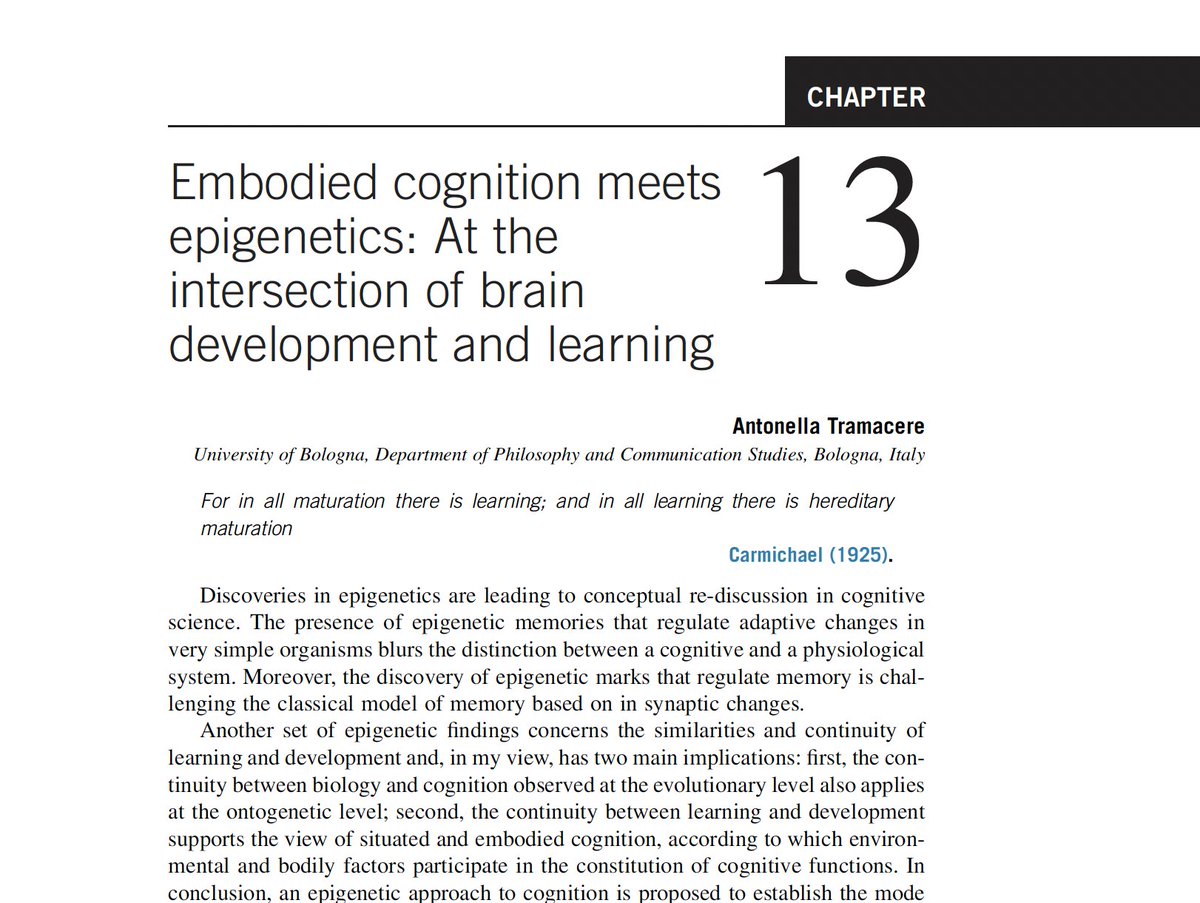
On Epigenetics and Evolution is finally out, where you can find my chapter ‘Embodied Cognition meets Epigenetics’, in which I argue that neuroepigenetics supports the idea that learning is like organ development and body development like learning new skills. DM to have it!
this clip of me talking about AI consciousness seems to have gone wide. it's from a @worldscifest panel where @bgreene asked for "yes or no" opinions (not arguments!) on the issue. if i were to turn the opinion into an argument, it might go something like this:
(1) biology can support consciousness.
(2) biology and silicon aren't relevantly different in principle [such that one can support consciousness and the other not].
therefore:
(3) silicon can support consciousness in principle.
note that this simple argument isn't at all original -- some version of it can probably be found in putnam, turing, or earlier. note also that the (controversial!) claim that the brain is a machine (which comes down to what one means by "machine") plays no essential role in the argument.
of course reasonable people can disagree about the premises!
perhaps the key premise is (2) and it requires support. one way to support it is to go through various candidates for a relevant principled difference between biology and silicon and argue that none of them are plausible. another way is through the neuromorphic replacement argument that i discuss later in the same conversation.
some see a tension between (1)/(3) and the hard problem. but there's not much tension: one can simultaneously allow that brains support consciousness and observe that there's an explanatory gap between the two that may take new principles to bridge. the same goes for AI systems.
this isn't a change of mind: i've argued for the possibility of AI consciousness since the 1990s. my 1994 talk on the hard problem (https://t.co/3ZpalLEABk) outlined an "organizational invariance" principle that tends to support AI consciousness. you can find versions of the two strategies above for arguing for premise 2 in chapters 6 and 7 of my 1996 book "the conscious mind".
i'm not suggesting that current AI systems are conscious. but in a separate article on the possibility of consciousness in language models (https://t.co/wMbzub55OT), i've made a related argument that within ten years or so, we may well have systems that are serious candidates for consciousness.
the strategy in that article on LLM consciousness is analogous to the first strategy above in arguing for AI consciousness more generally. i go through the most plausible obstacles to consciousness in language models, and i argue that even if these obstacles exclude consciousness in current systems, they may well be overcome in a decade.
of course none of this is certain. but i think AI consciousness is something we have to take seriously.
[the full conversation with @bgreene and @anilkseth can be found at https://t.co/AyVxxH3Izs]
A pocos minutos del cierre de urnas en México, Claudia Sheinbaum será sin duda la próxima presidenta de México, por una amplia ventaja, que también representa un merecido reconocimiento al presidente López Obrador.
¡Viva Claudia!
¡Viva México!
¡Viva Latinoamérica!
Special issue of Neuron @NeuroCellPress on consciousness, including a Neuroview piece by Claudia Passos Ferreira @cpassosf on infant consciousness.
infant consciousness article: https://t.co/bJmXjgrfsb
special issue on consciousness: https://t.co/JEHMrqSr5r
"This is a very important book that has the potential to become a classic text."
@ScienceMagazine reviews "The Blind Spot" by @AdamFrank4, @MGleiser, and @evantthompson: https://t.co/tnD6QuKQIl
Brains Are Not Required When It Comes to Thinking and Solving Problems--Simple Cells Can Do It | Scientific American
It’s time for the mind/ body dualism reminiscences to be reconsidered
https://t.co/Hm0NSj3WvW @drmichaellevin & team https://t.co/w6FBaoEPm8
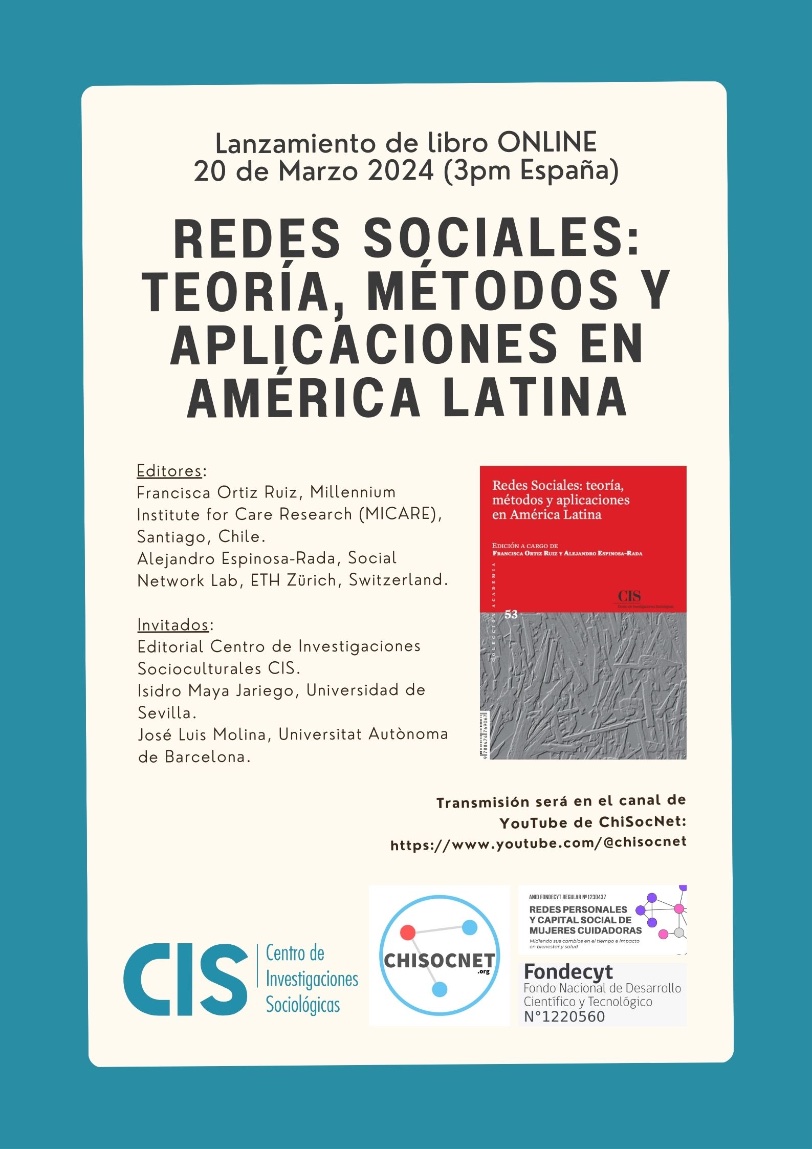
¡Tenemos fecha de lanzamiento!🌟
El 20.03.24 lanzaremos el libro online en @chisocnet YouTube en el link https://t.co/0R6ShSB9kk
Ambos editores @aespinosarada contaremos sobre el libro, además de contar con @molinajlmg y @isidromj quienes escribieron el prologo! @lista_redes