Very happy and honored to present our work from my postdoc project in @DaanNoordermeer lab @I2BCParisSaclay on CTCF clustering at TAD boundaries and the novel multi-contact 3C assay: Nano-C – now published @NatureComms.
https://t.co/6l1d6ID0PL.
A nice 🧵 written by Daan 👇
Nested epistasis enhancer networks for robust genome regulation https://t.co/VGaqGPLq3l
This research between our lab, Keji Zhao (NIH), Wing Wong (Stanford), reveals an epistasis enhancer network for gene expression robustness, and predicting non-coding genome in disease risk.
SPOTLIGHT ALERT! Here our take written with @Eileen_Furlong on a recent study from the @stark_lab - By exploiting functional genomics, enhancers can be classified based on their cofactor dependencies - a step towards disentangling enhancer logic? https://t.co/sbsUuAgTfH
You know CRISPR complexes can cut DNA/RNA….what if some of them cleaved proteins too?
Today in @biorxivpreprint, we (+ @omarabudayyeh@hnisimasu) continue our study of Cas7-11 and type III-E systems, revealing a new triggered protease function
https://t.co/MJEm3OZx49 1/6
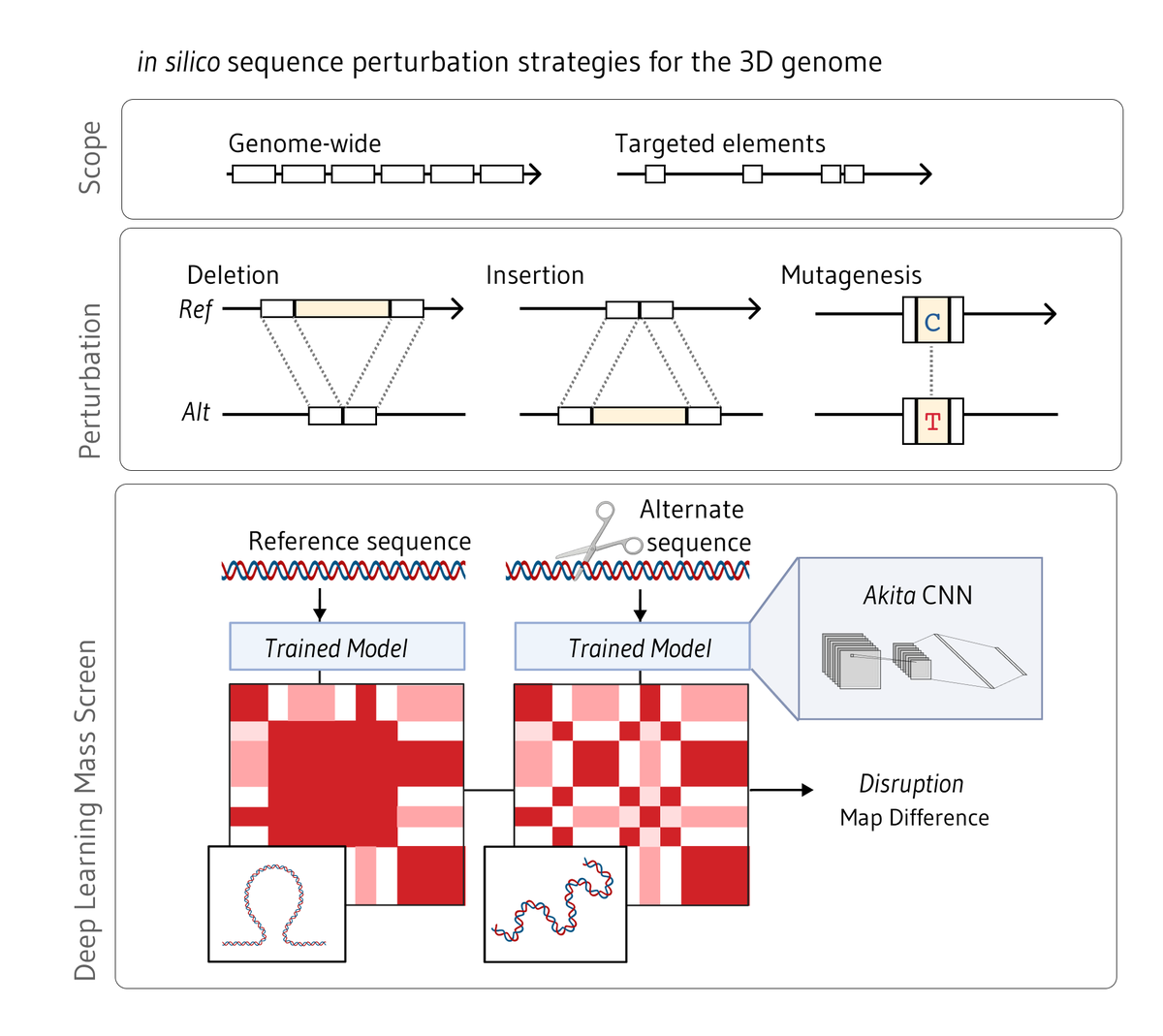
Excited to share our work developing experimental strategies for deep learning models to decipher how DNA sequence informs 3D genome folding! Our study points to understudied links between repetitive elements and chromatin organization. Link: https://t.co/CtcU7EbjMS (1/12)
@bradloncar@megtirrell Let me add this astonishing bit of clinical data - the first two pediatric subjects gene-edited for the most prevalent genetic disease on Earth.
From a clinical outcome perspective this is not merely an "eagle" (in golf parlance). It's a soaring eagle.
https://t.co/H6TGkaTtpP
Nearly 9 out of 10 genomics studies were conducted with people of European ancestry, despite constituting only 16% of the world’s population. The few studies that include ethnic minorities have been performed mostly on ethnic communities living abroad
https://t.co/DvoRjG8TtU
SEND is a novel concept of delivering mRNA into cells, published by @zhangf https://t.co/sYJnHakWNq. In our @NatureProtocols article https://t.co/8h2fMbMu2H, we discuss conceptual ideas of testing & researching SEND system in mice.
A short tweetorial about SEND & our article 1/7
Immune NLR genes are conserved in bacteria and provide protection against phage. An incredible study.
These bacterial NLRs recognize PAMPs that are conserved between phages and herpes viruses!
https://t.co/0HeB1qkX1Y
Today we share in @NatureProtocols detailed strategy and experimental procedures for designing and executing prime editing (and twinPE) experiments in mammalian cells. Congrats Jordan, @AlexanderASousa, Peyton, and @PeterJ_Chen for this thorough analysis.
https://t.co/ZlsYqaVud1
Kim et al. used prime editing to correct a mutation in dogs that causes hip dysplasia. Fibroblasts from a Labrador retriever with HD were fixed by PE➡️somatic cell nuclear transfer➡️implant embryos into surrogate mom➡️gene-corrected dogs. No off-target edits at predicted sites.
Today we report in @natBME the development of a suite of adenine based editors (ABEs) that are small enough to each fit, together with a guide RNA & all needed regulatory elements, into a single AAV to support efficient base editing in animals. 1/4
https://t.co/PLGg1b2Oce
This suite of single-AAV ABEs collectively cover enough PAM space (N3RRT, N4CC, N3VRYAC, NNGG) to place >80% of A-T base pairs in the human genome into at least one base editor’s activity window. 2/4
DeepMind and EMBL-EBI have released the predicted structures of over 200 million proteins covering almost every organism that has had its genome sequenced.
These are now openly available to the scientific community via the AlphaFold Database.
https://t.co/UJkeBoiml3
I’m excited to introduce our Retro-Cascorder, out today in @Nature! This molecular device logs barcoded receipts of gene expression in a temporal genomic ledger. Sequence the ledger --> recover the history of gene expression. https://t.co/aGkyUbRBJW
Excited to share my group's first pre-print from the @MRC_WIMM. We screened ~7000 genes for their roles in blood stem cell differentiation in vivo: https://t.co/YWvSL6YeCX
We also made a webapp resource so you can search for your favourite genes: https://t.co/LwZRIK69yl
1/3
Delighted to share my lab’s @jdavieslab first big paper in @Nature!
We’ve developed a new 3C technique called Micro Capture-C that can generate base pair resolution 3C data https://t.co/Mgr26d2bTE