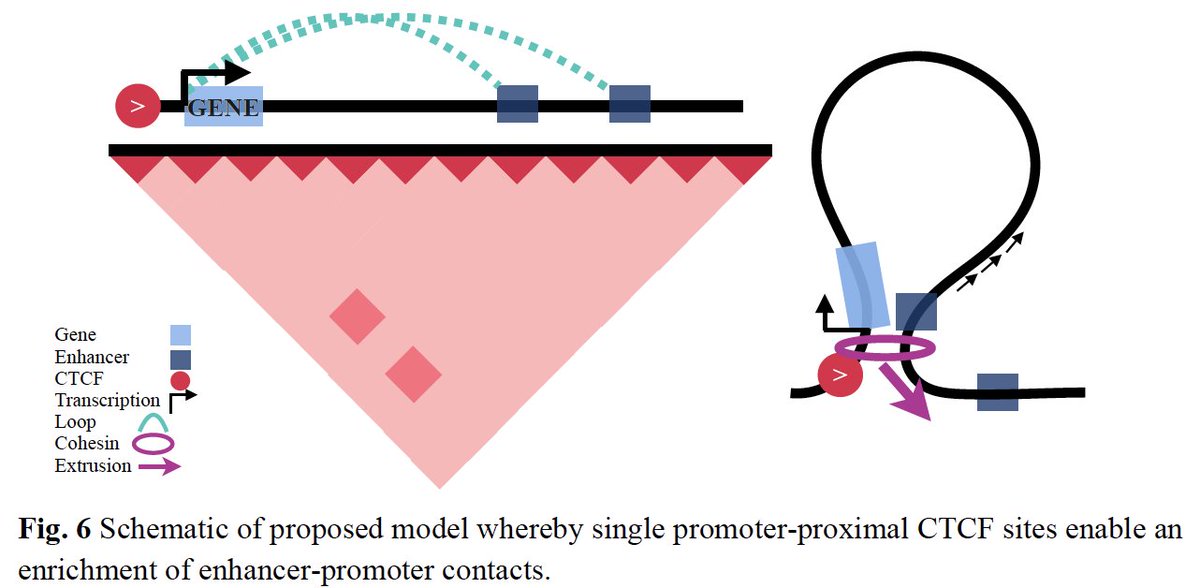
Very happy and honored to present our work from my postdoc project in @DaanNoordermeer lab @I2BCParisSaclay on CTCF clustering at TAD boundaries and the novel multi-contact 3C assay: Nano-C – now published @NatureComms.
https://t.co/6l1d6ID0PL.
A nice 🧵 written by Daan 👇
First preprint from the lab 🚨
How can enhancers regulate target promoters across vast genomic distances, and what is the role of cohesin loop extrusion in the process?
https://t.co/l7bwPsTSkd
(1)
Enjoy the weekend, and we’ll see you bright and early at 9:30 AM EST on Monday to kick off #chromatin2024! Fantastic lineup of speakers with discussion to follow each talk. Don’t forget to register if you haven’t yet: https://t.co/xHZSamYZuq
I am happy to share our new preprint!📢
We reviewed, the latest advances in bacterial chromosome organization and discussed the principles of chromosome folding that can be inferred from them
https://t.co/flGeSxR5sH
#GenomeBiologyI2BC@I2BCParisSaclay
I'm very happy to see my review on MLL leukemias and enhancer function published in a special issue of Current Opinion in Genetics & Development.
Chromatin and aberrant enhancer activity in KMT2A rearranged acute lym... https://t.co/GQTvUJtoUe
Check out our new tool: HiCrayon! It's a simple but powerful way of visualizing the overlap between 2D contact maps from Hi-C, Micro-C, etc. and 1D genomics data, such as ChIP-seq and compartment annotations. On BioRxiv and GitHub.
https://t.co/uw0pG3FwHm
https://t.co/crNbFuVQRD
Our work using single-molecule chromatin configurations to link TF binding to gene expression is now out on bioRxiv! Amazing effort from @bgrdoughty, @MichaelaThinks, and @juliaschaepe, and an immensely rewarding collaboration with the @BintuLab: https://t.co/u9aNQV4Ub9 [1/n]
You're invited to come find new science friends! Come join us for a science meet and greet- speed dating style! Learn about your fellow RDM scientists and maybe, find a collab match! Love not guaranteed 😅 Feb 15th at OCDEM. Registration QR below @RDMOxford
Very happy to see our last paper of 2023 is out:
The loci of many genes with redundant function (including paralogs) are in close proximity in 3D #Chromatin_loops. We show that such gene-gene loops often involve genes that cross-regulate each other’s expression.
1/4
Gene expression involves thousands of proteins that bind DNA, yet comprehensively mapping these is challenging. We developed ChIP-DIP – a method for simultaneous, genome-wide mapping of hundreds of DNA-protein interactions in a single experiment. https://t.co/NEH92mQTGs
NEW: Researchers from the Laboratory of Gene Regulation, led by @MiraKassouf & Doug Higgs, have identified a new type of non-coding DNA that helps to explain how our DNA is read. 👓🧬
Published today in Cell (@CellCellPress)!
Read the full story here: https://t.co/E6oTmmEBqh
How do "molecular motors" fold the genome?
A new #SciencePerspective looks at insights that are starting to yield an understanding of the mechanism by which these motors extrude loops of #DNA to structure genomes. https://t.co/RWXo0FfvQw
Exciting times #AI & genomics, gene prediction field, great collab with @stark_lab. Using transfer deep learning to make completely synthetic enhancers with predicted activity (tissue and stage in embryos). Check out the back-to-back complementary lovely paper from @steinaerts
Have you ever wondered which methods are out there to culture haematopoietic stem cells? Here we review progress and challenges facing the field today! https://t.co/VXffqpBjqc
@awilkinsongroup@MRC_WIMM#exphem#hsc
Interesting new from Corri Sept @MartinAryee et al. combines MNase HiChIP for CTCF with new FactorFinder algorithm to profile 3D interactions conditional on CTCF being bound.
Nice insights in loop extrusion from the perspective of CTCF-anchored cohesin
https://t.co/PYKiDKblYE
👉 Looking for a portable, high-throughput and out-of-the-box pipeline for basic processing and visualisation of your bulk ATAC-seq and ChIP-seq data? Look no further!
https://t.co/YSWghXC8BH
@SimoneGRiva10
@EmilyGeorgiade5
@ozturkravzae
Our new work asks which genomic elements are capable of setting up cell type-specific regulatory domains? Using analysis of natural variation combined with synthetic biology we show enhancers are both necessary and sufficient for their formation. https://t.co/V6GyyHbmfV
Our paper is out, Bravo and thanks to all the contributors!!👏👏
Take home: after DSB induction, gH2AX domains self-segregate to form a new chromatin compartment, in which some DDR genes also physically relocate to potentiate their expression.
https://t.co/laHCIJTBX9