#BitcoinSV - the ultimate Mooncoin
Teranode now live on Mainnet. See Pinned Post for a News Statement regarding BSV Transaction capability - from Amazon AWS.
@bsvdrip LocalBitcoin, an Exchange, an On/Off Ramp, DEX Swap. BSV to me is money. I don't do wierd MetaWhatsy Apps. I buy gas, groceries, services, cool gadgets, land, etc. I just want the Network effect that we deserve. Next thing is a Newspaper.
@cryptorebel_SV Note: I have no issues with black/colored people.
I have a problem with thugs, arrogant aholes, weak people, woke people. and people like Ty/Babbage that do all this BS Virtue Signalling. It's BSV, not BSVirtual Signalling. Weak, whining jerk. Really starting to hate this guy.
@cryptorebel_SV Ty's post reminds me of a Woke Video I saw during the George Floyd era. Some Black Thugs sitting in chairs on a little platform in the streets of NY, forcing White Women to kneel and kiss their hands. Interviewed, the women shook nervously and said it was their duty to equality.
@cryptorebel_SV Your story is flawed. In the real version, Mr nChain dies, and it is handed over to Mr TeranodeGroup, and then he dies, and it is again passed along, this time split between Mr NeoBridge, and Ms VP Management Global AG. And I am not really sure if you're trespassing or not. Maybe
@cryptorebel_SV BTC Core started by forcing @gavinandresen out. BCH got forked because @deadalnix had to have his own way.
Ty (@ProjectBabbage) is continuing on this path. His latest BRC-234 Proposal is a manipulative attempt at dividing BSV, and forcing a chain split.
https://t.co/TEejgFzaZK
💡💡Ahh Haa Moment!!
Ty is a devisive, manipulative, spoiled brat, pot-stirring POS. He's almost guaranteeing another Fork, but I think that's his goal at this point.
Like @deadalnix he wants to force the community to adopt his approach.
https://t.co/TEejgFzaZK
@cryptorebel_SV
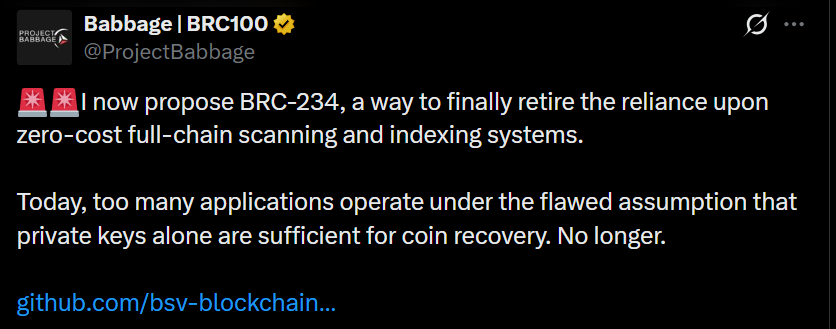
🚨🚨I now propose BRC-234, a way to finally retire the reliance upon zero-cost full-chain scanning and indexing systems.
Today, too many applications operate under the flawed assumption that private keys alone are sufficient for coin recovery. No longer.
https://t.co/iU0gy4f2at
Might as well tag a few more people for distribution, and consideration. Devs & Influencers.
https://t.co/8d0tQSip7S
I think this is becoming a Big Deal that is dividing hte community and injecting uneccessary fear into average Users. Nobody knows who to believe. I believe need recognizable and trusted members of the community to step up and provide clrifying facts in easy to understand language. This is not an attack on BRC-100 Apps & Wallets. It is a pleas for clarity regarding the marketing claims that Only BRC-100 Scales, and whether all other wallets will break.
@BitcoinSVtrain@kurtwuckertjr@Bitcoin_Beyond@CsTominaga@BSVSearch@Crypt0Spartacus@imablackwolf@murphsicles@RebeccaLiggero@RealCoinGeek@bethebroadcast@shruggr@BitcoinSVCOL@ElectroneumBel1
The real answer to this poll.. is people like @ProjectBabbage & @LightBSV gaslighting & dividing the community. Both of them SHOULD NEVER TALK, and honestly if they developed on another chain I wouldn't mind. Both are Arrogant, Insufferable know-it-alls.
https://t.co/uM26h3px6R
This week a little radio handset paying Bitcoin with no internet reached people on every side of the Bitcoin split. BTC accounts explained it fairly, credited the work, and said plainly it was BSV. That's how it should be.
Here is what struck me. The idea underneath doesn't belong to any one chain. A signed transaction is just a signed transaction. A radio carries it the same way whether it's BTC, BSV or BCH. The relay can't change it on any of them. The person paying holds their own key on all of them.
We have spent years arguing about whose Bitcoin is the real one, while the thing that matters to ordinary people is slipping away: money they control, that still works when the network, the bank or the power does not.
So I'd ask the three camps to stop treating each other as the enemy. Compare honestly, keep your differences, and build together on the part we share, sovereign money that works offline, by radio, at the edges, for people who will never read a white paper.
The code for the radio payments is on chain, open for anyone to build on, on any chain. If you can make it work on yours, do it, and show us.
#BSV
#BTC
#BCH
https://t.co/MfQe4hv06v
@SmilaZParadis@WuTao2023@Bitcoin_Beyond Good point. Wutao gone a bit Wackao lately! You should catch some of his AI fueled rants. Spectacularly nuts :) I wonder if the account got hacked.
I want to address some of the common responses to this I've seen.
The biggest misconception about Bitcoin: “It isn’t real until it’s confirmed.”
Yesterday someone sent a transaction over a handheld radio with no internet and no phone signal. The pushback came straight away: “It doesn’t count until it settles on the blockchain.”
That objection gets something basic wrong about how commerce works, and about how Bitcoin was designed.
Accepting a payment and settling it were never the same thing.
When a shop takes a cheque, the money hasn’t moved yet. Card payments settle days later and can be reversed months later. Merchants accept them anyway, because commerce has never run on certainty. It runs on managed risk. The whitepaper says so in its first paragraph: under the existing system, “a certain percentage of fraud is accepted as unavoidable.”
Satoshi answered this in 2010.
In the “Bitcoin snack machine (fast transaction problem)” thread, he described accepting payments in seconds with “good-enough” checking. When someone pushed back, he wrote: “I didn’t say impermeable, I said good-enough,” and said the loss in practice would be “far lower than with credit cards.” He wasn’t selling a technical utopia. He was describing how real businesses work.
What the merchant actually knows offline
With Bitcoin (BSV), the customer presents the transaction along with Merkle proofs for its inputs. The merchant checks those against block headers stored on their own device. No internet is needed. In seconds they know the coins exist, they’re in the chain, and the signatures are valid.
The only remaining risk is a double-spend. Think about what that means in a physical shop. The customer is standing at your counter, on your cameras, buying something in person. Double-spending you there isn’t a clever attack on the protocol. It’s fraud, it’s a crime, and you know who did it. That’s exactly the same protection that kept cheques working for a century.
Confirmations are a dial the merchant sets, not a rule the network imposes.
Section 11 of the whitepaper works out double-spend probability as a function of how many blocks you wait. That only makes sense if the recipient chooses how long to wait. So:
- A coffee or a bus fare: accept it instantly.
- A laptop: maybe wait for the network to see it.
- A car: wait for confirmations before you hand over the keys.
Same protocol, different decisions, because the economics are different.
Where the misconception came from
Many people believe “Bitcoin needs confirmations” because BTC changed its relay policy so that unconfirmed transactions can be replaced (Replace-By-Fee). Once replacement became the norm, zero-confirmation payments stopped being trustworthy there, and a generation of users learned that waiting for blocks was the only safe option. That was a policy choice, not part of Bitcoin’s design. BSV kept the original first-seen rule, so the payment that reaches the network first is the one that counts.
The bottom line
Bitcoin was built for the real world, where there are laws, identities, cameras, reputations and courts. It was never meant to replace all of that with block confirmations. It was meant to make payments cheap, instant and final enough for the risk involved.
Offline payments on BSV aren’t a workaround. They’re the system working as Satoshi described it.
@ProjectBabbage Why do I get the feeling this is a passive-aggressive suggestion for others that disagree w/YOUR approach rather than an honest statement of introspection?
Or is this you admitting the possibility that YOUR approach to shoving "The Standard" on all others is misguided & arrogant?
@cryptorebel_SV@mohrt It is an interesting approach. I don't disagree with you. But I think it is a long shot for the reasons I mentioned. I also think it gets convoluted over time, as coins move.
I admit I don't understand the process. Is it a 1-time taint that dies, or is it permanent attachment?
@cryptorebel_SV@mohrt I think we're increasingly entering a time where law doesn't matter. If an entity has power to do something, & the cost to challenge/reverse it is too costly or time consuming (courts can drag sh!t out years - while you are actively harmed) then the law efectively doesn't matter.
@cryptorebel_SV@mohrt I agree. Unfortunately you can sue a Ham sandwich and accuse it of being Roast Beef even if it isn't. Or Revoke, and force you to legally do the legwork to reverse. Power corrupts.
And again, use case matters. Simple Taint - maybe not. Block the coins as payment - more likely.