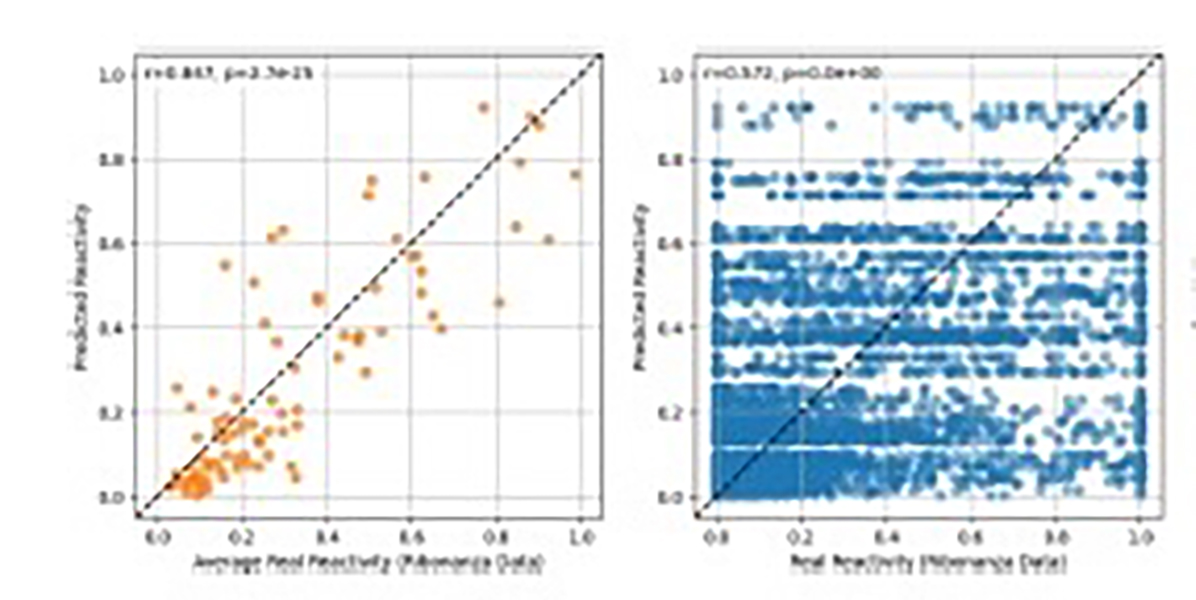
One of my major postdoc work paper out: Machine learning-based identification of general transcriptional predictors for plant disease
https://t.co/4KukB0SVWI
10 WEBSITES EVERY STUDENT SHOULD USE BEFORE GRADUATION.
Bookmark every single one. Your university will never tell you about most of these.
1. https://t.co/bpj7wp3QiY
Upload every textbook, lecture, and PDF for a course. Ask questions across all of them. Built by Google DeepMind.
2. https://t.co/JNZLwFHP1O
Search scientific research fast. Ask any question and get answers with links to relevant papers in seconds.
3. https://t.co/TQwOI9NqWn
The world's largest open library. Almost any textbook your professor assigned is on here for free.
4. https://t.co/QX6zTNmvWv
Research assistant that cites every source. Replaces 90% of Google searches for academic work.
5. https://t.co/1Qggp0qemz
Free reference manager that builds your bibliography automatically. Saves 20+ hours per semester.
6. https://t.co/NmzOmyDjOJ
Solves math, physics, chemistry, and engineering problems step by step. Shows the full working.
7. https://t.co/mbfkzEXIVW
The job platform built specifically for students. 1.4 million employers actively recruiting on it right now.
8. https://t.co/sDPgnL9aHW
Matches you to scholarships you actually qualify for. Over $3.4 billion awarded to students every year.
9. https://t.co/8OU64RkJ7f
Free Barbara Oakley course taken by 4 million people. The science of how to actually study and remember.
10. https://t.co/AKz109nRUx
Free with most university logins. 16,000+ courses on everything from Excel to AI engineering.
The students who graduate with the biggest head start are not smarter. They just found the right tools earlier.
The most provocative part of this article is not that multitasking destroys focus. Deep down, we already knew that.
The truly provocative part is this: modern companies have turned damaged attention into a work ethic.
If you reply instantly, you are “agile.” If you keep ten channels open, you are “engaged.” If you constantly interrupt your own thinking, you are a “team player.”
And then everyone wonders why people can no longer think deeply.
Maybe the real problem is not that employees do not know how to focus. Maybe the problem is that organizations have learned to punish focus and reward fragmented attention.
A Stanford professor spent years trying to prove that people who multitask the most are the best at it. He tested 262 students and found the exact opposite. It was the most embarrassing result of his career.
His name was Clifford Nass.
He had spent decades at Stanford studying how humans interact with technology, and by 2009 he was certain he knew what the results would show before the study even started.
He was wrong about everything.
Nass and his colleagues divided 262 Stanford students into two groups: heavy media multitaskers and light media multitaskers.
People who regularly juggled email, texts, multiple browser tabs, music, and TV simultaneously versus people who mostly did one thing at a time.
The assumption going in was obvious. Heavy multitaskers must have built some kind of superpower. Their brains had been training under constant load for years. They should be faster at switching between tasks, better at filtering out irrelevant information, sharper at holding things in working memory.
They tested all three.
Memory first.
Students were shown sequences of letters and asked to identify when a letter was repeating. The heavy multitaskers did worse and kept getting worse the further they went. The more they had multitasked in real life, the less their brain could hold in the moment.
Filtering second.
Students were shown a grid of red and blue rectangles, which disappeared, and were asked whether any of the red ones had moved. The instruction was clear: ignore the blue ones. The light multitaskers had no problem. The heavy multitaskers could not stop looking at the blue rectangles. They were pulled toward irrelevant information even when explicitly told to ignore it.
Task switching third.
This was the one that ended the argument. Researchers expected that if heavy multitaskers were better at anything, it would be moving between tasks quickly. That is the entire premise of multitasking as a skill. But the heavy multitaskers were dramatically slower and less accurate at switching than people who barely multitasked at all.
Nass described it in the words he would repeat for the rest of his life.
They are suckers for irrelevancy. Everything distracts them.
He went looking for what multitaskers were better at. He found nothing. Not one thing.
What he had discovered was the opposite of what everyone believed. Multitasking is not a skill that improves with practice. It is a habit that degrades the very machinery you need to think. The more you do it, the worse your brain gets at focusing when you finally try.
5 years later, neuroscientists at the University of Sussex put 75 adults in an MRI machine. They measured how often each person used multiple screens simultaneously and then looked at their brain structure.
The heavy media multitaskers had less grey matter density in the anterior cingulate cortex. That is the region responsible for attention, impulse control, and decision-making. Not weaker activation. Less physical tissue. The damage was structural, written into the architecture of the brain itself.
Nass had been warning companies about this for years. In 2012 he stood in front of a room of executives and told them that forcing employees to multitask was not a productivity strategy.
It was a brain safety problem. He used the exact words: OSHA problem. The same language you use when a factory floor is injuring workers.
Nobody changed anything.
The notifications stayed on. The open-plan offices stayed open. The Slack channels kept pinging. The expectation that a good employee responds to everything immediately and handles ten things at once stayed exactly where it was.
Clifford Nass died in November 2013 at 55, collapsing after a hike near Lake Tahoe. He had spent his entire career measuring what constant switching was doing to the human brain. The world listened politely and went back to checking its phone.
A psychiatrist in London had found something related a few years earlier. He gave IQ tests to workers while emails and phone notifications arrived in the background. Their scores dropped 10 points. More than the drop from smoking marijuana. More than missing a full night of sleep. The distraction did not just interrupt the work. It made people measurably less intelligent while it was happening.
Most people read that and laughed and went back to their inbox.
Gloria Mark at the University of California spent years tracking how long office workers actually stayed on one task before something pulled them away. The average was three minutes. And after each interruption, it took 23 minutes and 15 seconds to fully return to the depth of focus they had before.
Do that math across a normal workday and you arrive somewhere most people would rather not look at directly.
You are not bad at focusing. You have been practicing the wrong thing for years, inside systems designed to fragment your attention, and you have been rewarded for it the whole time.
The heavy multitaskers in Nass's study were not careless. They were the ones who said yes to everything, responded to everyone, kept every channel open. They were doing exactly what modern work asked of them.
And their brains were paying for it in ways nobody could see from the outside, until someone put them in a scanner.
The one thing that will not fix this is trying harder to focus while the notifications are still on.
Nass knew that. He said it out loud for years.
The people who would not listen are still sitting in open offices with 14 tabs open wondering why they cannot think straight after lunch.
20 years of plant biology in one chart. We asked: which techniques rose, which faded (source, Plant Cell)?
RNA-seq: 0.3% → 34% (≈100×). CRISPR: 0 → 21%. Northern blot, microarray, RT-PCR: collapsed. Western, qPCR, confocal: still everywhere.
#PlantBiology
@nanransohoff We're hiring proteomics, functional genomics and cell biologists (levels flexible): https://t.co/f6VK2FKQty
Not sure if these are quite the right fit? Reach out at [email protected]
Exercise does far more than build strength or endurance—it activates molecular pathways that help regenerate muscle, heart, and brain tissue.
Understanding these signals could pave the way for “exercise mimetics” that bring regenerative benefits to those unable to exercise. 🧬🏃 #Exercise #RegenerativeMedicine #HealthyAging @WuTsaiAlliance
https://t.co/wRNNzt084y
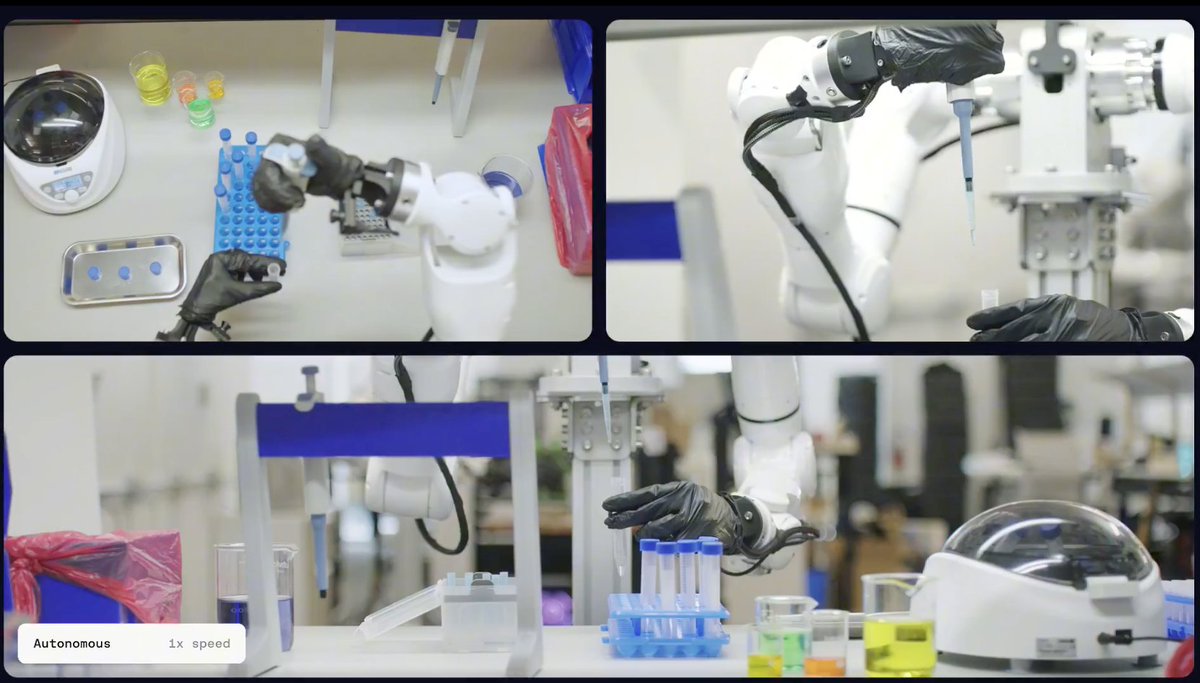
The papers detail Google Co-Scientist, FutureHouse’s research agent for lab-in-the-loop discovery, and Google’s ERA for scientific software search.
Different pieces of science that are now being turned into software for:
☑️ hypothesis generation.
☑️ experiment choice.
☑️ data analysis.
☑️ scientific code.
For life-science researchers, this means a wave of cool new tools - and questions about what the human role becomes when discovery increasingly comes from machines. (2/6)
It’s undeniable: the AI scientists are here.
On May 19, Nature published three papers that gave the field one of those “something just changed forever” moments.
Here’s what you need to know. 🧵 (1/6)
Your brain is not shaped by a single decision. It is shaped by thousands of exposures accumulating across decades.
Every night of poor sleep.
Every chronic stress cycle.
Every city you lived in.
Every relationship.
Every hormone fluctuation.
Every period of cognitive overload.
Neuroscience now refers to this as the exposome.
The total environmental and biological load acting on your brain across your lifespan.
What most people experience as “intuition” or “mental sharpness” is often the visible output of invisible exposures interacting with neural architecture for decades before the moment arrives.
Your cognitive performance did not emerge in isolation.
It was built.
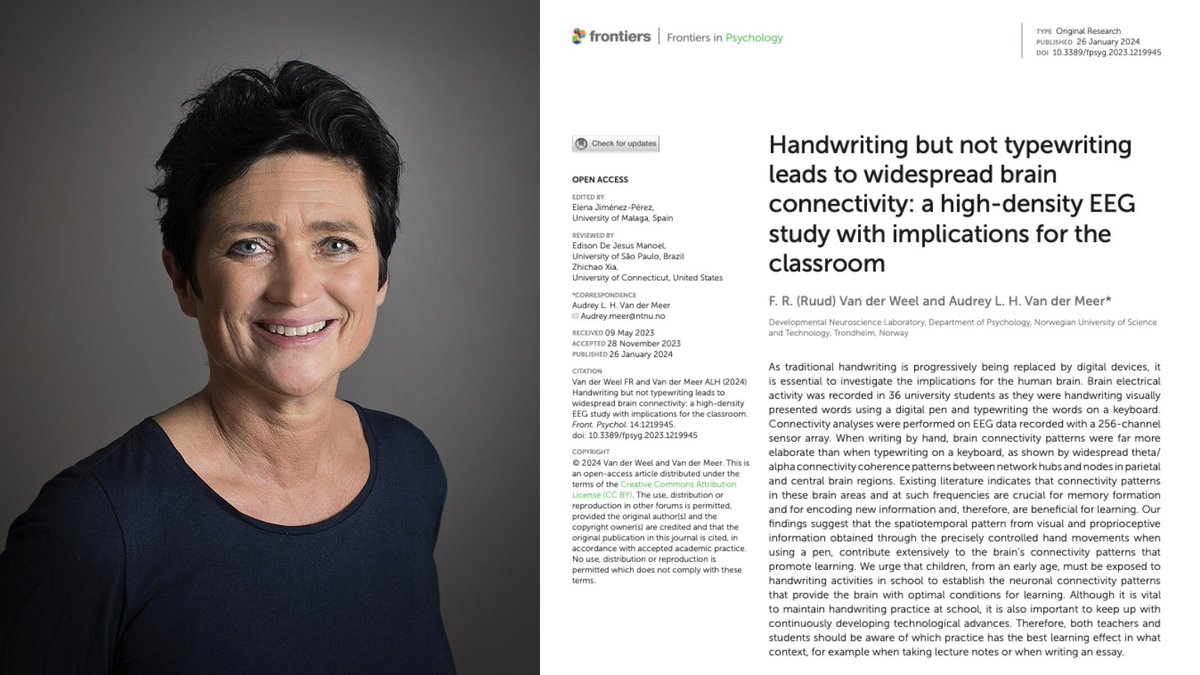
A Norwegian neuroscientist spent 20 years proving that the act of writing by hand changes the human brain in ways typing physically cannot, and almost nobody outside her field has read the paper.
Her name is Audrey van der Meer.
She runs a brain research lab in Trondheim, and the paper that closed the argument was published in 2024 in a journal called Frontiers in Psychology. The finding is brutal enough that it should have changed every classroom on Earth.
The experiment was simple. She recruited 36 university students and put each one in a cap with 256 sensors pressed against their scalp to record brain activity. Words flashed on a screen one at a time.
Sometimes the students wrote the word by hand on a touchscreen using a digital pen, and sometimes they typed the same word on a keyboard. Every neural response was recorded for the full five seconds the word stayed on screen.
Then her team looked at the part of the data most researchers had ignored for years, which is how different parts of the brain were communicating with each other during the task.
When the students wrote by hand, the brain lit up everywhere at once.
The regions responsible for memory, sensory integration, and the encoding of new information were all firing together in a coordinated pattern that spread across the entire cortex. The whole network was awake and connected.
When the same students typed the same word, that pattern collapsed almost completely.
Most of the brain went quiet, and the connections between regions that had been alive seconds earlier were nowhere to be found on the EEG.
Same word, same brain, same person, and two completely different neurological events.
The reason turned out to be something nobody had really paid attention to before her work. Writing by hand is not one motion but a sequence of thousands of tiny micro-movements coordinated with your eyes in real time, where each letter is a different shape that requires the brain to solve a slightly different spatial problem.
Your fingers, wrist, vision, and the parts of your brain that track position in space are all working together to produce one letter, then the next, then the next.
Typing throws all of that away. Every key on a keyboard requires the exact same finger motion regardless of which letter you are pressing, which means the brain has almost nothing to integrate and almost no problem to solve.
Van der Meer said it plainly in her interviews.
Pressing the same key with the same finger over and over does not stimulate the brain in any meaningful way, and she pointed out something that should scare every parent who handed their kid an iPad.
Children who learn to read and write on tablets often cannot tell letters like b and d apart, because they have never physically felt with their bodies what it takes to actually produce those letters on a page.
A decade before her, two researchers at Princeton ran the same fight using a completely different method and ended up at the same answer. Pam Mueller and Daniel Oppenheimer tested 327 students across three experiments, where half took notes on laptops with the internet disabled and half took notes by hand, before testing everyone on what they actually understood from the lectures they had watched.
The handwriting group won by a wide margin on every question that required real understanding rather than surface recall.
The reason was hiding in the transcripts of what the two groups had actually written down.
The laptop students typed almost word for word, capturing more total content but processing almost none of it as they went, while the handwriting students physically could not write fast enough to transcribe a lecture in real time, which forced them to listen carefully, decide what actually mattered, and put it in their own words on the page.
That single act of choosing what to keep was the learning itself, and the keyboard had quietly skipped the choosing and skipped the learning along with it.
Two studies. Two countries. Same answer.
Handwriting makes the brain work. Typing lets it coast.
Every note you have ever typed instead of written went into your brain through a thinner pipe. Every meeting, every book highlight, every idea you captured on your phone instead of on paper was processed at half depth.
You did not forget those things because your memory is bad. You forgot them because typing never woke the part of the brain that would have made them stick.
The fix is the thing your grandmother already knew.
Pick up a pen. Write the thing down. The slower road is the faster one.
Yesterday, I was giving an intro talk to our dept's new PhD students. Technical things aside, my number 1 suggestion has remained the same over the years: Treat your PhD like a job.
- Avoid 1.5h lunch and three tea breaks.
- Avoid gossiping and loitering at work.
- Lab at 9 am and leave at 6 pm. Being productive till 11 pm in the lab is a lie people till themselves when their day starts at 1 PM.
Everything worth doing can be done with high intensity focus during work hours. And having fun in life is the secret to being productive in a marathon.
Many of our users rely on a multifaceted combination of genomic, transcriptomic, proteomic, phenotypic, metabolomic, imaging, sensor, and other data produced at scales amenable to statistical analysis.
Learn more about our resources: https://t.co/ZaW7JwvyPC
Nanopore direct RNA sequencing is redefining how we detect RNA modifications, enabling long-read, transcriptome-wide views with minimal RNA handling. This perspective highlights both the power and current limitations of DRS in probing the epitranscriptome https://t.co/fXbNkpq2sr
Traditional single cell transcriptomics doesn't capture most non-coding RNAs. In this work, led by @alinaisakovaSci and @StephenQuake, we introduce TotalX, a @10xGenomics-compatible pipeline that captures both coding and non-coding transcripts. Out now in @NatureBiotech! 1/7