The PRIME lab is hiring for a postdoctoral research position. If you have expertise in biomaterials or synthetic biology and are interested in immune dysfunction in autoimmunity or chronic wounds, please apply here: https://t.co/nh8jZ5P4D5
It's been a great few weeks for the PRIME lab. Excited to continue a long thread in chronic wounds from my PhD and very thankful for the support of @NIH!
U-M BME Assistant Prof. Aaron Morris has received an NIH Maximizing Investigators’ Research Award (MIRA) from the National Institute of General Medical Sciences to understand why certain wounds fail to heal. @MorrisBioEng Read more: https://t.co/LegS2dwaie
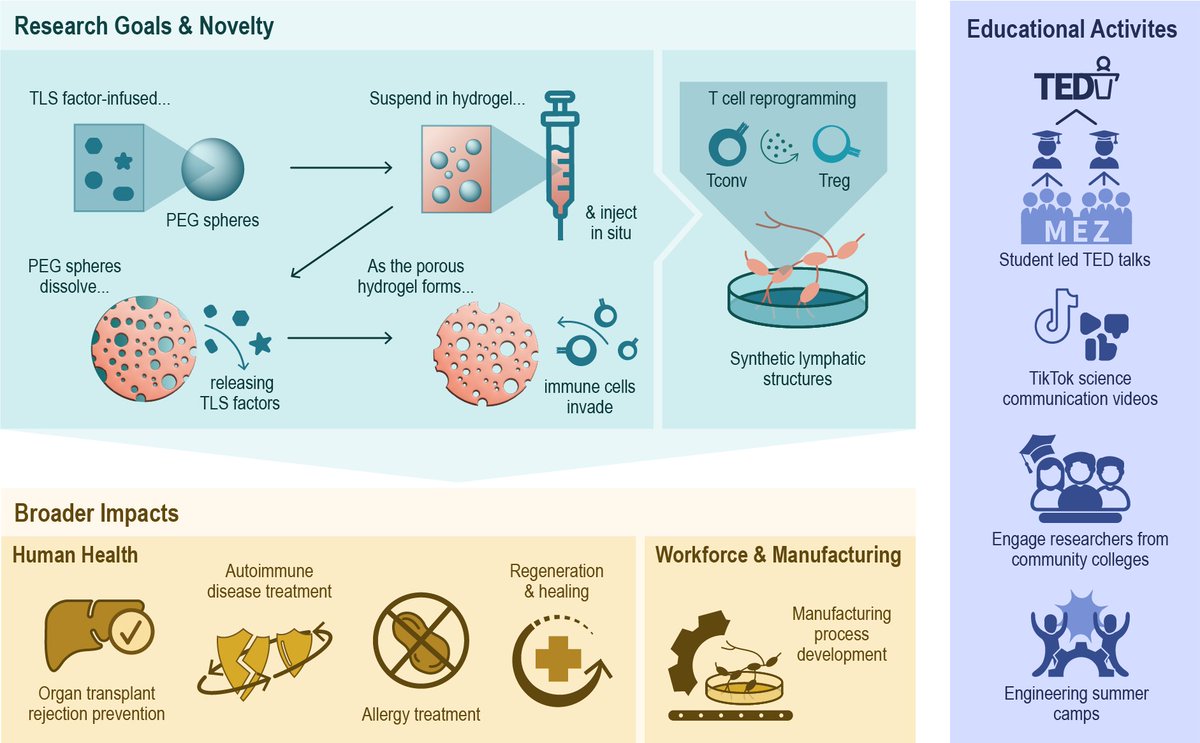
U-M BME Assistant Professor Aaron Morris has received an NSF CAREER Award to advance new strategies for immune cell therapies by recreating key features of lymphoid tissues outside the body. Read more: https://t.co/EjExNYpu63
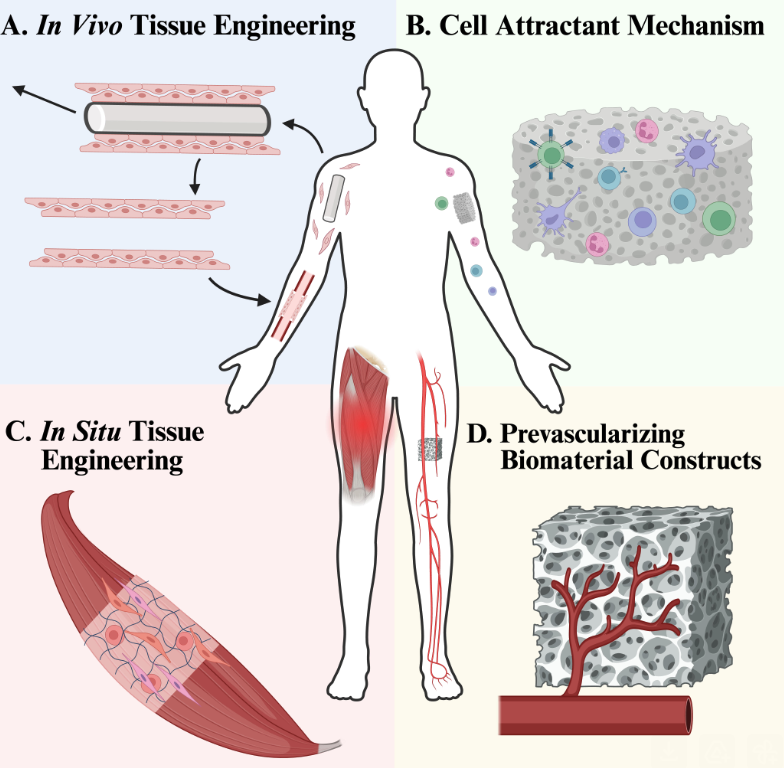
An article by U-M BME PhD candidate Mary Dickenson and Aaron Morris, Assistant Professor, Biomedical Engineering, with Robert Oakes, Assistant Professor, U. of Delaware, highlights a shift in how scientists view the body’s foreign body response. Read: https://t.co/RtixCnOt1k
Typically the FBR is viewed as a problematic response to implantable devices. Yet recent work by our group and many others has shown that it can be harnessed for a variety of useful ends. We hope this reframing will inspire others to join this exciting area.
Excited to share our recent review paper in collaboration with @SmittyOakes. https://t.co/4LboHWBYKV.
We discuss a growing body of work that seeks to leverage the foreign body response (FBR) to implanted materials for good. @UMBME@udbme
Typically the FBR is viewed as a problematic response to implantable devices. Yet recent work by our group and many others has shown that it can be harnessed for a variety of useful ends. We hope this reframing will inspire others to join this exciting area.
Excited to share the first paper led by my group and fully conducted in our lab: https://t.co/ZB0XbK1TqQ
@_Sydney_Wheeler developed new approaches for enriching antigen-specific T-cells in vivo. Current methods are limited by the rarity of these cells and require expansion.
I'm so proud of @_Sydney_Wheeler for working tirelessly to get this finished and the rest of the team! It's amazing to see it in the world, but also highlights just how long science takes. Sydney started this project simultaneously with the start of the lab in 2022
Congratulations on this awesome story finally out in @nchembio from @TheLeonardLab! I'm thrilled to have played even a small role in this exciting work. @HaileyEdelstein and @amparo_cosio, nice job on a really impressive study.
How can we combine the exquisite function of natural receptors with the programmability of synthetic biology? Check out this exciting new story led by @HaileyEdelstein and @amparo_cosio out today in @nchembio
Check out the TED Radio Hour this week: https://t.co/ytDXu6pF3C . It's a really exciting episode about the future of biotech. I was fortunate to get to talk about some of the exciting work my group is up to at @UMBME@UMengineering . Thanks @manoushz for the feature.
I am honored to be elected a fellow of the American Institute for Medical and Biological Engineering (@aimbe ) joining a group of outstanding individuals who work tirelessy to advocate for effective science policy that benefits all of society


![JCRnEDITORS's tweet photo. Antigen-conjugated scaffolds enable sustained delivery of antigen and enrichment of antigen-specific T-cells.
| Aaron H. Morris @UMBME |
[Open Access]
#AntigenConjugation #SustainedDelivery
https://t.co/EpO1eu8ciA https://t.co/GczXYylEDG](https://pbs.twimg.com/media/G9VvRHBbEAEyG4S.jpg)


