Today, Mastercard is announcing plans to expand settlement capabilities to include stablecoin, intraday, holiday, and weekend options, giving partners more choice in how and when transactions are settled. That means we’re:
✅ Enabling greater choice to settle in fiat or regulated stablecoins
✅ Improving liquidity management for time sensitive, cross border flows
We’re supporting settlement with @Circle’s USDC, @Paxos-issued stablecoins including USDG,USDP and @PayPal’s PYUSD, @Ripple’s RLUSD and @SoFi’s SoFiUSD across a range of supported blockchain networks including Arbitrum, @Coinbase’s Base, @CantonNetwork’s Canton, Ethereum, @0xPolygon, @Solana, @Tempo and XRPL. ARQ Finance, CBW Bank, @crossriverbank, @Lead_Bank and @Nuvei will be among the first to support.
Mastercard just paid $1.8 billion for a company with $40 million in annual revenue. For every dollar BVNK makes in a year, Mastercard is paying $45. For a five-year-old startup most people have never heard of.
BVNK builds the plumbing that connects regular bank accounts to stablecoins, which are digital currencies designed to always be worth $1 that can move across borders in seconds instead of days. Companies like Deel and Worldpay already use BVNK to move money for their customers across 130 countries. The company processes about $10 billion a year in transactions.
The part CoinDesk leaves out is the bidding war. Coinbase tried to buy BVNK for about $2 billion last year but walked away in November. Mastercard also tried to acquire a different stablecoin company, Zerohash, for somewhere between $1.5 billion and $2 billion. That deal fell through too. They kept shopping until they found a seller.
This follows a pattern. In October 2024, Stripe paid $1.1 billion for Bridge, a company that does basically the same thing as BVNK. That was the largest crypto acquisition at the time. Mastercard’s BVNK deal beats it by 64%, just 17 months later. The GENIUS Act, a US law signed in July 2025 that gave banks clear legal rules for working with stablecoins, kicked the whole land grab into gear.
The numbers behind the rush: stablecoin transaction volume hit $33 trillion in 2025, up 72% year over year. That figure includes trading and automated transfers, not just payments, but even the payments-only slice is growing fast. For context, Mastercard processes about $9.5 trillion a year across its entire network. Sending $200 abroad through traditional banks still costs about 6% in fees according to the World Bank. Stablecoins cut that dramatically.
One detail easy to miss: Visa Ventures was actually an investor in BVNK. Mastercard just bought a company its biggest rival helped fund. Visa went a different direction, building stablecoin payments into its own network instead of acquiring. It now runs over 130 stablecoin-linked card programs across 40+ countries and processes about $3.5 billion in stablecoin payments per year.
BVNK was valued at $750 million in its December 2024 fundraise. Fifteen months later, Mastercard is paying more than double. The $1.8 billion includes $300 million tied to hitting performance targets, but even the guaranteed $1.5 billion is double what BVNK was worth just over a year ago.
Stripe paid $1.1 billion for Bridge. Mastercard paid $1.8 billion for BVNK. The old-guard payment companies are buying their way into crypto, and the entry price keeps climbing.
Digital assets are entering a new phase. What once ran in parallel to existing financial systems is increasingly being applied to solve practical, real-world needs — often behind the scenes – from cross-border remittances to B2B money transfers. This creates new opportunities to add value in how money moves globally.
Today, we introduced the Mastercard Crypto Partner Program — a global initiative that brings together more than 85 crypto-native companies, payments providers, and financial institutions. Together, we're creating a forum for meaningful dialogue and collaboration as this space continues to mature.
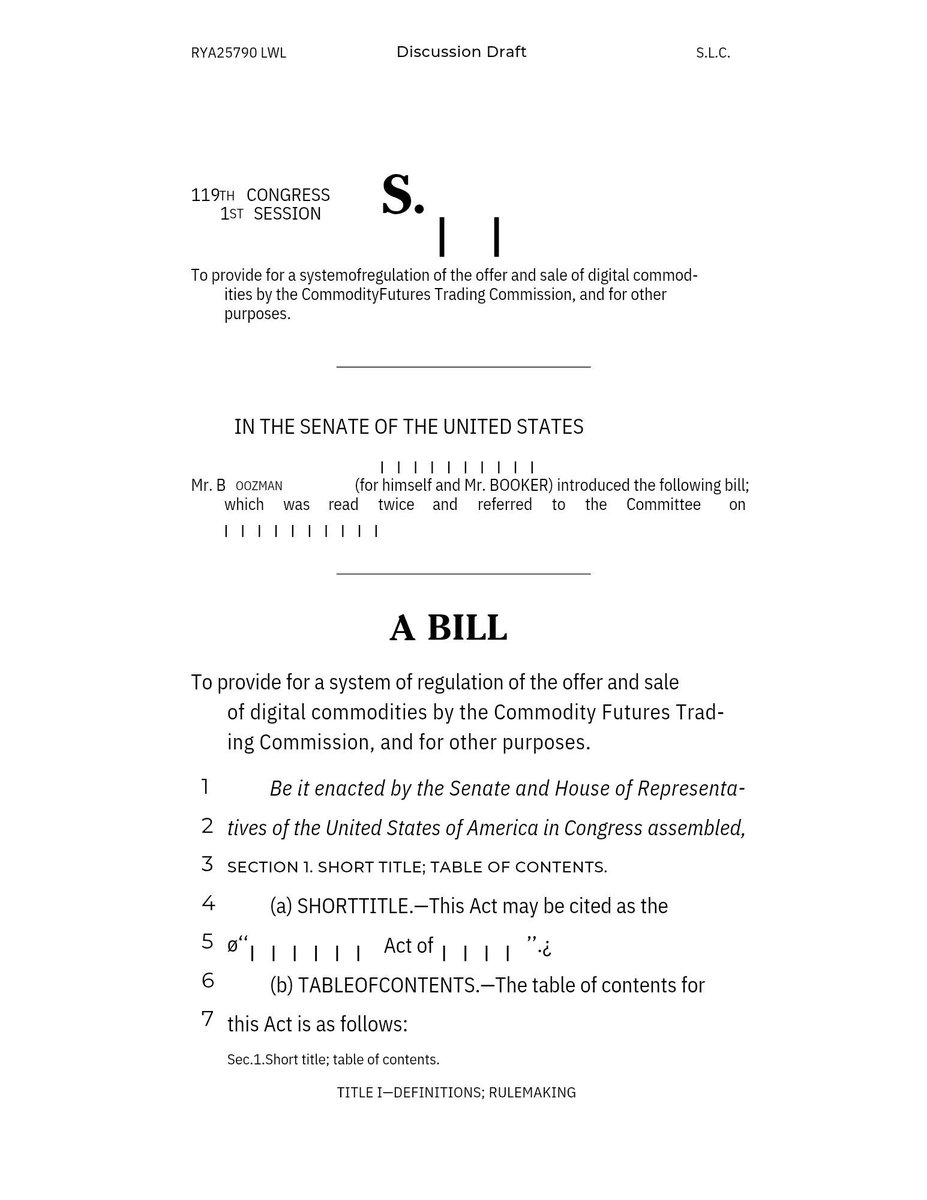
🚨 THE WHITE HOUSE HAS SET A MARCH 1 DEADLINE TO MOVE THE CRYPTO MARKET STRUCTURE BILL FORWARD.
The core issue has now been decided, and it goes against crypto firms and stablecoin holders: no yield on idle balances.
Today’s meeting was led directly by the White House, which brought draft text and controlled the discussion. Coinbase, Ripple, a16z, and crypto trade groups attended. Banks were represented through national banking associations.
The draft makes it clear that firms will not be allowed to offer rewards simply for holding stablecoins. The savings account style yield model is effectively off the table.
The debate has narrowed to whether rewards can be allowed only when tied to specific activities such as lending or other structured use.
The draft also gives the SEC, Treasury, and CFTC the power to enforce the ban on idle stablecoin yield, with penalties of up to $500,000 per violation per day.
Banks are still pushing for a deposit outflow study to examine whether payment stablecoins could reduce traditional bank deposits.
However, the broader market structure bill is still viewed as positive for crypto overall.
It aims to create clearer rules around custody, exchange oversight, token classification, and the roles of the SEC and CFTC. A formal framework would reduce regulatory uncertainty that has limited institutional participation.
For crypto firms, clarity on what is allowed and what is not could unlock more long term capital, even if certain yield models are restricted.
Talks will continue this week, and an end of month agreement is realistic.
After that, a formal framework could be ready by March 1, and the bill would move to the next stage.
The SEC just handed crypto its most important win of the year so far, but nobody’s really talking about it.
Here’s what actually happened today, and what comes next.
CoinList is going fully non-custodial and onchain.
We’re simplifying the product to do one thing exceptionally well: help people access the best token sales and receive tokens directly into wallets they control.
Crypto evolves every 6 months. New metas, new faces, new tech. Most companies don’t survive across cycles, much less within one. @CoinList has endured multiple cycles since 2017 because we’ve continuously reinvented ourselves without losing the core: great projects, fair access, real distribution.
The world is changing and in some ways it's already changed. Companies are more efficient than ever thanks to AI. Others are leveraging blockchains and noncustodial systems to increase trust and reduce operational drag. Together these shifts give any company operating leverage: become faster and cheaper and just as, if not more, revenue-generating.
Our customers, projects and investors, conduct most of their activity onchain and are not interested in further centralized custody and trading. They just want access to great deals, tokens delivered on time, and 100% control over their wallet. Pushing custodial features any further would distract from what we do best.
So we listened. The market wants verifiable, onchain finance where users hold their own keys, and we want to meet that demand by becoming more crypto-native and getting closer to our users.
Later this year, we’ll introduce noncustodial wallets in partnership with @privy_io, the leading provider of secure, scalable, and user-friendly wallet infrastructure. Soon, when you log into your CoinList account, you’ll have a noncustodial wallet associated with your account. All of your assets, under your complete control.
And even better, when you participate in a CoinList sale, you’ll receive distributions directly to your noncustodial wallet. No intermediaries, no delays.
And we’re not stopping there. CoinList will be running ICOs, trading, and tokenizing assets, all onchain.
If you currently hold assets in CoinList custody, we’ll make migrating them simple and safe. You will receive an email on product changes that are relevant to you.
If you’re here for access to great deals, the experience just got a lot better and we’re excited to see you onchain.
Today we're announcing Archetype Fund III - a $100M fund dedicated to backing founders who are weaving crypto into the fabric of society.
Deep gratitude to the LPs who share our conviction and to the founders who let us work for them every day.
$MOVEUSD by CFX Labs is now natively multichain and live on @solana, @base, and @ethereum, powered by @wormhole NTT
@moveusd is a U.S. dollar-referenced digital asset designed to be fully backed 1:1 with permissible reserve assets in alignment with GENIUS Act standards.
$MOVEUSD is now live on Ethereum & Base powered by @wormhole NTT.
Built for the Global Main Street, @moveusd delivers GENIUS-ready, U.S. bank-integrated stablecoin access to builders & businesses in 180+ countries.
Press release → https://t.co/VikwxXtbgY
Stablecoin clearing house (SCH) has been a topic of conversation for the last many months.
When there's many parties, fragmented liquidity, and inefficient coordination, then it starts to create a need for a clearing house.
SCH sounds like a really big idea, but history tells us there's more to the story.
JUST IN: 🇺🇸 Treasury Secretary Bessent says crypto stablecoins can lower government borrowing costs and reduce national debt.
"A thriving stablecoin ecosystem will drive demand from the private sector for US Treasuries, which back stablecoins. This newfound demand could lower government borrowing costs and help rein in the national debt."