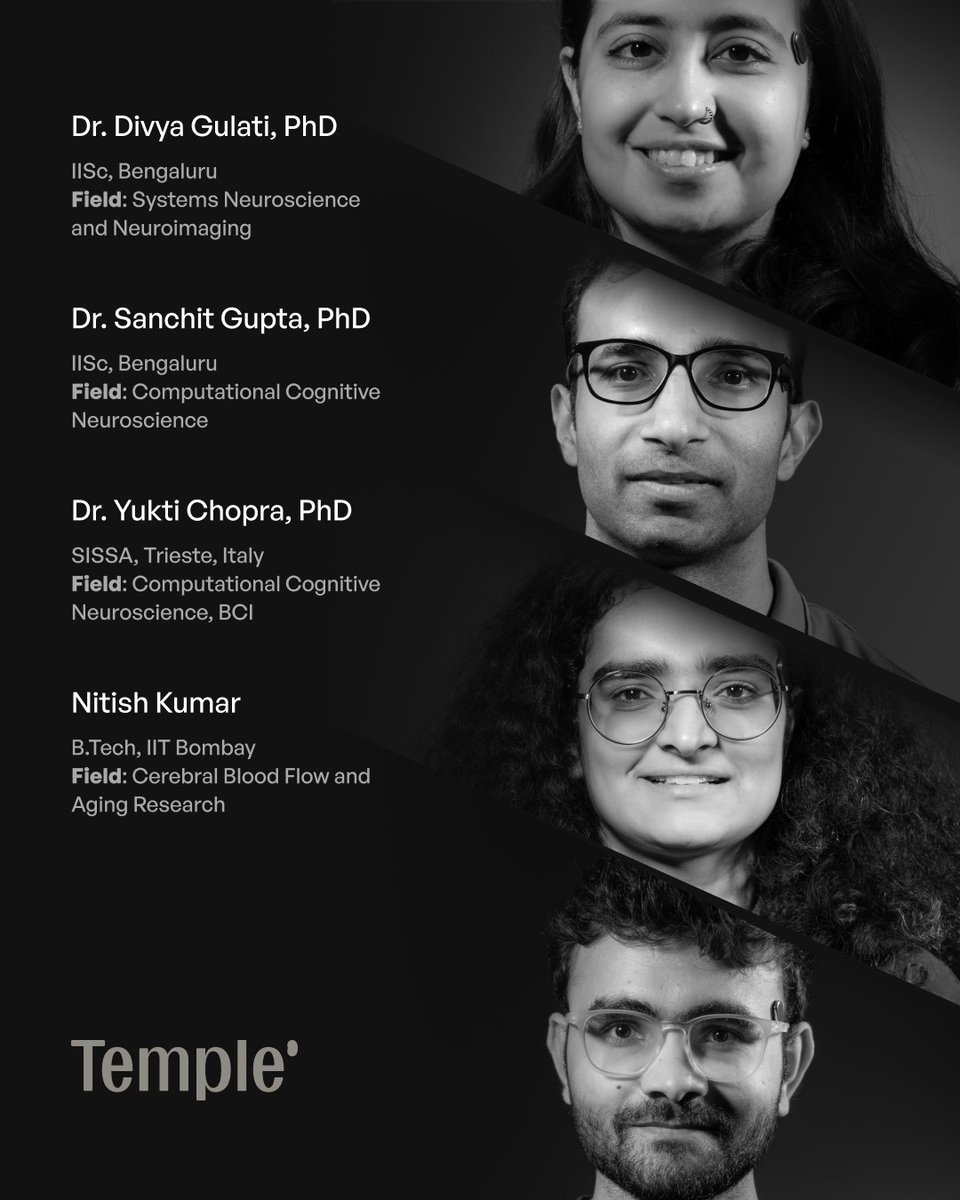
India has always idolised actors and cricketers. The last few years, entrepreneurs and founders have also gotten mobbed at the airports. How I wish we started celebrating scientists as much as we celebrate actors, cricketers, and founders.
On that note, meet the Temple scientists behind Brain Flow: Dr. Divya Gulati (IISc), Dr. Sanchit Gupta (IISc), Dr. Yukti Chopra (SISSA Trieste), and Nitish Kumar (IIT Bombay).
This team led, built, and validated the first continuous, wearable measurement of blood flow to the brain.
Your brain uses 20% of your blood supply. It controls your hormones, sleep, immunity, and repair. That supply drops every year as you age, and you have never measured it. Even hospitals can only capture a single snapshot.
Measuring and maintaining brain flow could be one of the most important health and longevity interventions of our time.
At Temple, we have some of the best minds in the country, working on the one problem that sits upstream of every other: extending healthy human life.
I am proud of our team, and looking forward to a lot of firsts and breakthroughs in the future.
The best outbound starts before you automate anything. Founders need to learn who actually has the problem, what gets their attention, and what makes them reply. YC Visiting Partner @ChristinaG325 recommends doing at least your first 100 outreaches by hand so you can learn those things yourself.
Drawing from her experience generating and closing millions of dollars through founder-led sales at OneSchema, Christina shares eight ways founders can improve their outbound, from targeting the right people and writing emails worth reading to following up, debugging low reply rates, and using customer language to sharpen your message.
00:38 - Start manual before you automate
01:25 - Targeting beats perfect messaging
02:23 - How to find the right job titles
03:07 - Picking the right companies
03:47 - Intent signals
04:25 - Craft a message worth reading
06:00 - A cold email that works
07:19 - Subject lines
07:37 - Improve your LinkedIn profile
08:47 - What your reply rates are telling you
09:47 - Follow up, and reply fast
10:37 - Block out time for outbound
11:25 - Use the messaging from your customers
12:27 - Your slog compounds
the startup ecosystem is becoming distributed R&D.
acquihires used to be the end of the story. company struggles, founders get jobs + the product disappears.
that sequence is changing. the acquihire is becoming a career path.
frontier labs + billion-dollar startups are going directly to founders mid-company with personal compensation packages an early-stage startup cannot compete with.
@poolside. @inflectionAI. @character_ai. @CovariantAI. @adept. the list keeps growing.
the deal is some version of: we want the people or IP. founders get paid personally. the company may license technology or wind down separately. the cap table does not necessarily participate in the economics the way it would in an acquisition.
three things change:
-talent markets compress startup timelines:
a founder no longer has to wait for an exit to monetize frontier expertise. if two years of proving a hard technical thesis creates an eight-figure employment option, that changes the expected value of grinding independently for seven.
-founder alignment gets harder to underwrite:
the question used to be whether a founder could build through difficulty.
now it is what happens when the founder has a life-changing personal liquidity option.
-venture returns leak outside the cap table. licensing + founder hiring separate the two.
the company created the experiment. investors financed it. the founder’s expertise became enormously valuable. but the highest-value transaction may happen at the individual level.
there is a deeper structural shift underneath this: large AI companies cannot explore every technical branch internally. startups increasingly do the exploration for them.
and the best engineers do not want to join big companies. they want to found things. so incumbents let them leave, watch what they build, and hire them back when it works. this is an extremely efficient talent filter.
incumbents can then buy the talent or capability once uncertainty has collapsed.
the uncomfortable question for early-stage venture is who gets paid for the experiment.
What are our dreams for India?
In ep 3 of Watching the Wheels, @srajagopalan, @pranaykotas & I put together a wishlist for India: https://t.co/DcKsVzrMkX
Do watch, comment, like, subscribe, share! (That's our wishlist for ourselves! ) 🙂
At the core of our mission is working through how to ensure increasingly powerful AI benefits everyone.
We believe that, at some point in the future, AI acceleration for frontier model development may be so high that the world will need to pace the rate of AI advancement.
We hope to contribute to work led by the U.S. government, alongside other labs and the open-source community, to develop the tools and mechanisms that could make that possible.
https://t.co/pMCtiQjMoo
Think you have Product-Market Fit just because customers love your product? Think again.
On the latest episode of How VCs Think, @sajithpai (@BlumeVentures) and @dineshpaii (Rainmatter) sit down to decode what real PMF looks like.
Watch the full episode on the Rainmatter Youtube Channel. Link in comments.
Zomato and Swiggy have shown that food delivery can be profitable.
But the largest cloud-kitchen operators, such as Rebel Foods and Curefoods, remain in the red.
Swish believes that combining the two models is the answer: owning the customer interface, the kitchen and the delivery network.
Traditional cloud kitchens and restaurants depend on aggregators for demand, paying commissions and delivery fees that can take away 20–30% of an order’s value.
They bear the cost of running kitchens without controlling customer acquisition, ordering behaviour or repeat usage.
Swish wants to close that gap through its own consumer interface and a 10-minute delivery promise.
It believes this model can generate operating margins of 15–20% on a Rs 250 order.
Read more: https://t.co/LWfqKbvanJ
Open-sourcing GenOffice, the world's first full-featured open-source AI Office for PC and Mac.
GenOffice is free for everyone, ad-free. All the editing tools you'd expect, no strings attached.
How it started?
One engineer, one week, $10,000 in tokens. That's what it took to build the GenOffice Alpha.
Help shape the AI office experience
We invite you to build the rest of it with us. Join the GenOffice group chat on GenTeam and bring your requests straight to the agent. Not by writing code, but by telling it what you want. You say what you need, and every piece of your feedback becomes part of the product.
What's in GenOffice?
Docs, Sheets, Slides, and PDF, with all the editing tools you already know. And with Genspark Super Agent built in, powered by top-tier models, it digs into research, crunches your data, then writes the doc or builds the deck for you, using your Genspark credits.
This is an Alpha, and we mean it. Come tell us what's broken and what's missing. Everyone who jumps in with real feedback gets 1,000+ Genspark credits as a thank you.
GitHub 👉 https://t.co/CZS2Lbpnae
Download it now 👉 https://t.co/HmCSwH65Fn
Dear @narendramodi and @nitin_gadkari, I urge you to heed science, reason, and the concerns of ordinary Indians.
Here, I explain why India’s E20 policy hurts vehicle owners, water resource, and the environment; and helps the politician-middleman, the sugar, and the liquor lobby:
There are two GTM playbooks for AI companies selling into the enterprise: the Lighthouse and the Landgrab.
Lighthouse: win a few marquee customers, build social proof, and reassure the buyer who’s afraid of making the wrong call.
Landgrab: win on math, move fast, and sign the largest number of customers possible, logo be damned.
Most assume they have to educate the market, and they default to the Lighthouse. But in markets where the buyer already knows the problem and a mistake won’t cost them their job, chasing logos is a distraction.
Full piece from a16z's Joe Schmidt and Julian Marx: https://t.co/IguoXFNZs1
The Invisible Metric in Startup Building: "Founder Form"
When Messi goes five matches without scoring a goal, or Virat Kohli goes through a dry spell, the sporting world doesn’t assume they’ve suddenly forgotten how to play. We don't demand they be permanently benched or declare their career over.
Instead, we use a very specific word: Form.
We recognise that sports require immense psychological, emotional, and physical intensity. "Form" fluctuates. It has peaks, valleys, slumps, and flow states.
Yet, in the hyper-rational, metric-driven world of startups, we treat founders like machines. We expect them to ingest capital and seamlessly produce flawless strategic execution 365 days a year. If a quarter misses expectations, a product launch bombs, or a key hire walks out, the immediate reaction from boards, markets, and sometimes even fellow co-founders is panic, blame, or a sudden loss of faith.
Over the last 19 years as an entrepreneur and through supporting hundreds of founders in their journeys, I’ve realised one undeniable truth: Founder Form is real. And ignoring it can destroy perfectly good startups.
The Anatomy of the Two States: The Slump vs. The Flow
Building a company demands an elite athlete's intensity. Because it relies heavily on human judgment under extreme uncertainty, founders inevitably move through distinct cycles of form:
When you are in "Bad Form" (The Slump): Every strategic bet feels slightly off. You make a hiring mistake, a key client churns, your pitches don’t quite click, and your decision-making feels sluggish or over-analyzed. You are working just as hard - often harder, out of sheer desperation - but your timing is gone.
When you are in "Good Form" (The Flow State): Everything you touch turns to gold. You make a gut-call on a product pivot and it works flawlessly. A casual coffee meeting scales into a massive strategic partnership. Investor meetings go super smoothly. Your energy is infectious, and the team rallies without effort.
When you are in a slump, it feels like nothing will ever work again. When you are in flow, it feels like you can never fail. Both illusions are dangerous, but the slump is where companies break.
The Danger of Asymmetry in Co-Founder Pairs
The ultimate test of a co-founder relationship isn't how you celebrate wins together; it’s how you handle a divergence in form.
In a multi-founder setup, it is incredibly rare for all partners to be in peak form simultaneously. The danger arises when Co-Founder A is in a legendary flow state, while Co-Founder B is grinding through a deep slump.
If they don't understand the concept of "form," this asymmetry breeds deep resentment. Co-Founder A starts thinking, “I’m carrying the entire weight of this company.” Co-Founder B, already drowning in self-doubt, feels isolated, judged, and increasingly anxious - which only prolongs the slump.
Great co-founder relationships survive because they view performance through the lens of a team sport. When your partner’s timing is off, you don't call them incompetent. You step up, cover the field, take the heavy shots, and give them the breathing room to find their rhythm again. You do it gladly, knowing that next quarter, the roles might be reversed.
A Message to Investors: Stop Managing to the Daily Scorecard
To the investor community: when a founder is in a slump, adding institutional pressure or questioning their fundamental capability is the equivalent of a manager screaming at a struggling athlete from the sidelines. It doesn't fix their footwork; it merely tightens their grip on the bat.
Seasoned investors back the person, understanding that form is temporary, class is permanent.
If a founder who has previously delivered high-quality execution hits a wall, the goal shouldn't be to micro-manage the metrics. The goal should be to help them remove the noise so they can find their baseline.
The Founder’s Playbook for Regaining Your Form
If you are a builder currently grinding through a slump, remember how elite athletes get back into the runs:
Go Back to Basics: When a batsman loses form, they spend hours in the nets focusing on basic footwork, not hitting sixes. Stop trying to solve the entire macro crisis today. Focus on small, undeniable execution wins. Go talk to three customers. Fix one internal bottleneck. Rebuild your momentum incrementally. Confidence will grow with action, shrink further with idleness.
Manage the Fatigue: Founders tend to respond to a slump by doubling down on work, leading straight to burnout. But a chaotic mind cannot produce elite execution. Step back, rest, and disconnect briefly to regain perspective.
Trust the System: Accept that market forces and luck play a massive role in early-stage startups. If the core capability is there and you keep showing up to the crease with clean mechanics, the flow state will return.
Startups are a game of endurance. We can’t expect builders to be flawless algorithms, and we must support them like the elite psychological athletes they are.
Give your co-founders and yourself the grace to find form again. It’s just a matter of time before they find it.
Mark Cuban just described the largest wealth transfer of the AI era.
Almost nobody understood what he said.
Cuban: “There are 33 million companies in this country. Aren’t going to have AI budgets. Aren’t going to have AI experts.”
Not tech startups.
The shoe store. The regional trucking outfit. The accounting firm with 12 employees.
The businesses that actually run the physical economy.
They know AI is coming. They have no idea what to do with it.
Cuban: “You’ve got the head of Microsoft saying software is dead because everything’s going to be customized to your unique utilization.”
Software is dead.
The SaaS era ran on one rule. Build a generic product. Force millions of companies to bend their workflows around it. Charge rent forever.
AI ends the contract.
The business stops bending to the software. The intelligence bends to the business.
But customized by whom.
The third-generation manufacturer cannot tell Claude from Gemini. The county hospital is staring at a reactor asking where the light switch is.
Cuban: “Who’s going to do it for them?”
That question is worth more than the frontier models themselves.
Hundreds of billions are being burned to build the foundation. The smartest engineers alive are locked in a bloodbath over who owns the base layer.
Let them fight.
Let them burn the capital. Let them drive the cost of raw intelligence toward zero.
Because the wealth does not collect where the brain is built.
It collects where the brain meets the business.
Every ambitious kid in college right now thinks survival means a seat at OpenAI or Anthropic.
Cuban is staring at the other 99 percent of the economy.
Learn the models. Then learn the messy, unglamorous reality of how a 50-person company actually operates.
Walk through the door. Understand their problems. Wire the intelligence directly into their revenue.
That is not a job title. That is an entire economic class being born.
You do not need to build the brain. You need to build the nervous system.
The biggest winners of the electricity era were not the engineers who built the generators. They were the ones who walked into dark factories and showed the owners where to plug in.
33 million companies are standing in the dark right now.
Silicon Valley is racing to build the god. The fortunes will belong to whoever teaches him a trade.
My only advice to CEOs this year..
Hire tinkerers.
Make it high status.
Find ones that will explore the edges and (ideally) naturally gifted at teaching people.
Empower them to freely roam across the org and fix large problems that can be automated.
All your execs will complain that these tinkerers don’t understand scale or systems (rollout being a favorite word).
Listen, and ignore them. Or even better give them budget to hire a tinkerer to achieve their targets.
Give these tinkerers ambition, purpose and hard targets and watch them fly.
Sequoia just called the end of an entire go-to-market era and most SaaS companies won’t realize what hit them for 18 months.
Product-led growth was built on one assumption: humans would try the software. The entire playbook since 2010 optimized for human discovery. Beautiful landing pages. Frictionless free trials. Viral invite loops. Slack, Dropbox, Zoom, Calendly. $200B+ in market cap created by winning the user’s first 5 minutes.
None of that matters if an agent is picking the software.
Claude doesn’t care about your hero image. It can’t be impressed by your Dribbble awards. It’s reading documentation, parsing user reviews, checking API reliability, and matching features to use case. All the surface-level polish that convinced lazy humans to click “sign up” becomes irrelevant.
The new PLG funnel isn’t landing page → free trial → activation → conversion.
It’s agent query → documentation scan → feature match → recommendation.
Which means the new moat looks completely different. You don’t need the best onboarding. You need the best documentation. You don’t need viral loops. You need structured data that agents can parse. You don’t need a beautiful UI for the first session. You need an API that an agent can actually call.
The companies that won PLG hired designers and growth hackers. The companies that win agent-led growth will hire technical writers and developer relations engineers.
And here’s the part nobody’s pricing in yet: agents don’t have loyalty. They don’t have switching costs. They’ll recommend Supabase today and something better tomorrow if the documentation is cleaner or the pricing is more transparent. The stickiness that made PLG so powerful, the network effects and learned behavior, doesn’t transfer.
Sequoia is telling you the entire distribution layer is being rewritten. The question is whether your product is optimized for human attention or machine parsing. Most are built for the wrong audience.
You can summarize any webpage with Firecrawl 🔥
Perfect for research, content curation, or building AI agents that need quick context!
Try it out in our Playground, SDK, or your favorite no-code automation platform!
Came across this video by Evernote founder @plibin detailing the 'Amazing State Machine' framework. This is very high on insight density. Thanks Phil for this!
Founders selling a subs product or service should look at the 'Amazing State Machine' framework. Sadly not so useful for one-time or low frequency usecase like mortgages, or college admission.
The framework deconstructs user activity into 14 flows (see image), e.g., #6 moves low value users to high value users (those who use the app more frequently and extract value from you, not pay most or you extract value from), or #12 (holding on to high value users). You can now have specific teams assigned to each flow
#6 - upgrade team
#12 and 7 - high value user retention and delight team. You can even track revenue and costs per flow.
Three big learnings:
A/ All churn is not the same. First time user to inactive != High value user to inactive user (or even Low value user to inactive user). This was a very actionable insight.
B/ There is a heirarchy of flows - #12 is v important. If #2 is v high, then there is usually no point focusing on #1 (acquiring new users). This is a leaky bucket.
C/ The most aligned startup models allow you to make the most revenue from high value users. If there is a user extracting highest value but doesnt pay the highest (e.g., Meta) it is a less aligned biz model than one where your revenue from user increases in proportion to the value they derive from your platform (e.g., Apple).