after hacking into the ducati’s cluster board via thousands of voltage glitches, the cluster no longer boots properly (stuck in a blinking light animation)
to diagnose this, I had claude analyze the blinking lights pattern and frequency to track down the exact location in my bike’s dumped firmware that produces these patterns and lcd display (the lcd contents were ambiguous and had two candidates)
we tracked it down to a region of code whose only entrypoint is a failed firmware code integrity checksum, presumably caused by the thousands of voltage glitches we injected causing some of the flash memory cells to lose charge, corrupting the firmware code itself
top-left: original video + cropped regions on the LEDs,
bottom-left: analyzed LED brightness across time
right: dumped firmware opcodes that produce this pattern
does your audio-input LLM secretly know how to generate speech? yes but it sounds like a scary demon!
deepdream but for speech: starting with noise audio, I tried optimizing the probability of a desired transcription, while keeping the model frozen.
volume up! 🎧
Sneak peek from our Chief Research Officer @m__frei at CDFAM - Computational Design Symposium this morning: Heaviside can now predict full 3D electric and magnetic fields, a leap forward from S-parameters to the entire 3D electromagnetic field distribution.
More on Heaviside-1 to come soon👀
Erdős supposedly said of the Collatz Conjecture that "mathematics is not yet ready for such problems" and I wonder if another layer of problems is now accessible or basically the same layer being picked over with a fine tooth comb faster than we ever could before
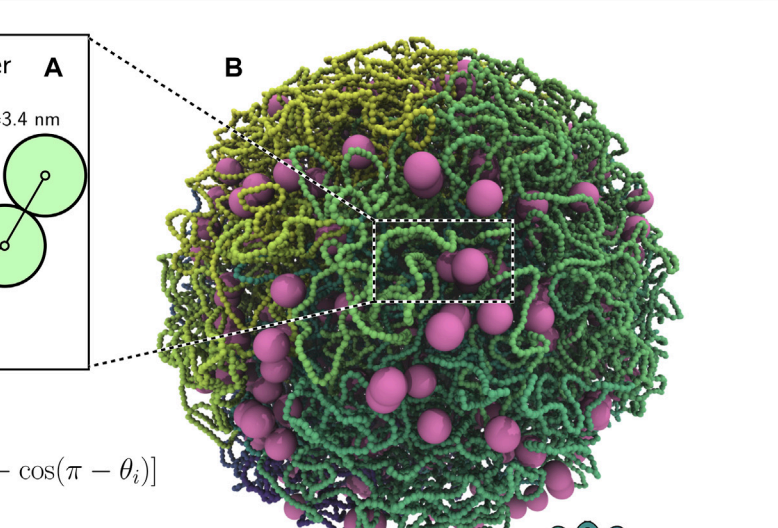
[Reading Recommendation] In these lecture notes is presented a great course on random matrix theory showing the most famous and widely used classic results, discussing the merits of each analytical approach, and highlighting the applications.
https://t.co/tBopVLMe06
The broader point: a featurizer is a hypothesis about how a model’s representations are structured.
We think this is a step forward in tools reflecting that.
Paper, code, and full post: https://t.co/jcY3PRB2kn
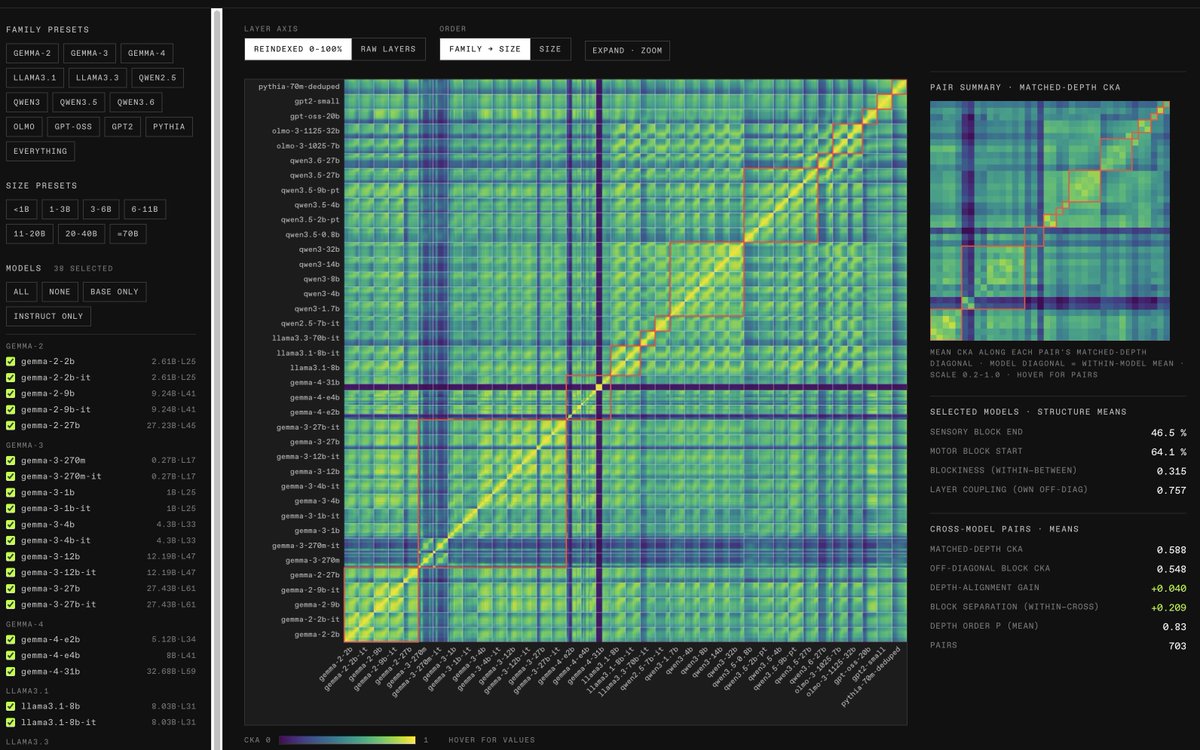
computed the similarity (CKA) on the J-lens geometry of every layer inside and across 38 open models. the patterns are weirdly universal: same depth layout, same organization at the same relative depth, even between unrelated families like llama and olmo
https://t.co/C6188kLOXg
Memory cost and capacity are significant issues for AI accelerators.
Unlike game rendering, model inference can have a deterministic memory access pattern. You don’t need “random access memory” at all for model weights, and you could tolerate cold-start latencies in the multiple milliseconds, as long as continuous reads were delivered at the necessary bandwidth.
NAND flash is over 100 times cheaper per GB than HBM, so there should be opportunity there, even after giving a flash controller a 1024 bit interface with HBM bandwidth.
You could make a specialized pin protocol that just supported pipelined transfer of full 16KB+ pages from the flash to program-managed accelerator scratchpad memory and improve per-pin performance over HBM, but it might be more convenient to make it still look like a true random access memory with very fragile performance characteristics, where anything but sequential reads falls off a 1000x+ performance cliff.
That has the advantage of automatically using existing cache hierarchies, and providing a natural path to update the flash memory with new model weights. With the stream-to-scratch interface, code has to be completely rewritten before it works at all, while the ram-emulation interface will start off just extremely slow, and you can incrementally sort out the changes for full performance.
There may be cases where there isn’t enough scratchpad SRAM to hold the weights for a layer, which might force you to deploy the old optical drive optimization technique of duplicating data in multiple places on a sequential read to avoid seeking, but there would be capacity to burn.
It might be possible to do something like cuda graph capture to record a memory access trace and have everything magically remapped to a linear sequence, but deploying programmer / agent elbow grease to manage transfers and access in a scratch ram ring buffer would be lower risk.
A split memory system consisting of some channels of flash and some channels of HBM will probably be suboptimal compared to a uniform memory, but it could be much cheaper, and allow much larger models to be run.
I think th case is strong for inference, but you have to stretch more for training. You can still linearize all the weight memory accesses, both reads and writes, but flash memory would quickly wear out from the writes, even if they were all perfectly page aligned. Replacing low-latency HBM with massively parallel cheap(er) DRAM at high latency might still be a worthwhile cost savings.
I wish Canada, Prime Minister @MarkJCarney, and all Canadians a Happy Canada Day. Ukraine joins you in celebrating this day. We appreciate Canada’s leadership in helping us protect the lives of our people across many domains: defense assistance, pioneering work on sanctions against Russia’s shadow fleet and financial sector, diplomatic advocacy, and much more. We are grateful that we can count on your continued support in all these areas. Thank you, Canada!
We’re happy to announce 2 releases today:
- 🧠Brain2qwerty v1 is published at @NatureNeuro
- 🚀 Brain2Qwerty v2 is now publicly released
Explore how we decode sentences from non-invasive brain recordings: https://t.co/IdR6gK2hcd
Links:
📄v1 Nature Neuro: https://t.co/wnRjc9W9gI
📑v2 Meta preprint: https://t.co/oSfLOQFcvg
💻Code: https://t.co/Xbe0XWfWQL
📊Data: https://t.co/SCBbs4AhTg
📝Blog: https://t.co/15RvsAaXlH
🧵Thread: https://t.co/d8FJrVyDut
Like a stadium full of sports fans doing the wave, neurons coordinate their electrical signals in rhythmic patterns that sweep across the cortex, the brain’s outermost layer.
Recent studies in humans and animals have shown these patterns, called traveling waves, can take on complex shapes, among them a rotating spiral that has been observed during deep sleep, memory retrieval, and other brain processes.
A new study has now captured the fast-spinning waves spanning whole brains, offering clues to how they’re organized and what they might do.
Learn more: https://t.co/96amfrLUI5 @NewsfromScience
Work done at @FLAIR_ox and @MATSprogram with Mattie Fellows, @AlexDGoldie, @jonathanrichens, @j_foerst and Oliver Richardson.
🌐 Website: https://t.co/KEjZWG8usD
📝 Paper: https://t.co/kB1lwoFanD
💻 Code: https://t.co/T0CB9XdUux
⬇️ Agent & implicit WM evolving over training.
Model-free agents learn to maximise reward without modelling the environment. Right?
In recent work, we challenge this narrative by proving that agents, trained on a sufficiently rich set of goals, encode a unique and accurate world model in their value functions.
1/


![Underfox3's tweet photo. [Reading Recommendation] In these lecture notes is presented a great course on random matrix theory showing the most famous and widely used classic results, discussing the merits of each analytical approach, and highlighting the applications.
https://t.co/tBopVLMe06 https://t.co/xP4qxG0OXn](https://pbs.twimg.com/media/HM2IxP5W4AA1iN4.png)
![Underfox3's tweet photo. [Reading Recommendation] In these lecture notes is presented a great course on random matrix theory showing the most famous and widely used classic results, discussing the merits of each analytical approach, and highlighting the applications.
https://t.co/tBopVLMe06 https://t.co/xP4qxG0OXn](https://pbs.twimg.com/media/HM2IxPTXUAAw97K.png)
![Underfox3's tweet photo. [Reading Recommendation] In these lecture notes is presented a great course on random matrix theory showing the most famous and widely used classic results, discussing the merits of each analytical approach, and highlighting the applications.
https://t.co/tBopVLMe06 https://t.co/xP4qxG0OXn](https://pbs.twimg.com/media/HM2IxPTXQAAb1od.jpg)






![Underfox3's tweet photo. [Reading Recommendation] In these lecture notes is presented a great course on random matrix theory showing the most famous and widely used classic results, discussing the merits of each analytical approach, and highlighting the applications.
https://t.co/tBopVLMe06 https://t.co/xP4qxG0OXn](https://pbs.twimg.com/media/HM2IxP6W4AASQqM.jpg)