MicroDuck looks like a cute desk toy. The hardware tells a different story.
At just 25 cm tall and around 780 g, this small robotic duck packs a surprising amount of engineering into its body.
Here’s what’s inside:
• 15 motors controlling its legs, head, neck and beak
• Rockchip RK3566 processor
• 1 GB RAM and 32 GB storage
• A camera for visual input
• An 8-microphone array for audio input
That combination gives MicroDuck the hardware for movement, vision and voice interaction in a compact form.
The robot needs to manage multiple joints while responding to its surroundings.
Small robots like this are also interesting because they bring robotics closer to everyday environments. A compact platform can be easier to place on a desk, carry around and use for experiments than a full-sized humanoid.
Of course, the hardware specs alone don't tell us how well it performs.
Real-world tests would help answer questions about walking stability, voice recognition, response time and battery life.
Still, MicroDuck is a good reminder that you don't need a human-sized robot to explore the engineering behind embodied AI.
Would you keep a robotic duck on your desk if it could move, see and talk to you?
Tomorrow morning, I’ll release a blog that outlines a detailed roadmap for setting up evals on subjective / open-ended tasks. The blog also covers a variety of stats / ML tricks for reducing noise and increasing confidence in your evals.
Here is a list of blogs, papers, and other resources (written both by me and by others) I often return to when thinking about this topic:
- High-quality human data: https://t.co/5o8flZLzzX
- Human evaluation guidelines: https://t.co/BwgTwv26e3
- LLM-as-a-Judge core concepts: https://t.co/ZVVIqezskV
- LLM-as-a-Judge practical guide: https://t.co/Qsv78WlBfB
- LLM-as-a-Judge best practices: https://t.co/S76u1d4NS1
- Rubric-based judges (RL focus): https://t.co/rNOAiEL59D
- Rubric-based judges (eval focus): https://t.co/jUrQIgQrxz
- Stats for LLM evals: https://t.co/Qsu4vBZ1DH
- Adding error bars to evals: https://t.co/hYMrnaiGxb
- Anatomy of a benchmark: https://t.co/7nFvsMCyR0
- Agent evals: https://t.co/LkdsoLXYGu
- Full ecosystem for agent evals: https://t.co/jkA8DT8t8W
Would highly recommend reading all of these if you're interested in building better evals. Each of these blogs also link to further papers / resources on each topic that are incredibly useful.
Meta Superintelligence Labs:We introduce Muse Glimmer, an open-source 30B parameter causal language model with perception encoder, purpose-built for autonomous agentic tasks on consumer hardware. Muse Glimmer integrates multi-step reasoning, reliable to...https://t.co/Xq88GkAaO1
this is pure f*cking gold for anyone running coding agents
Jev founder Diogo Amogo wrote a PDF on building a Jev harness
the promise:
> 200x faster
> 400x cheaper
the model hasn't been the slow part for a while
the speed and the cost sit in the harness wrapped around it
• how to use it
> drop this PDF and the article below into Claude Code or Codex
> let it rebuild its own setup
one evening of setup
and your agent starts next week on a harness most teams still don't have
AI-generated scientific output is scaling beyond available human review capacity. Scaling scientific discovery requires scaling verification.
We introduce OSVerify, a framework for one-sided verification: rejecting as many invalid solutions as possible while preserving rare valid ones for expert review.
We used OSVerify to referee 11 recent OpenAI math preprints, identifying 5 major and 13 minor issues, all verified by human experts.
Our key insight: checking a proposed error can be easier than judging an entire solution. Instead of directly judging solution correctness, OSVerify decouples verification into error proposal (searching for potential errors) and error validation (checking whether they are real and substantial).
On competition and research mathematical benchmarks, OSVerify reduces invalid solutions requiring expert review by 46% on average compared to voting under the same low-FNR constraint, or 57% with an RL-trained validator.
Verification can also guide discovery. OSVerify can be integrated into existing scientific discovery workflows. Paired with an agentic math solver, it helped resolve 3 open conjectures in the Langlands program and contributed to resolving the Manin constant conjecture. All proofs were confirmed by mathematicians.
Our broader goal is to provide verification-based evaluation signals for scientific discovery, enabling test-time scaling and self-improvement even when reliable automatic evaluators are unavailable.
Project: https://t.co/pSW9iJhvHg
Paper: https://t.co/WUXDDhIz0o
GitHub: https://t.co/2BF5EfdbUe
[1/n]
The real world abounds with recursively self-improving systems, but one in particular deserves attention: Science, modeled as a system (perhaps even as an agent, with goals and resources). If you want to really understand AI RSI, science should be your reference point.
Science is an intelligent system, and it is obviously recursively self-improving:
1. Scientific discoveries unlock new technology that helps build better experimental tools. This is a top driver of progress in nearly all fields.
2. They unlock new conceptual advances (ideas, theories) that help solve more problems.
3. They increase society's economic output, leading to more resources flowing into science.
4. They unlock better faster tooling (e.g. more compute via better chip & networking technology).
As a result, many measures of scientific *input* grow exponentially:
1. Headcount (doubles every ~15 years)
2. Global R&D spending (doubles a bit faster, every ~13 years)
3. Papers and patents (technically this is a measure of headcount)
4. Compute dedicated to science (doubles every ~2 years)
But is scientific progress exponential? Historically, the rate of scientific impact over time has remained roughly constant since the start of the industrial revolution (i.e. scientific progress is *linear*). 1850-1900 was about as dramatic as 1900-1950 or 1950-2000.
1850–1900: Evolution, germ theory & antiseptic surgery, thermodynamics, electromagnetic field equations, the periodic table, pharmaceuticals, electricity, telegraph and telephone, internal combustion engine, skyscrapers, mechanized agriculture...
1900–1950: special and general relativity, quantum mechanics, nuclear fission & atomic energy, antibiotics, genetic theory, electronic computers, information theory, synthetic polymers and plastics, the transistor, aviation...
1950–2000: DNA, genetic engineering, integrated circuits, microprocessors & personal computing, the Internet, crewed spaceflight, moon landing, satellite communications & GPS, standard model of particle physics...
In real terms, like life expectancy, which has increased in a remarkably linear fashion of roughly 3 months per year since 1840, progress is a straight line. This is especially apparent for fields where impact is easy to measure, like biology, medicine, and agriculture.
I first wrote about this phenomenon and its causes in 2012, and a steady stream of research has confirmed it in the years since. Examples include the 2018 paper by Nielsen and Collison, "Science Is Getting Less Bang for Its Buck," and the 2020 economic paper, "Are Ideas Getting Harder to Find?" (In fact, I believe the Nielsen paper stemmed from a conversation I had with him about this exact idea six months earlier)
In short, the primary cause is that research solves the highest-impact, easiest problems first, and every subsequent problem is either harder or lower-impact. Exponentially so. The paper that presented information theory wasn't very hard to write (single author!) but you'd have a hard time ever writing a CS paper that beats it in impact.
This is why science as a system requires exponential resources (input) to produce linear impact (output). It gets exponentially harder over time.
Worth thinking about if you're pondering RSI for AI. I fully believe AI RSI is already happening and will accelerate in the future. But I do not believe this leads to an "intelligence explosion" -- that would fly in the face of everything I know about intelligence and everything I know about recursively self-improving systems.
Nvidia has now a big problem.
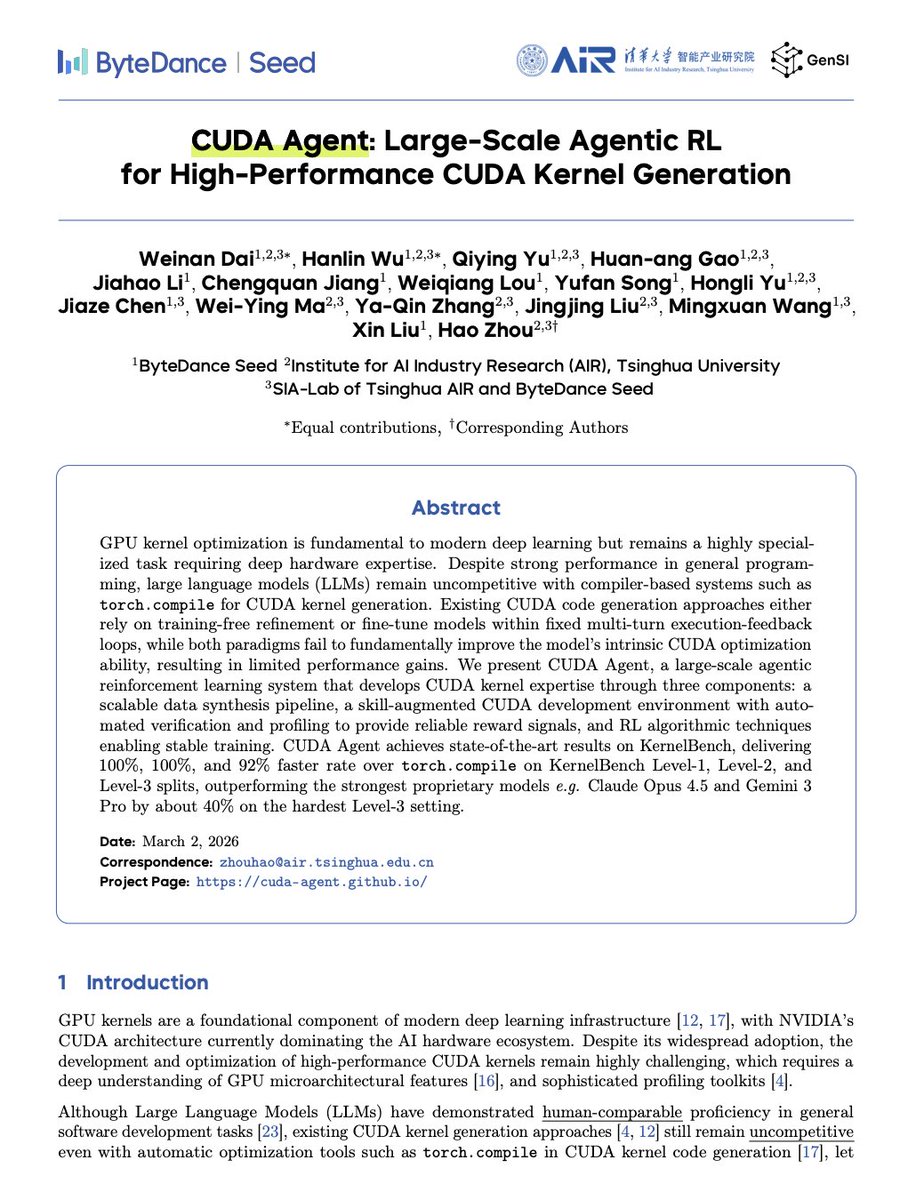
China built an AI that writes CUDA better than humans experts.
Writing high-performance CUDA kernels for GPUs has always been a black art. It requires a brutal, microscopic understanding of hardware architecture, memory hierarchies, and parallel processing.
Even the best LLMs have traditionally choked on it, completely outperformed by old-school compilers like torch.compile.
ByteDance and Tsinghua University dropped a paper introducing “CUDA Agent.”
It is a large-scale agentic reinforcement learning system that transforms LLMs from passive code-completers into active, autonomous hardware optimizers.
Instead of guessing code in one shot, the agent runs in a continuous, multi-turn loop. It writes code, compiles it, profiles the hardware bottlenecks, catches its own bugs, and rewrites it.
The results completely shatter previous benchmarks.
It didn't just match static compilers. It left them in the dust.
• 2.11× faster than torch.compile • 2.60× faster than standard eager mode
• Achieved a massive 98.8% pass rate on complex kernel generation tasks
It discovered advanced operator-fusion techniques that static compiler heuristics can't even see.
For years, we’ve assumed that while AI can write web apps and python scripts, deep hardware-level optimization would require human engineering for a long time.
That assumption just expired.
The models aren't just writing software anymore.
They are optimizing the silicon it runs on.
Please check out @DeepSeekHarness. We just released packaged desktop versions for macOS and Windows; Linux users can get it from the @deepseek-ai/dsh package on npm. https://t.co/Cde0dZ6cPy
Where does money invested into the AI buildout actually go?
For every $100 flowing into the supply chain:
- $50 to chips
- $20 to power
- $15 to networking
- $15 to cooling, buildings, and land
More charts in State of Markets II: https://t.co/MTaxKUxa2w
China built an AI that works like a human brain and it's 100x faster than current LLMs while using 97% less energy.
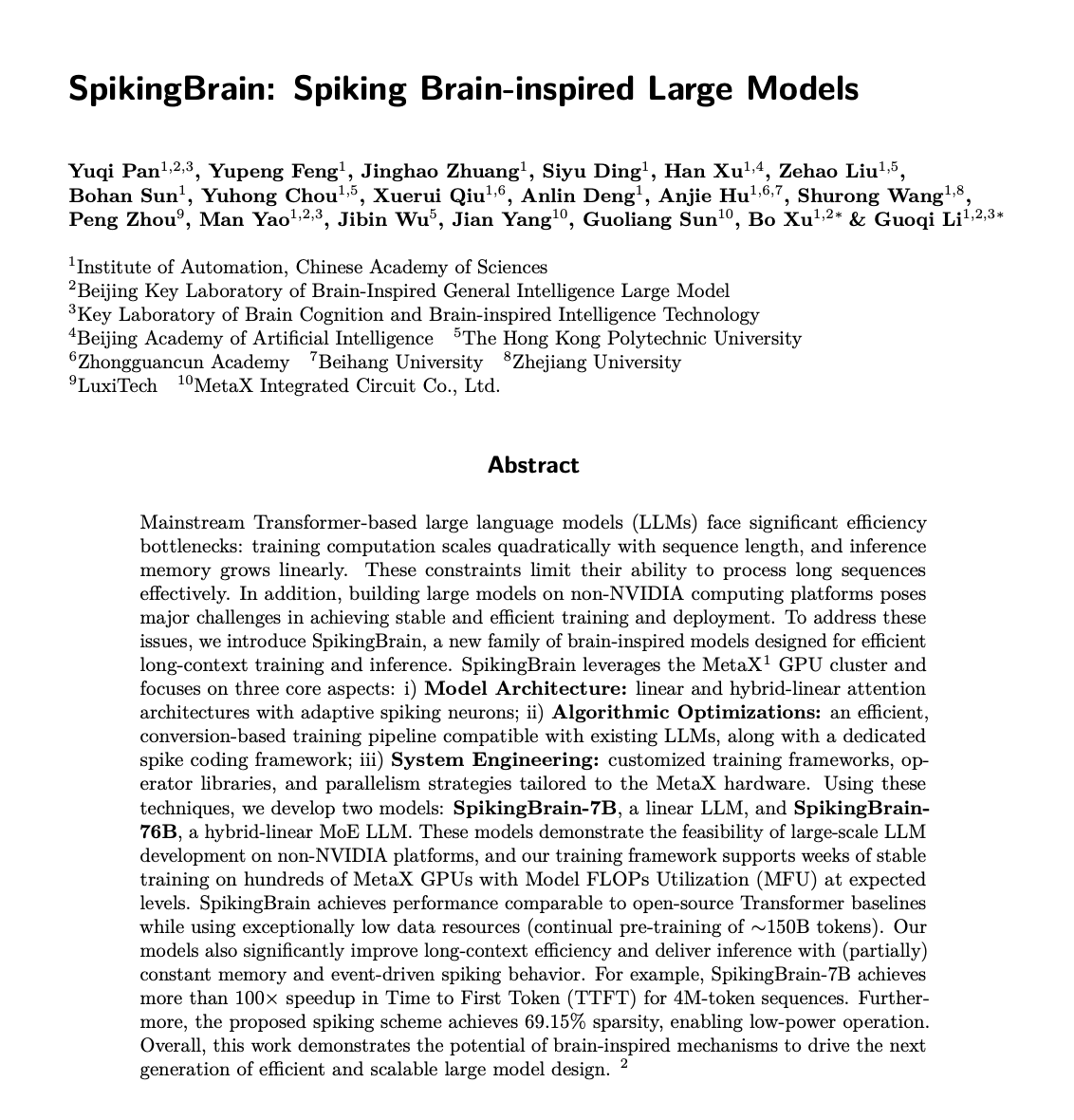
It’s called SpikingBrain, a family of brain-inspired large models that completely re-engineers how AI processes information.
Instead of burning endless energy on continuous matrix multiplications like traditional Transformers, SpikingBrain uses adaptive spiking neurons.
It mimics actual biological firing patterns.
Neurons only activate when triggered by specific events, meaning the model achieves a staggering ~69% sparsity at the micro level.
It doesn't waste compute on silence. It only thinks when it needs to.
And results change the game for long-context processing:
• Achieves over a 100× speedup in Time to First Token (TTFT) for massive 4M-token sequences.
• Matches performance with advanced open-source Transformer baselines while using a fraction of the data.
• Built to run and scale stably on non-NVIDIA hardware clusters (like MetaX chips), completely bypassing Western hardware dependency.
We spent years trying to brute-force bigger AI models by throwing more electricity and silicon at them.
Nature figured out how to do it efficiently millions of years ago.
The entire RAG industry is about to get cooked.
Researchers developed a new RAG approach that bypasses almost everything traditional RAG depends on.
- No vector DB
- No data embeddings
- No chunking
- No similarity search
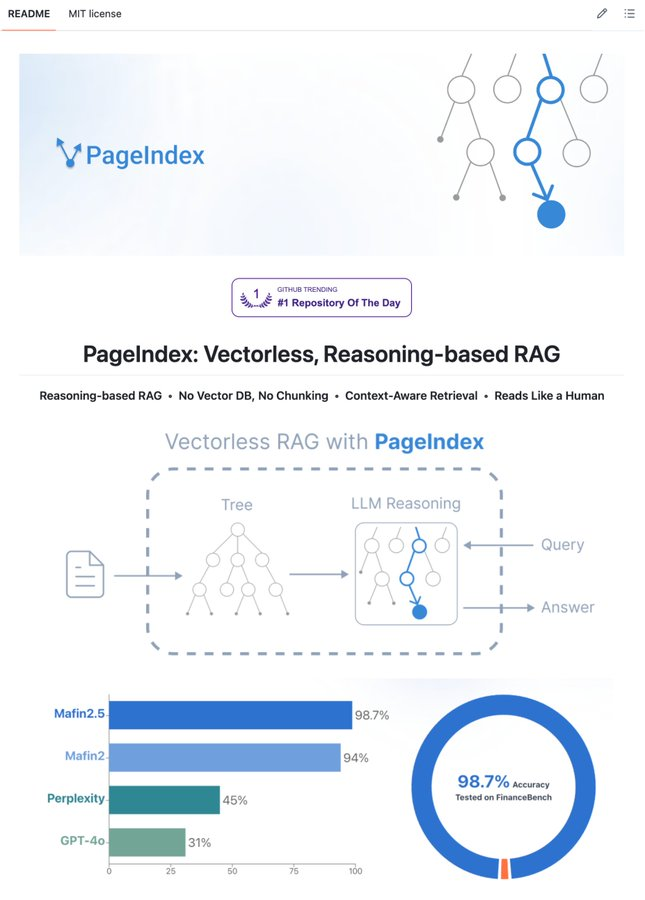
It's called PageIndex.
Instead of splitting your documents into chunks and loading them into Pinecone, it creates a tree index that lets the LLM reason through them like a human reading a book.
98.7% on FinanceBench. Outperforms every vector RAG on the leaderboard.
100% free. Open source.
[1/n] Can a world model drive without training a driving policy?
Introducing AD-E2E-JEPA, a JEPA-based world model for end-to-end autonomous driving.
📄: https://t.co/dU4Xe463sB
💻: https://t.co/NPCWFCGUPr
Joint work with @kevinghstz, Prof. @ylecun, and Prof. Anna Choromanska
These are the best visual AI resources for learning Transformers, LLMs, embeddings, diffusion, inference and model internals ↓
1/ Transformer Explainer - Watch GPT process text through embeddings, attention, MLPs and next-token prediction.
https://t.co/vkyxOqDVll
2/ Brendan Bycroft’s LLM Visualization - Explore an LLM from architecture down to tensors and operations.
https://t.co/ZFGH0pRtP3
3/ 3Blue1Brown - Visual intuition for linear algebra, neural networks, backprop, attention and Transformers.
https://t.co/plaENBG6aQ
4/ The Illustrated Transformer - One of the clearest visual explanations of embeddings, Q/K/V and attention.
https://t.co/tYrJCm17L6
5/ TensorFlow Playground - Watch neural networks learn as you change layers, activations, features and learning rate.
https://t.co/vva9dm1Gnv
6/ Google PAIR AI Explorables - Interactive explainers on LLMs, generalization, interpretability and model behavior.
https://t.co/vva9dm1Gnv
7/ Distill - Exceptional visual essays on t-SNE, feature visualization, GNNs and interpretability.
https://t.co/FuqpUdDwZD
8/ Abhik Sarkar’s Transformer Visualizations - RoPE, KV cache, FlashAttention, MQA, GQA and more.
https://t.co/vva9dm1Gnv
9/ Visual Guide to Attention Variants - MHA, MQA, GQA and MLA visually compared.
https://t.co/nbpKMa0cpT
10/ Visual Guide to Mixture of Experts - Routing, experts, sparse activation and load balancing.
https://t.co/3gu7xq5e3i
11/ Modular LLM Inference Handbook - Prefill, decode, KV cache, batching, quantization and speculative decoding.
https://t.co/itMIfZnPP5
12/ Apple Embedding Atlas - Explore clusters, neighborhoods and outliers in large embedding spaces.
https://t.co/hxKdXSp5I2
13/ Diffusion Explainer - Follow Stable Diffusion step by step.
https://t.co/YVHEG1zslC
14/ Neuronpedia - Explore features, activations, SAE latents and attribution graphs inside real models.
https://t.co/F8P8eNDH3W
15/ Seeing Theory - Probability, Bayes, distributions, regression and inference made interactive.
https://t.co/KeEhGNSMIQ
16/ CNN Explainer - Visualize convolutions, feature maps, activations and pooling.
https://t.co/sCwv59d2S6
17/ GAN Lab - Train a GAN in your browser and watch its generated distribution evolve.
https://t.co/G94RDWMNak
Save this. There’s a serious AI curriculum hiding inside these links.
Agents can be AI, but agency is human. It is every individual’s responsibility to empower our own agency, with the help of tools. But the North Star should always remain human centered.
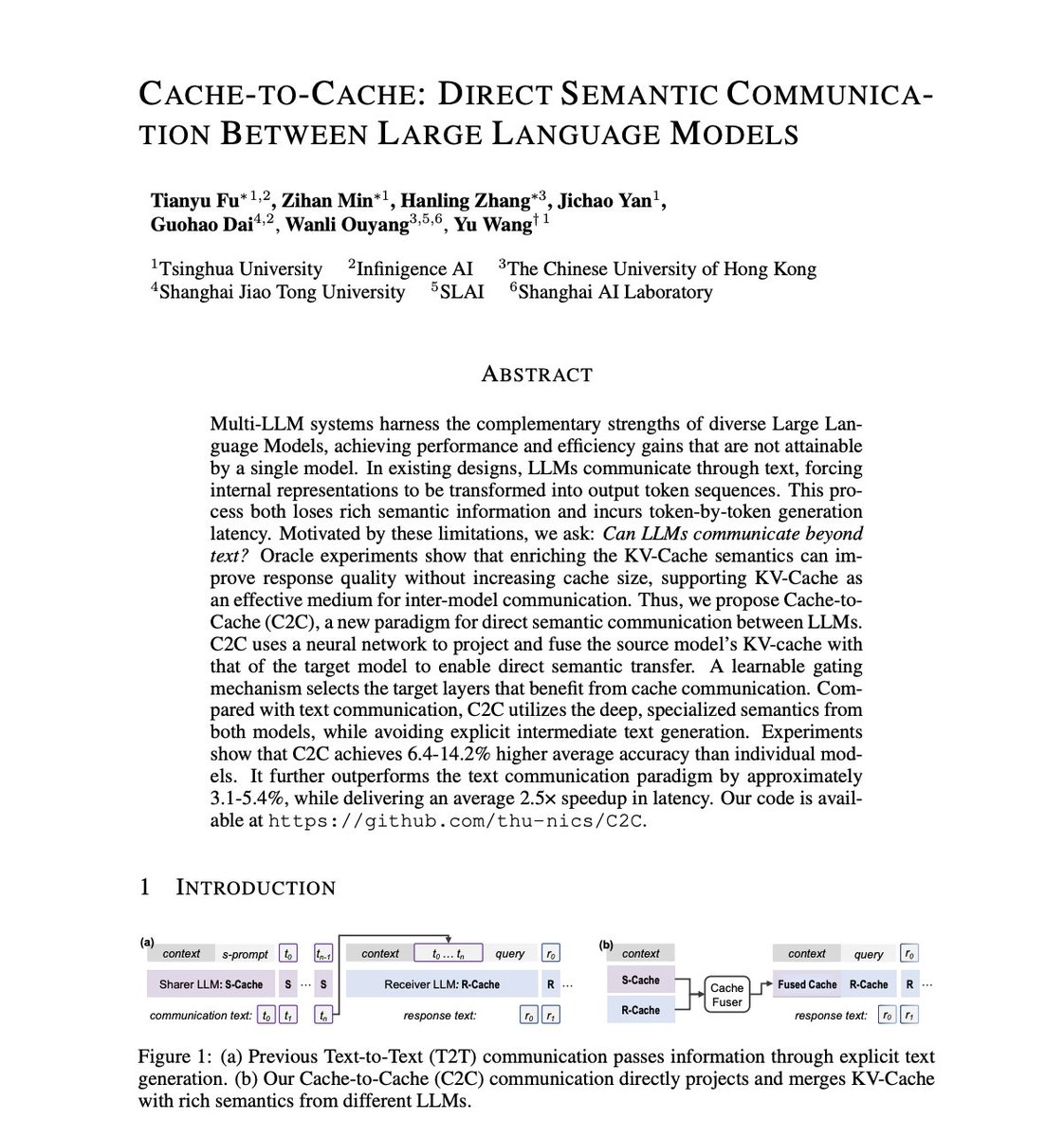
LLMs can now talk to each other without words.
Chinese researchers open-sourced a new paradigm that lets LLMs communicate without generating a single word.
It’s called Cache-to-Cache (C2C) communication.
right now, when multiple ai agents work together, they are forced to translate their internal "thoughts" into human text tokens just to pass a message. this loses rich semantic meaning and causes massive token-by-token latency.
So, instead of spitting out words, c2c uses a neural network to directly project and fuse the source model's "kv-cache" right into the target model. it is pure, direct semantic communication.. they even added a learnable gating mechanism to select exactly which layers benefit most from the cache transfer.
the benchmark results are actually crazy:
- avoids all intermediate text generation latency
- accuracy jumps by up to 14.2% compared to individual models
- beats traditional text-based agent communication by over 5%
- delivers a massive 2.5x speedup in overall speed
we are literally watching llms bypass human language to build their own silent, high-speed neural network..
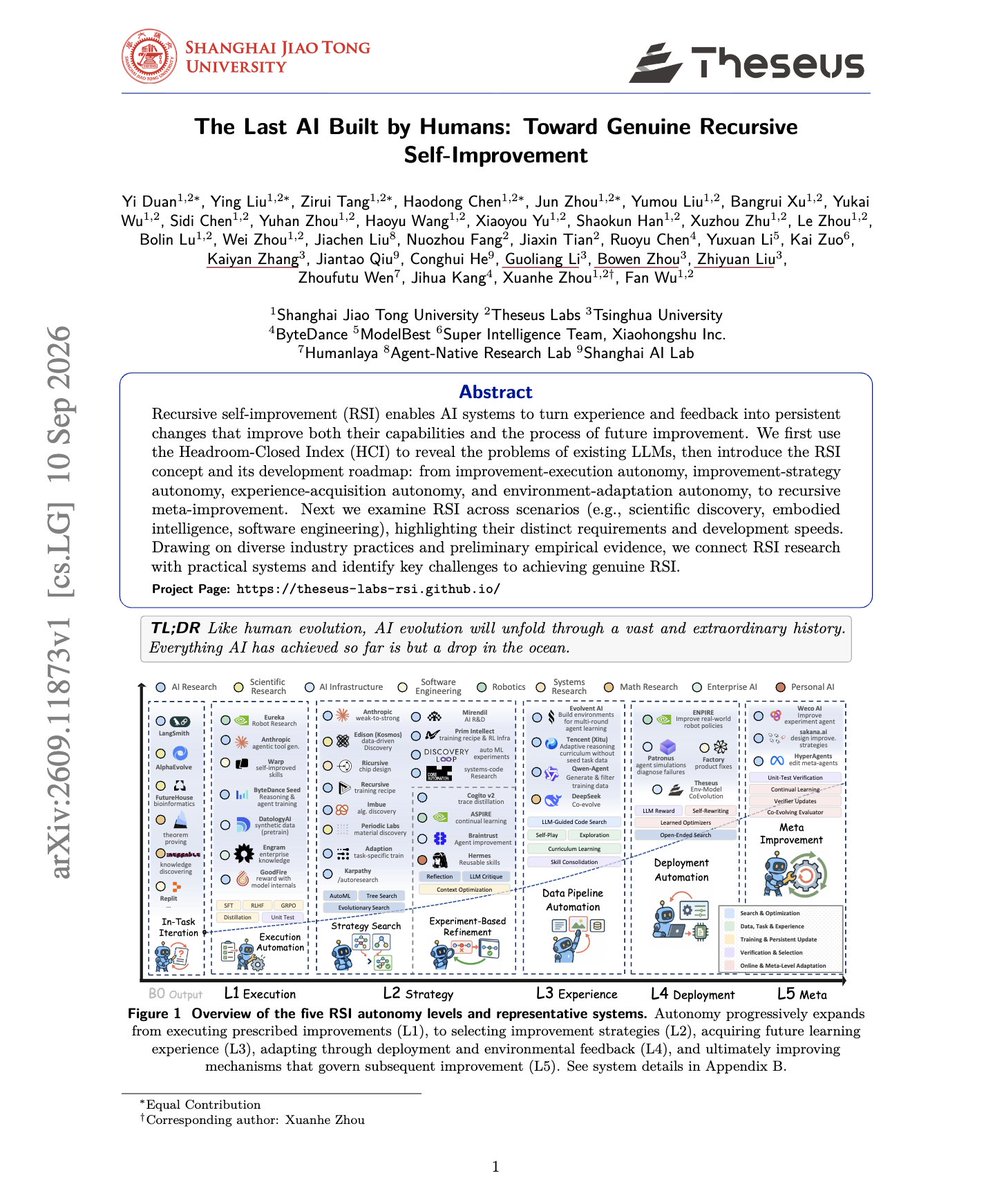
“The Last AI Built by Humans: Toward Genuine Recursive Self-Improvement”
This paper argues that true recursive self-improvement isn’t just AI getting better at tasks, but AI getting better at getting better.
They map a path from AI simply executing human-designed improvements to choosing its own improvement strategies, generating its own learning experiences, adapting from deployment, and eventually modifying the mechanisms that create future improvements.
The endgame is moving from humans building each better AI to building an AI whose improvements persist, feed into the next generation, and recursively improve the improvement process itself.
https://t.co/MbeNPZ4PA7