Mars in motion! ⏩
While on its way to explore a mysterious, metal-rich asteroid, our Psyche spacecraft sped by Mars for a gravity assist to pick up speed and adjust its trajectory. As it approached the planet, it captured this series of high-res snaps.
Reading between the layers: Evidence suggests a 245-foot-thick (75-meter-thick) stack of ancient rock on the rim of Jezero Crater was built by repeated asteroid impacts.💥
More on Perseverance’s finding: https://t.co/akuyj8xasU
Join us live on July 16 at 2 p.m. ET to meet the team building NASA’s Dragonfly, learn how it will explore Titan’s rich prebiotic chemistry (the molecules and processes that can lead to life), and see how the mission is coming together.
Set a reminder: https://t.co/1WNVoH6tEP
Skywatchers will be treated to two amazing sights in the night sky tonight: Comet 10P/Tempel 2 and the Milky Way. To find the comet, use binoculars to search for a fuzzy glow in the constellation Capricornus.
To study sea ice thickness, more than one view can help.
NASA scientists spent two weeks flying above the Arctic with cutting-edge sensors aboard. When combined with satellite and on-the-ground measurements, the data helps us better understand how the region is changing.
The International Space Station orbited over Los Angeles on July 4th as America marked 250 years of independence with a burst of fireworks lighting up the city below — a celebration so bright it reached all the way to space!
Today marks a new chapter for @Caltech and JPL as Ray Jayawardhana officially becomes the Institute’s 10th president!
We’re excited to work alongside him to explore new frontiers, pursue bold ideas that inspire the world, and champion the extraordinary people who make both possible.
Together, we’ll continue to dare mighty things. https://t.co/vkGzsPYhy1
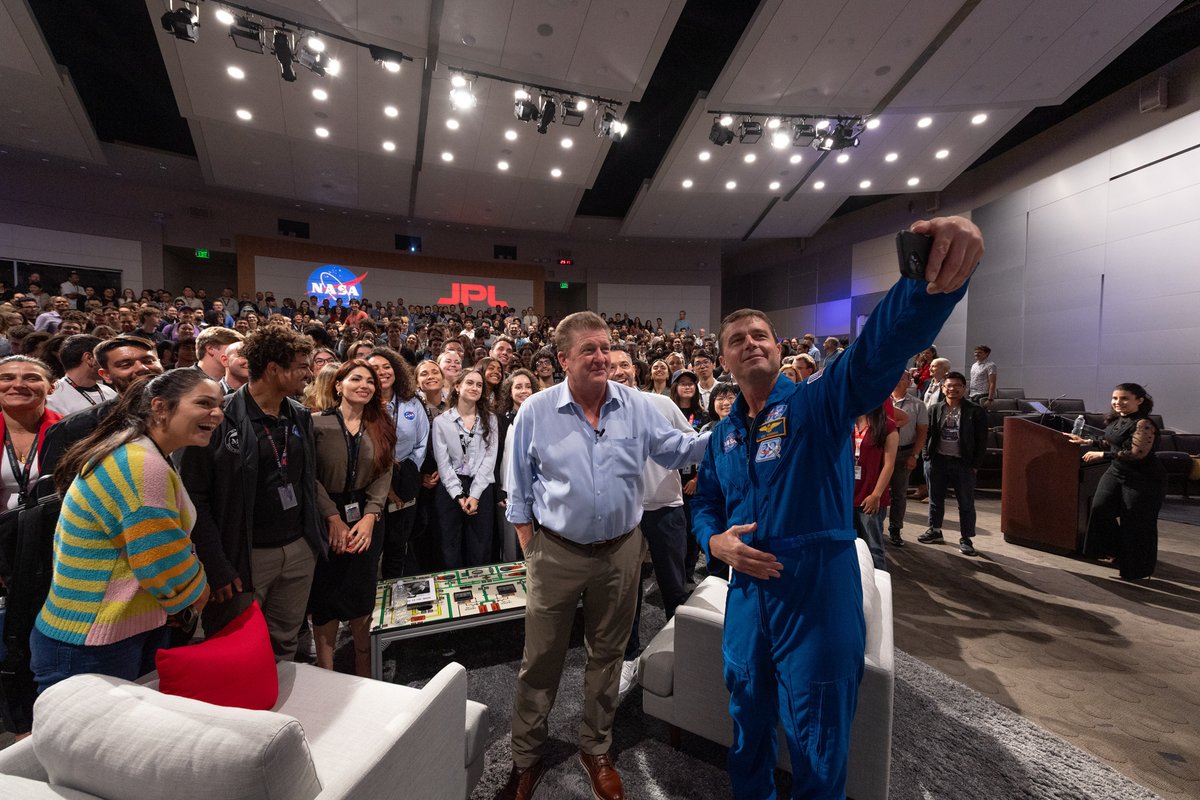
“Each of us has a little tiny, finite life. We have enormous gifts that need to be shared, and that's the stuff we need to be doing. We have got to push as far as humanly possible.”
Thanks to @astro_reid for the inspiring visit to JPL!
Finding asteroids before they find us!
Happy International Asteroid Day. NASA’s new NEO Surveyor mission is our next-generation near-Earth object hunter. Slated for launch next year, it will be the first spacecraft built specifically to find large numbers of asteroids and comets that are potentially hazardous to Earth.
As it scans the solar system, NEO Surveyor's sensitive infrared detectors will track the most elusive near-Earth objects — particularly ones that are hard to find with ground-based telescopes. https://t.co/EME2wW4WaB
Photo finish! 🏁📸
On June 14, Perseverance completed a Martian “marathon” by surpassing 26.2 miles (42.195 kilometers) of travel. The day before, NASA’s Mars Reconnaissance Orbiter snapped this view of the rover and its tracks from space.
New upgrades to the Cold Atom Lab aboard the @Space_Station are helping scientists take precise measurements of quantum phenomena that happen at the atomic level.
Learn more: https://t.co/7KUrtoBlOt