Current market thoughts 👀
I'll repeat myself again, we will see fresh all time highs in the indices in the coming weeks/months.
We have seen many of these fast pullbacks and all of them have been forgotten sooner after.
We bought a starter position for $WYFI at the 0.618 fib and I plan to make this a large position in my portfolio.
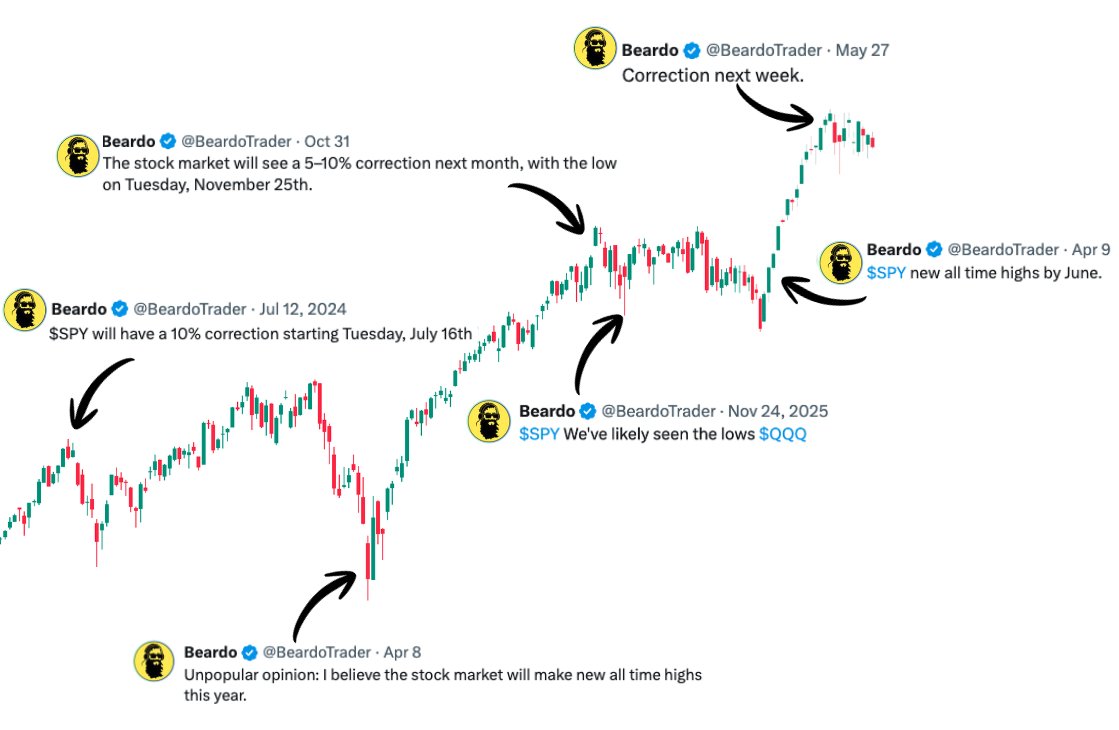
We have absolutely nailed this chart predicting a 40%+ pullback unlike the rest of FinX.
$ASTS has potential for a bottom here, but if price breaks this current support we move much lower.
$CRWV $IREN $RDW all look to be a large flat correction, we are much closer to a bottom than people think.
I'm planning to make $CAVA my next buy and I will buy big.
No changes to crypto as it's still wave 2, and wave 3 will truly make generational wealth. My favourite names are $ETH $BTC $SOL $MSTR $COIN.
$OKLO and $SMR, my two favourite nuclear plays, continue to make lower lows and I'm staying patient for support confirmation.
$HIMS is approaching the 200dma from above, lose this level and we go a lot lower.
$RDDT bouncing off the 50dma today and continues to be one of my favourite long term holds.
$ORCL making a lower low, confirming the Wave C I charted months ago. This will pull back lower with the rest of software such as $PLTR $ZETA $ADBE.
I am a huge buyer once $NU completes its pullback.
$NRGV and $ZTS are heavily underappreciated.
All charts related to anything mentioned here have been posted with entries and targets.
Any feedback on the account is always welcome, let me know what you'd find helpful and want to see more of.
Any questions, drop them below 👇
When there's an indiscriminate selloff like this, it's good to remind yourself of the fundamentals.
E.g. Look at space the past month.
Nothing has fundamentally changed... in fact, most names have gotten better.
$AMPG announced a stock buyback, terminating its offering from before, down ~30% since the IPO.
$ASTI's space PV passed Atomic Oxygen exposure testing, down ~60%.
Both $RKLB / $ASTS have had new deals and authorizations, yet they're down ~40%.
$CPSH is still a solid bottleneck play for US AlSiC, down ~48%.
$FLY won a NASA contract and another JPL subcontract, down ~49%.
$SATL signed a new geospatial partnerships, down ~51%.
Same with $SPIR, $VELO, $YSS, and basically the rest of the sector.
It definitely doesn't help with $SPCX dragging down sentiment for the sector, oil ripping from the blockade, or KOSPI rugging every night.
(Same can be said about semis, neoclouds, robotics, and just about everything else)
For those who have held this entire time, I do think everything will pick back up eventually.
For those who took my warning about not holding through the IPO, you now know why. The post-IPO turbulence is no joke.
@EchoAnalysis Thanks for posting this. I ordered 50000 shares at $36. Once I saw your previous posts, I canceled. Only 50 shares filled at $35.73 so I’m down $339, Which is not bad compared to 50000 shares.
Jensen Huang is literally telling you what stocks to buy for the AI supercycle.
Here are 10 stocks Jensen has mentioned or invested in.
1. $NOK - Nokia
NVIDIA invested $1B directly. Building the AI-RAN platform for 6G together. Trials with T-Mobile starting in 2026. The AI-RAN market is expected to exceed $200B in cumulative sales by 2030.
🚨Be careful. Something bad may be coming
I predicted this S&P 500 rally, but now I see something different.
A bearish pattern is forming.
Every 4 years, July was followed by a big $SPX sell-off.
Data:
July 1998 → -23.71%
July 2002 → -32.41%
July 2006 → -9.60%
July 2010 → -18.94%
July 2014 → -11.05%
July 2018 → -19.27%
July 2022 → -19.92%
July 2026 → -????
This pattern has never failed.
My first target is 6,320.
If you want to buy stocks, wait about a month.
See how the market moves.
I will post a warning before the news does.
Very strange coordinated pump effort in $WYFI recently…and, to no surprise, it doesn’t appear to be working.
I shared this chart with a few people over the weekend and said the bearish divergence suggested a rollover back toward the $24–$26 area was the higher-probability outcome.
$SPCX ROADMAP:
$150 → $200 → $75
$75 → $90 → $80
$80 → $130 → $170
$170 → $200 → $250
Bookmark this tweet and compare it later 🔖
Now here’s why.
This chart is not random.
It’s following the same IPO trap structure almost perfectly.
Stage 1:
– Day 1 euphoria
– Retail buys the hype
Stage 2:
– First brutal selloff
– Everyone who chased the launch gets punished
Stage 3:
– Dead money
– The crowd gets bored
– Then scared
– Then sells at a loss
That’s the entire point.
– Institutions don’t buy when everyone is screaming about the IPO
– They wait until nobody cares
– They buy when retail gives up
Stage 4:
– The real move begins
– Not from the hype
– Not from Day 1
From the zone where everyone is too scared to touch it.
Don’t be exit liquidity.
Be patient.
Keep in mind: I’ve called every major market top and bottom for over 10 YEARS.
I was one of the only people who called the top in October, and I’ll do it again, that’s literally my job.
If you still haven’t followed me, you’ll regret it.
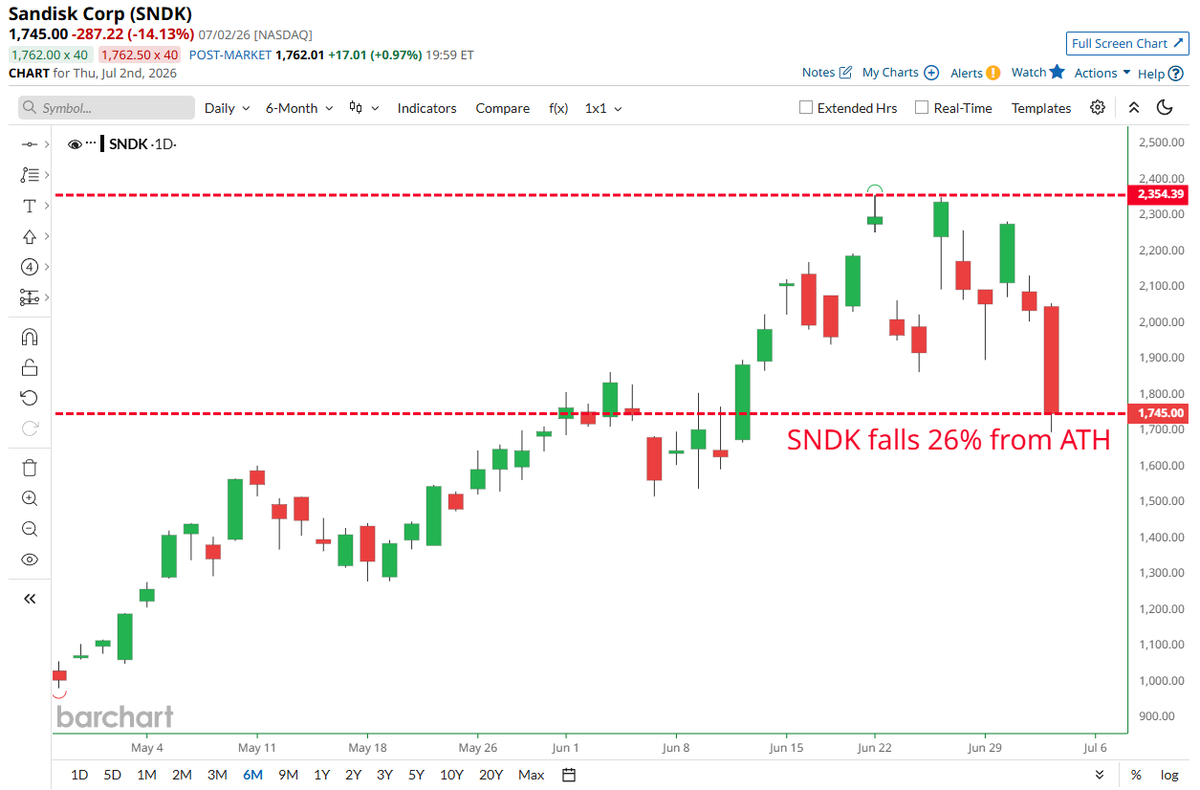
1 year ago, $SNDK ran from $40 to $2400 for 6000%
Then it crashed back to $1500 before spiking again.
Here's 4 set-ups exact 1000% potential:
1. $BE (Bloom Energy)
Buy zone: $220–230 = prior base / breakout retest
• AI data centers need power NOW → fuel cells = fastest time-to-power
• Brookfield just scaled their AI-infra partnership to $25B (5x expansion)
• Q2 earnings Jul 28 first real profitability inflection
2. $ASTS (AST SpaceMobile)
Buy zone: $64–72 = double-bottom reload
• Only space-based cellular broadband hitting phones direct (not hype anymore)
• AT&T + Vodafone = distribution already solved
• BlueBird 11/12/13 launch from Cape Canaveral this Aug → constellation scaling
3. $IONQ (IonQ)
• Pure-play trapped-ion quantum leader (early innings like NVDA 2016)
• Genesis Mission + Trump quantum EOs = government tailwind (Aug deadline)
• Gov + enterprise contracts stacking
Buy zone: $35–38 = accumulation on pullback
4. $NBIS (Nebius)
• Full-stack AI neocloud GPU clusters + platform + tooling
• €27B Meta deal + Microsoft = anchor customers locked
• Raised ARR guide to $900M–$1.1B, now in the Nasdaq-100
Buy zone: $180–200 = breakout shelf / prior base
Pay attention, these don't move because they're cheap. They spike because narrative + timing + execution align just like $SNDK
$SNDK spiked 6000% in 1 year, but robotics is the next theme. I'd pay attention to this one too:
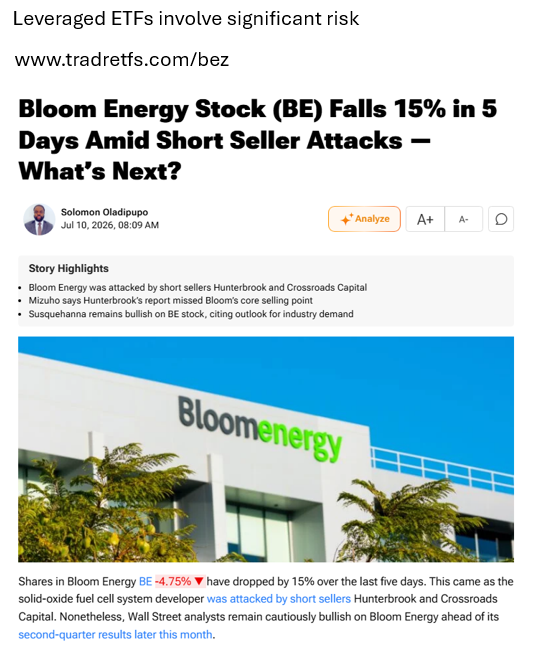
Bloom Energy was up 2,000% in 2 years, but was it built on a lie? Hunterbrook Capital, a short-selling fund, says $BE is reliant on Chinese scandium despite its CEO saying otherwise. For magnified bearish exposure, consider the Tradr 2X Short BE Daily ETF $BEZ from @TradrETFs
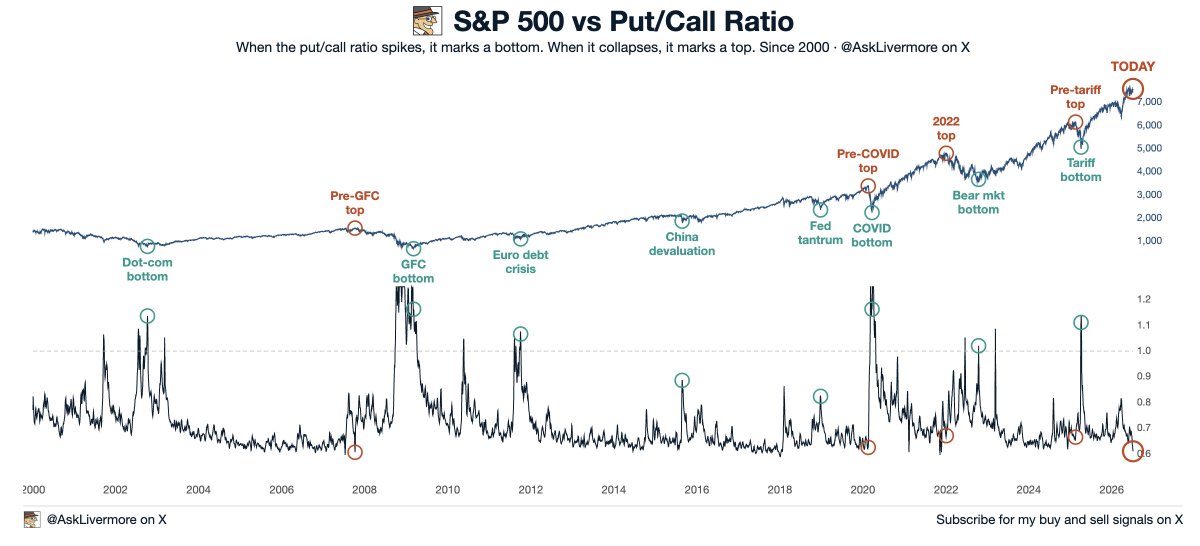
This is all you need to time the stock market. Save this. Screenshot it. You will need it.
The put/call ratio tells you when everyone is panicking and when everyone is too comfortable.
Every single time the put/call ratio spiked above 1.0 since 2000, it marked a generational buying opportunity:
- Dot-com bottom (2002)
- GFC bottom (2009)
- COVID bottom (2020)
- Tariff crash (2025)
Every single time it collapsed below 0.70, a pullback followed:
- Pre-GFC top (2007)
- Pre-COVID top (2020)
- 2022 top
- Pre-tariff top (2025)
Right now? The put/call ratio just hit 0.61, the lowest since December 2020. That means options traders are the most bullish they've been in nearly 6 years.
Does that mean sell everything? No.
But it means this is the time to stay balanced, not all-in into one sector. The best buying opportunities will come soon, stay patient.
When everyone is greedy, be cautious.
When everyone is fearful, be aggressive.
Trump made 220% profit on this stock in a few months.
It has now collapsed 47% from its highs and you can buy it 26% below the President's own exit price.
Here it is:
$SLNH
Here we have someone claiming to have done “DD,” yet somehow the entire analysis seems to consist of:
- attack @mikealfred
- call $SLNH worthless
- ignore everything actually happening inside the company
- press post
Well here is what Soluna has actually done:
- Built a real operating data-center hosting business, with Q1 2026 revenue growing strongly year over year.
- Has already shown smaller-scale execution with Kati 1 going live and contributing to Q1 growth. Not hyperscale AI proof yet, but not a zero-execution story either.
- Shifted from being viewed as a proprietary Bitcoin mining story toward a broader power-backed digital infrastructure platform.
- Built a diversified model, not just an “AI trend” pitch: BTC hosting, AI/HPC infrastructure, owned power, grid services, demand response/ERS, project development and power monetization.
- Has a clear low-cost MW angle. The point is not just “more megawatts”; it is cheap, controllable, power-backed MW that can become financeable infrastructure.
- Controls a larger 4.3 GW renewable-powered data center pipeline, so Kati 2 and Dorothy 3 are not isolated one-off ideas.
- Kati 2 is not a tiny side project. It is being developed as a 350MW+ AI/HPC campus, with management previously discussing a roadmap that could potentially scale beyond 1GW over time.
- Positioned Dorothy 3 as a potential 150MW to 300MW AI/HPC campus, backed by controlled power rather than a random grid-queue dream.
- Secured the EDF/Masdar behind-the-meter power structure at Project Kati, tied to the Las Majadas Wind Project.
- Soluna and Metrobloks are also working with EDF Power Solutions North America to expand the power available for Kati 2 beyond the initial structure.
- That EDF Power Solutions North America relationship now has a much bigger backdrop, with the platform moving under KKR’s umbrella which is one of the world’s largest infrastructure investors, actively targeting renewables, power and AI data-center infrastructure.
- The KKR angle is bigger than EDF alone. KKR’s Helix platform launched with over $10B committed capital alongside NVIDIA, Vistra and KIA to coordinate data centers, power and connectivity for AI demand.
- Acquired the 150 MW Briscoe Wind Farm, giving Soluna owned power at Project Dorothy and a much stronger vertical-integration angle.
- Brought in Metrobloks for Kati 2, and this is not some random consultant. Their team brings deep hyperscale data-center experience across AWS, Meta, Equinix and global infrastructure development.
- Metrobloks matters here because it fills the exact credibility gap bears point to: hyperscale AI/HPC design, leasing, operations and tenant engagement.
- Moved Kati 2 from MOU to a definitive JV structure.
- Completed initial design work for Kati 2.
- Launched the RFP process for Phase I design-development and construction.
- Advanced tenant due diligence with hyperscalers and neoclouds.
- Started formal commercial negotiations with at least one potential tenant.
- Now appears to be moving toward the real unlocks: tenant, lease, project financing and construction execution.
The macro tailwind? ⬇️
- AI data centers need massive amounts of power.
- Grid queues are getting longer.
- Power availability is becoming a bigger bottleneck than land alone.
- Transmission constraints and curtailment are becoming more visible.
- Infrastructure capital is moving toward power, renewables and data-center capacity.
- Flexible load, demand response and grid-aware compute are becoming more valuable as peak demand rises.
So my question here is simple: Are you bearish on the actual setup or just arguing with the old Soluna still stuck in your head? @DeepValueBagger