Fungal bioelectricity offers broad potential.
It does not require external input to generate signals.
Spontaneous activity can support decentralized and self-regulating control in robotic systems.
🍄🤖 BREAKTHROUGH: Mushroom-Controlled Robots at Cornell! 🤖🍄
Cornell University engineers have given a *king oyster mushroom* a robot body—and it’s learning to move! Here’s how this wild #AI x #Biohybrid experiment is pushing the boundaries of robotics, biology, and environmental sensing:
🔹 **Living Brainpower:**
Researchers grew *Pleurotus eryngii* (king oyster) mycelium directly into robotic hardware, allowing the fungus’s natural electrical signals to control the robot’s movement. No traditional computer “brain”—just mushroom!
🔹 **How It Works:**
- The robot interprets the mushroom’s electrophysiological activity (tiny electrical impulses in the mycelium, similar to neural activity)
- These signals are translated into commands that make the robot move, twitch, or roll across surfaces
- The robots can sense and respond to their environment, including changes in light and other stimuli
🔹 **Types of Robots:**
- A wheeled bot that rolls across the floor
- A soft-bodied, five-legged “star” robot that shuffles awkwardly
🔹 **Why Mushrooms?**
Fungal mycelia are highly sensitive to environmental cues, making them ideal for sensing and adaptive behavior in robotics.
🔹 **First-of-its-Kind:**
This is the first published work showing *fungi* providing real-time sensorimotor control for robots, opening up a new field of “biohybrid robotics” where living organisms and machines become one.
🔹 **Potential Impact:**
- More autonomous robots that can adapt to unpredictable environments
- New ways to harness living materials for sustainable, responsive tech
- Lays groundwork for future research using the *fungal kingdom* for smarter, eco-friendly machines
🔹 **Quote from the Team:**
“This is just the first of many projects that will use the fungal kingdom to provide environmental sensing and command signals to robots,” says Prof. Rob Shepherd.
🔗 Read More:
ScienceAlert: https://t.co/H5fAjgCcx5
CNN: https://t.co/ioNIVEUfkq
Cornell Chronicle: https://t.co/e3AvqEocAi
#AI #Robotics #Fungi #Biohybrid #MushroomRobot #Science #Innovation #NatureMeetsTech 🍄🤝🤖
The Current State of Biohybrid and Soft Robotics
Exploring how biology and robotics are converging to create machines that grow, heal, and even reproduce.
Check out my latest article in Matthew Berman’s Forward Future AI: “Biohybrid & Soft Robotics: The Surge of Living Machines”
These innovations are reshaping industries and challenging our understanding of life and technology.
#AI #Robotics #Biohybrid #SoftRobotics #DylanCurious #ForwardFutureAI @forwardfuture
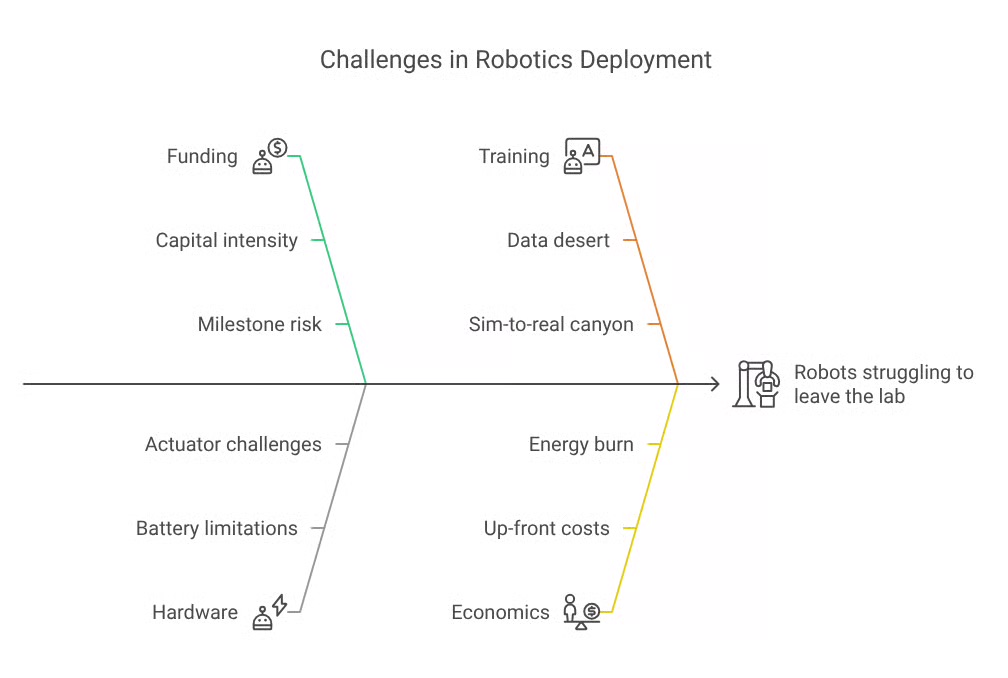
Robots look amazing in the demo.
Then trip over a curb IRL.
The robotics revolution is stalling in all the boring, messy places: frozen floors, fragile mugs, bad unit economics.
Curious what it’ll take to bridge the sim-to-real gap?
This one’s worth your time.👇
Trending in #Robotics:
https://t.co/q8RNrZcToi
1) Ultrafast jumping in soft robots (@SciRobotics)
2) On-site construction with aerial robots
3) Biohybrid robot contracts like the human iris
4) Poligromorph Materials (@Advintellsyst)
5) LiDAR odometry & dual quaternions
MIT's new artificial muscles move like the real thing—multi-directional, biohybrid, and built for the future of soft robotics. Game-changer tech right here. https://t.co/wVAhfGGshW @jonirwin
🌿 @Cornell researchers crack a 100-year mystery—plants use pressure to send stress signals! This could lead to two-way communication between plants and farmers.🌾💧
🔗 Read more: https://t.co/ieT8sUnwZt
#Cornell#PlantScience#AgTech#CROPPS
@multicellgenome Apr 21
Morphogenesis, starvation, and light responses in a mushroom-forming fungus revealed by long-read sequencing and extensive expression profiling
That is, extensive expression profiling
https://t.co/4dOlTvl113
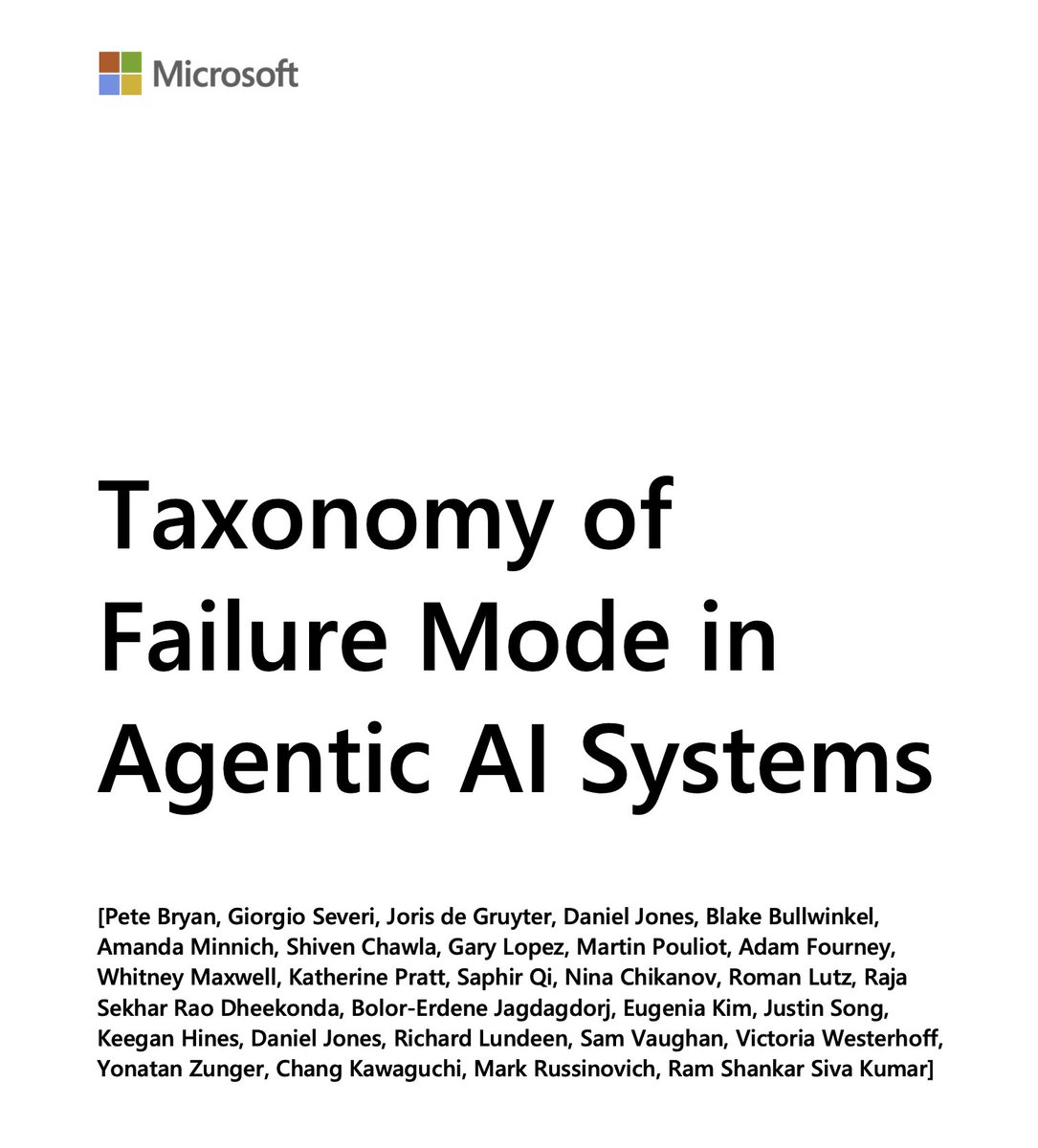
Neat report from Microsoft providing a taxonomy of failure modes in agentic AI systems.
If you are building agentic systems today, you will run into many issues.
Some of the common ones are summarized in this report.
Great resource for AI devs.
MycoDAO is building the first decentralized fungal biotech powered by Solana.
We collect all the fungal tissue on the planet into our BioBank, rewarding users who find new fungi.
— DeSci built with 🍄 mushrooms, owned by the people.
Learn more at https://t.co/tkJVr1hiq7
Elon Musk: "Once you have general purpose humanoid robots and autonomous vehicles ... there's no actual limit to the size of the economy."
@elonmusk breaks down the amazing potential of AI plus robotics:
"I think that there's no actual limit to the size of the economy."
"Once you have general purpose humanoid robots and autonomous vehicles, you can build anything."
"The economy is really just the average productivity per person times number of people. That's the economy."
"And if you've got humanoid robots where there's no real limit on the number of humanoid robots, and they can operate very intelligently, then there's no meaningful limit to the economy."
"The good future of AI is one of immense prosperity, where there is an age of abundance, no shortage of goods and services, everyone can have whatever they want."
"Anything that is a manufactured good or provided service, with the advent of AI plus robotics, the cost of goods and services will trend to zero."
This is from Elon's amazing interview at the 2024 All-In Summit.
Apply for 2025: https://t.co/AWcgvLf2yZ
With the announcement of our acquisition of @pollenrobotics, many people have been asking me what is "open-source AI robotics"?
In my opinion, it's a mix of:
- Open-source models (https://t.co/GPsdf17ZAk + @LeRobotHF + others)
- Open-source datasets (https://t.co/4ZOIEmz8Lz)
- Open-source hardware (can be 3D printed or standard like https://t.co/B6uWgsDTeH).
Anything else? Maybe ultimately, you could even have an open-source app store of robotics skills (https://t.co/fiKRLRqQ6I?) that you pick from to train your robots to do thousands of fun and useful things.
We've been surprised to see thousands of people building their open-source robotic arms with the latest tutorial we released so we believe there's demand for it: https://t.co/jqcNdLCquj!
Let's go!
This is a clear sign that, in reality, Trump isn’t seeking to manufacture iPhones in the US.
Phones are in the old tech basket.
Much like TV screens and regular laptop and desktop computers.
The goal is to build AI chips, robots and EVs.
Tech boom 2.0
What if low-cost robots could handle high-precision tasks? [Paper ⬇️]
This team shows it’s possible with only 10 minutes of demos.
✅ Learns fine manipulation like threading, slotting, and opening lids
✅ Works without expensive robots or fancy sensors
✅ Uses a simple teleop interface for data collection
✅ New ACT method avoids common imitation learning failures
Shows what’s possible when you rethink how robots learn.
Project: https://t.co/ptYUzwFwre
Paper: https://t.co/75qYPPwmeV
♻️RT to convince @tonyzzhao, to be on my podcast @builddeeptech!
🤖 Diving into Robot Foundation Models! 🧠
Starting a small series of Demystifying Robotic Foundational models starting with πο (Pi0) from @physical_int. Understanding Pi0 gives great context for later models like Gemini Robotics & GR00T N1.
The core idea behind many robot foundation models? Leverage existing Vision-Language Models (VLMs)! 🌐
Why? VLMs trained on web data already grasp language & visual concepts – super useful for robots understanding tasks & scenes. Pi0 builds on this foundation. It uses Google's PaliGemma (a ~3B parameter VLM) as its base. It's relatively lightweight for a foundation model!
The goal is to adapt this VLM, turning it from understanding vision/language (VLM) into a model that can also *act* (VLA - Vision-Language-Action).
Now How does this by adding a dedicated ~300M parameter "Action Expert" module. 🦾
The action expert has its own weights but works tightly with the VLM backbone. Think of it like adding a specialized motor control unit to the VLM's brain. (Inspired by Transfusion architecture).
Generating robot actions (continuous joint movements) is tricky for standard models. Pi0's Action Expert uses a cool technique: Conditional Flow Matching. This is one of the neat tricks behind Pi0. ✨
It learns to generate smooth, realistic, continuous action sequences using a flow matching loss (more on this soon!).
👇🧵 1/4