@_Checkmatey_ Thanks for another banger! What are some macro podcasts you'd recommend for someone who can follow what you talked about here and would like to go deeper?
Jeff is super insightful & I enjoy his podcast appearances where hosts get him to unpack his ideas for plebs like me.
But his writing often feels out of reach.
So I unpacked Jeff’s Theory of MicroStrategy with the help of ChatGPT — great stuff 👌
https://t.co/EK72hN20pa
As $MSTR officially enters the NDX 100 today, here is my 1-page executive summary on the "Theory of MicroStrategy" and how to profit off of the unstoppable hyperfinancialization of finance.
The trade of the decade is just getting started. Buckle up.
@HamelHusain Submitted 📨
Are you planning to make the other recordings available? Missed this and wish I had registered, but Maven registration is closed and says there won't be future cohorts 😢 Would love to check out other sessions @bclavie mentioned 🙏
@cursor_ai my account says I'm not subscribed to Pro but I'm getting charged. Try to reach out by email, no response. Could you DM me so I can share account details and you can investigate please?
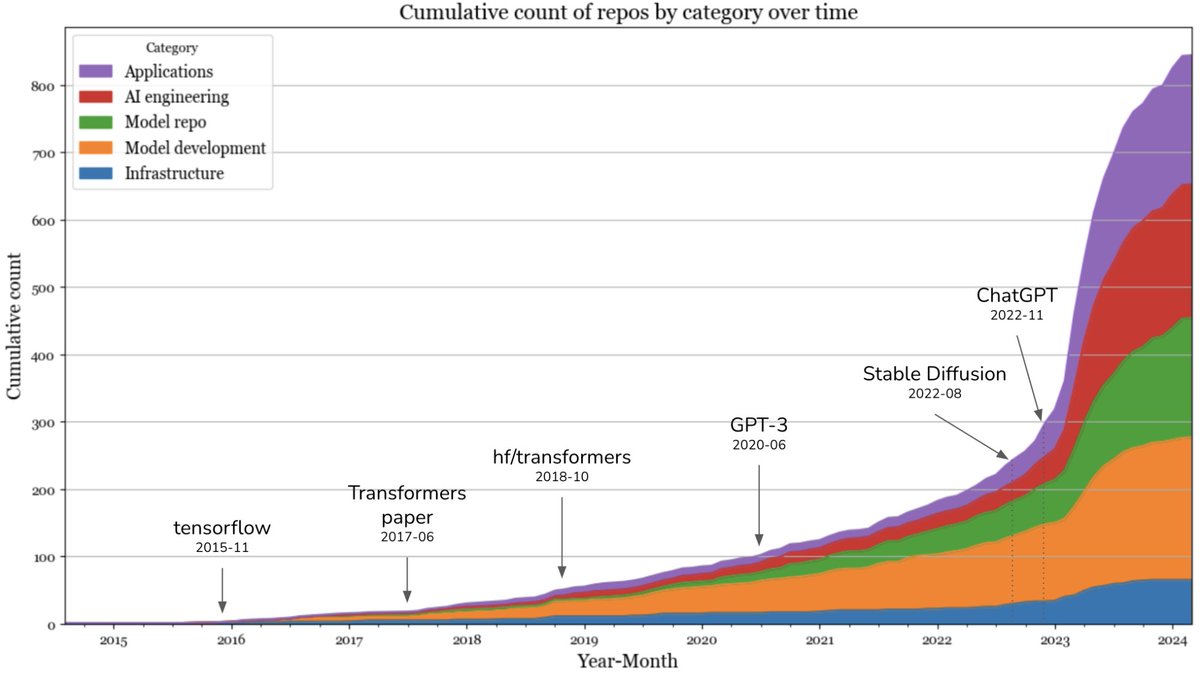
I went through the most popular AI repos on GitHub, categorized them, and studied their growth trajectories. Here are some of the learnings:
1. There are 845 generative AI repos with at least 500 stars on GitHub. They are built with contributions from over 20,000 developers, making almost a million commits.
2. I divided the AI stack into four layers: application, application development, model development, and infrastructure. The application and application development layers have seen the most growth in 2023. The infrastructure layer remains more or less the same. Some categories that have seen the most growth include AI interface, inference optimization, and prompt engineering.
3. The landscape exploded in late 2022 but seems to have calmed down since September 2023.
4. While big companies still dominate the landscape, there’s a rise in massively popular software hosted by individuals. Several have speculated that there will soon be billion-dollar one-person companies.
5. The Chinese’s open source ecosystem is rapidly growing. 6 out of 20 GitHub accounts with the most popular AI repos originate in China, with two from Tsinghua University and two from Shanghai AI Lab.
Everything I'll forget about RAG part 3 is about something that bugs me in most RAG pipelines - the complete neglect of structure.
https://t.co/pwHkqTIbS4
GPTs and HF assistants are pretty underused as didactic tools - so much easier to show rather than tell
Practical Tips and Tricks used in a Production RAG Application
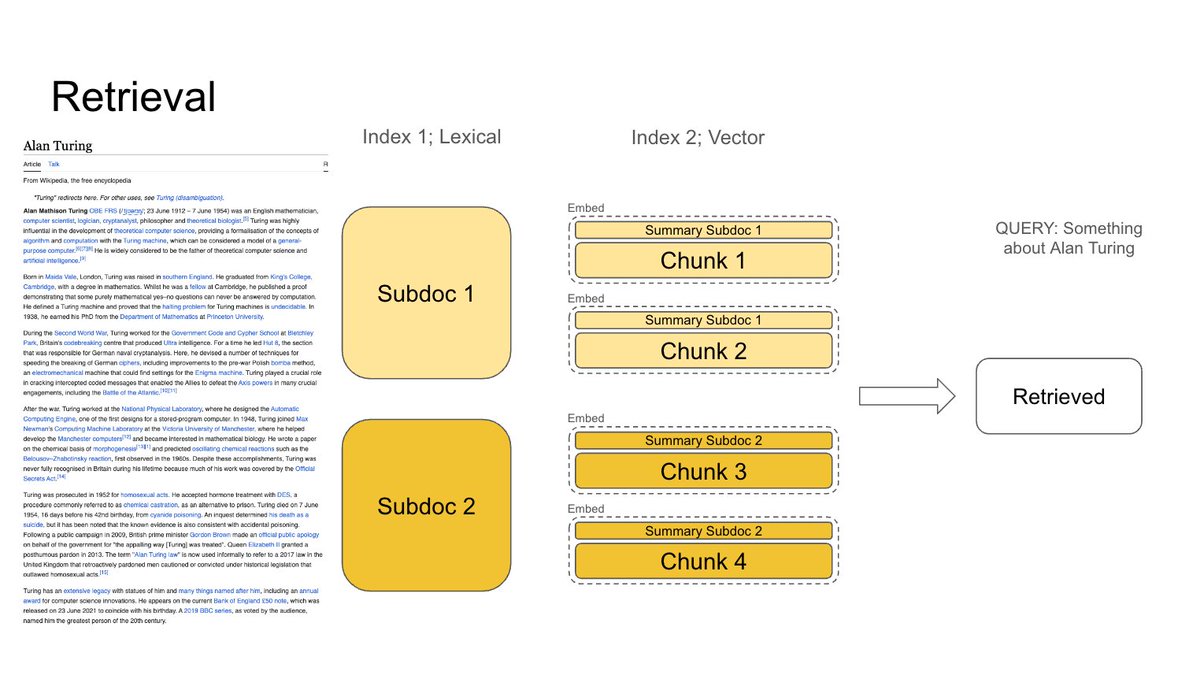
There’s hundreds of RAG techniques, but the most useful ones are those that power a live LLM application. @sisilmehta from @heyjasperai presents some new best practices that helped his team deploy a production app with good tradeoffs between accuracy, speed, latency 📈.
1. Injecting “sub-document metadata” to each chunk for global context that also isn’t too vague
2. Using LLMs to rerank chunk summaries to save tokens but also do better than cross-encoders
3. Use XML and emotion prompting to get well-structured outputs free of hallucinations.
Check it out: https://t.co/f0Ix9GuyBi
Interesting trend in AI: the best results are increasingly obtained by compound systems, not monolithic models.
AlphaCode, ChatGPT+, Gemini are examples.
In this post, we discuss why this is and emerging research on designing & optimizing such systems.
https://t.co/tfnNuoTNNY
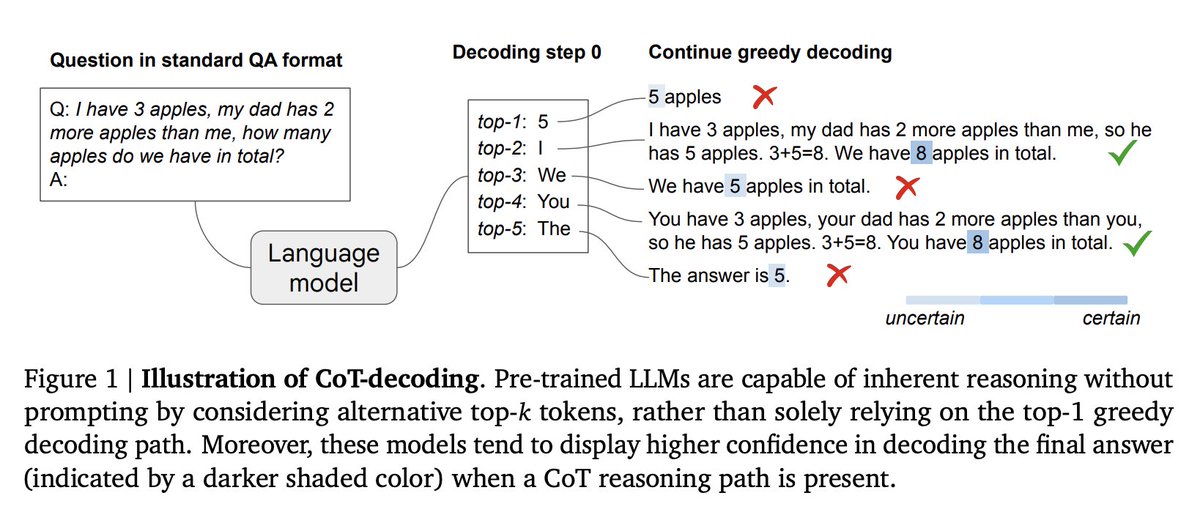
Chain-of-thought reasoning without prompting
New paper by DeepMind suggests that CoT reasoning could emerge by changing the decoding process.
Replace greedy decoding by investigating top-k token paths and find step-by-step thinking along some of them.
https://t.co/iPrrJVPynh
Meta’s LLM for software testing work is super exciting.
This paper describes Meta’s TestGen-LLM tool, which uses LLMs to automatically improve existing human-written tests. TestGen-LLM verifies that its generated test classes successfully clear a set of filters that assure measurable improvement over the original test suite, thereby eliminating problems due to LLM hallucination. We describe the deployment of TestGen-LLM at Meta test-a-thons for the Instagram and Facebook platforms. In an evaluation on Reels and Stories products for Instagram, 75% of TestGen-LLM’s test cases built correctly, 57% passed reliably, and 25% increased coverage. During Meta’s Instagram and Facebook test-a-thons, it improved 11.5% of all classes to which it was applied, with 73% of its recommendations being accepted for production deployment by Meta software engineers. We believe this is the first report on industrial scale deployment of LLM-generated code backed by such assurances of code improvement.
We'll be open sourcing an LLM → UI streaming mechanism powered by the @vercel AI SDK and RSC.
It will help you build rich AI apps that go beyond text and markdown, with optimal performance and robustness to UI state changes.
Super exciting release 🔥
ColBERT is clearly the way to go and this makes it much more accessible to deploy in prod – thanks for the great work @jobergum & @vespaengine 🙏
Announcing ColBERT in @vespaengine, enjoy!
- A new native Vespa ColBERT v2 embedder
- ColBERT token-level vector compression (32x)
- Support for long context via Vespa mixed tensors
- Offload to disk
- Eval
Plus, it boasts the largest FAQ ever!😅
https://t.co/kNHMvXpV3e
@tcosta@raphaelschaad Thanks! Now I have the Notion icon when the app's running and your icon after quitting. Any way to have your sweet sweet dark icon when it's running too?