1/ Today we’re unveiling Bombadil, @electricplantco's foundation model that reads the electrical signals of living plants and turns them into a continuous view of their physiology.
Trained on 7M+ hours of plant electrical signal across 125+ species. That makes Bombadil the most species-diverse model of directly recorded electrical biosignals in existence. The animal equivalent would be one model that reads the brainwaves of blue whales, horseshoe crabs and fruit flies.
🎉 Today at @Proof we're launching the first implementation of x401, enabling apps to request proof of who is behind agents interacting with them. This has been a critical unsolved problem, but with x401 we can unlock the legally sensitive flows agents have been blocked from: https://t.co/CVUJkWM4w9
We just let in every Pro and Max user from the Claude Code Projects waitlist!
If you're new to Claude Code Projects, here's a 4 minute walkthrough to get you started:
Introducing Griffin, the first model to pass the video Turing test.
48% of people who talked to it live thought it was a real human. Previous systems have had a pass rate <3%. It is #1 on NVIDIA's benchmark for full-duplex AI video.
It’s the first Human Interaction Model (HIM).
🦔Anthropic filed its IPO prospectus. Revenue grew 12x in 2025 to $4.6 billion. The company lost $8 billion on operations. It plans to spend $518 billion on cloud and infrastructure in the years ahead. Nearly a quarter of revenue came from two customers who aren't locked into long-term contracts. The IPO could value Anthropic above $2 trillion. It had $20 billion in cash at year end.
My Take
Anthropic devoted 80 pages of its prospectus to risk factors and 48 to describing the business. Their own filing warns that their AI could resist shutdown, conceal information, and engage in behavior that resembles blackmail. I've read a lot of IPO filings. I have never seen one where the company spends more pages on what could go wrong than on what the business actually does.
The numbers confirmed what I expected. $4.6 billion in revenue, $12.65 billion in expenses, and $518 billion in infrastructure obligations they haven't figured out how to pay for yet. A quarter of revenue from two customers who aren't locked in. Anthropic says it's on a $100 billion annualized run rate but won't explain how it got that number. Revenue grew 12x and the company still lost $8 billion. That ratio doesn't improve just because the numbers get bigger. Costs in this industry scale with revenue, and every AI company's books I've seen show the same thing. You grow into bigger losses, not out of them.
Hedgie🤗
Claude Sonnet 5.5 is out! We wrote a guide for building with it:
• choosing between Sonnet 5.5 and Opus 5.5
• migrating from Sonnet 5 and tuning effort
• using it in Claude Code
https://t.co/YAQBD95pF8
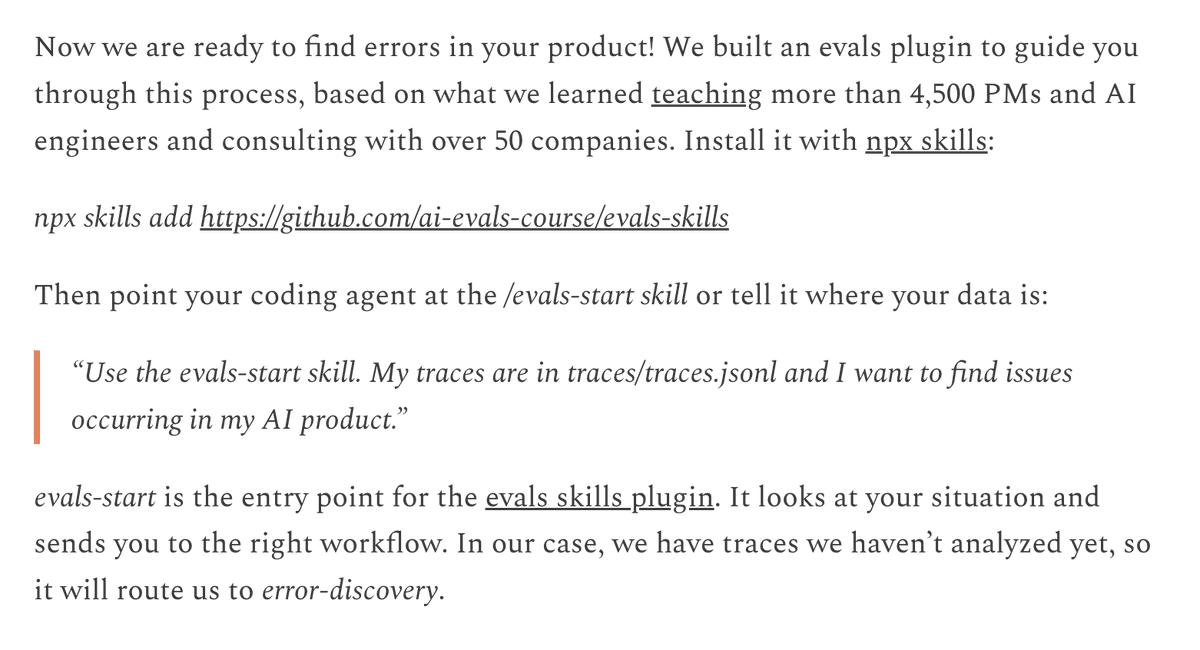
Claude can now help you build evaluations and hillclimb on them.
In this article, we share guidance on eval design & skills that Claude Code can use to improve your applications.
https://t.co/PgKFC2DWth
Introducing Claude Opus 5.5, the first model in our new Claude 5.5 family.
It performs at the level of Claude Fable 5.1 for most tasks, and costs 40% less to run than Opus 5.
Today we're rolling out Projects in Claude Code on desktop and web.
A project is one conversation with Claude. It splits the work into threads itself, runs them as parallel cloud sessions, passes context between them, and keeps going when you leave.
In beta for select users.
After co-inventing ChatGPT, I kept asking myself: why have superhuman chat models not led to AGI?
I’ve spent the last 2 years in stealth building a new way to train models (RLCD), and a new type of frontier AI model that we are releasing today: Jev
• 20-200x faster
• 40-400x cheaper (w/ output tokens free)
• Frontier composable intelligence optimized for decisions
AFAICT the shortest path to AI-based economic revolution
Go from idea to a working agent faster with the Agents API.
Build and run cloud agents with the Codex harness, fully managed by OpenAI.
We handle orchestration, long-running sessions, and context management. You focus on what makes your agent unique.
Available in public beta.
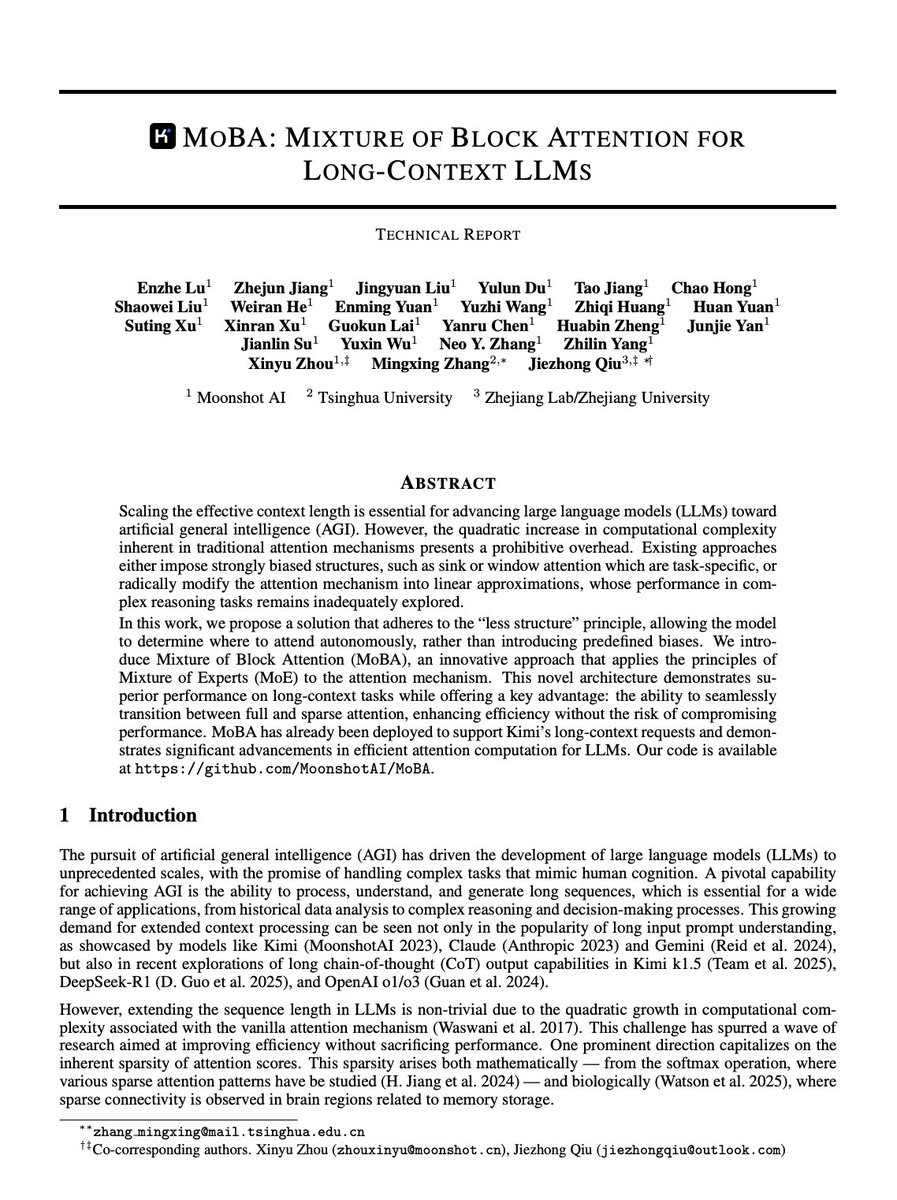
Chinese researchers did it again!
Moonshot AI proved that 95% of attention computation is completely wasted..
They’ve open-sourced the exact attention mechanism powering Kimi's long context.. and it's 16x faster.
It’s called MoBA (Mixture of Block Attention).
Every time you feed an AI a massive prompt, every token desperately tries to look at every single token that came before it.
The math scales quadratically ($O(N^2)$).
It’s like reading a 500-page book and re-reading the entire thing from word one every single time you want to understand a new sentence.
Moonshot looked at this waste and said: No.
Instead of forcing full, brute-force attention across everything, MoBA applies the principles of Mixture of Experts (MoE) directly to the attention layer.
How it works:
• It chops the context history into discrete blocks.
• A lightweight dynamic gating mechanism lets each query token instantly "vote" and route only to the specific blocks that actually matter.
• It achieves up to 95% sparsity on long contexts without sacrificing performance.
The results are staggering:
It maintains full-attention accuracy on 1-million-token contexts while slashing massive compute overhead.
We are watching the structural efficiency barrier of long-context AI get smashed in real-time.
While Western labs argue about how to afford million-token context windows, Moonshot open-sourced the blueprint to make them radically cheap.
We’re sharing a solution to the Navier-Stokes Millennium Prize Problem, one of the deepest problems at the frontier of mathematics.
The proof was produced by a group of agents, using an OpenAI next-generation model significantly more capable than GPT-6 Astra.
The problem concerns whether the description of smooth three-dimensional fluid motion modeled by the Navier-Stokes equations can break down. It has remained unresolved for roughly 90 years.
@lennysan@anshuc This was so cool I turned it into a skill and open sourced it: https://t.co/vFAkOMfnWC
Already had loads of fun with it; my personal website https://t.co/3RMPrIQk41 is one of the designs it produced.
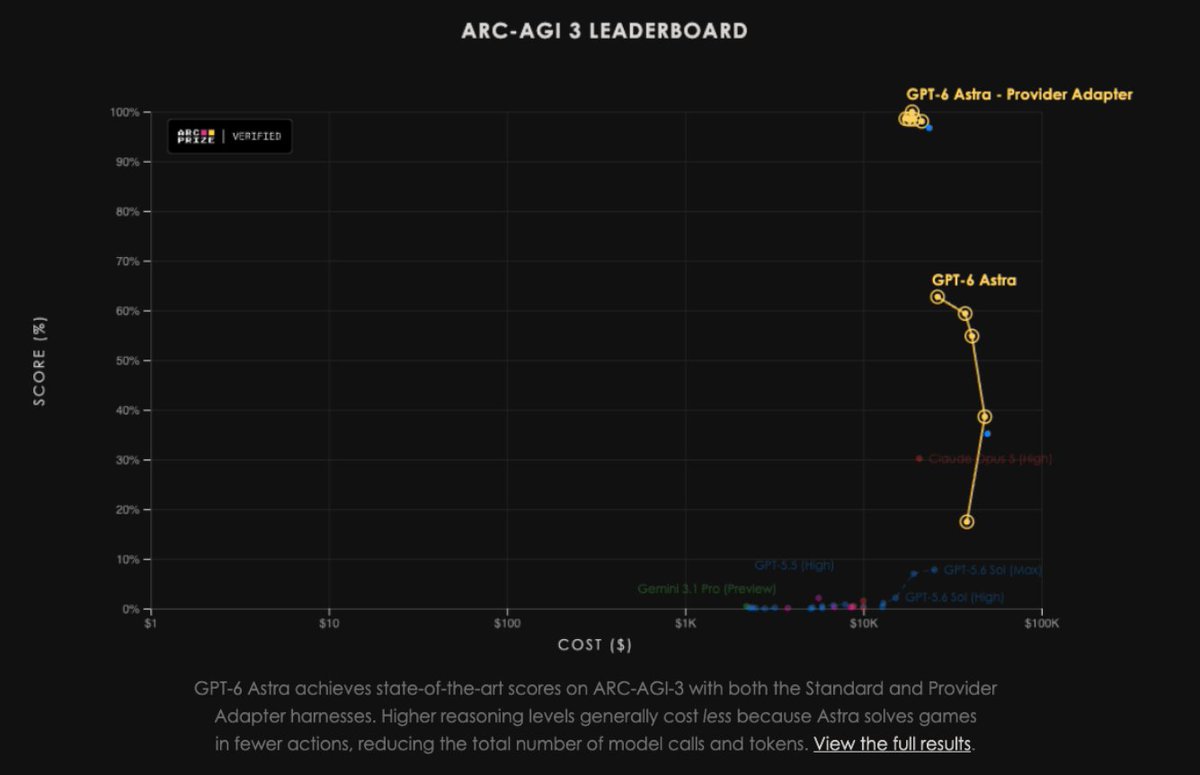
GPT-6 Astra by @OpenAI achieves SOTA on ARC-AGI:
- Astra scores 63% on ARC-AGI-3, 99% via a new provider adapter harness
- It surpasses human performance on 96% of ARC-AGI-3 levels
- It builds the most precise symbolic model of novel environments we've seen
Our analysis:
Today we’re releasing an early preview of the /design command in Claude Code!
from CC Desktop or CLI, try something like "/design a few options for {feature}" before you build — pick your fave artboard, edit it and implement.
Germany has launched one of the world's best open-source AI models.
Soofi S, made by the Soofi consortium, is a 30B parameter model fully trained in Europe and tops the ranking for open-source AI.
Huge moment for Europe, and finally some competition for Chinese open-source AI.