Victor Haghani helped build LTCM & watched it collapse — with winning trades still on the books. The lesson was never what to buy. It was how much.
Victor Haghani (Co-founder @ LTCM | Founder @ Elm Wealth | Author of The Missing Billionaires)
"It wasn't on the selection of the trades. It was on the sizing."
We cover:
- The two decisions every investor makes: what to own and how much, and why everyone fixates on the harder one
- The biased-coin game that bankrupted Wall Street PMs and finance grads: a 60/40 edge handed to them, and they still blew up
- Why the cost of risk is a fee you pay yourself, plus the napkin rule to price it (15% vol = 2.25% a year)
- The Elon problem: 50% vol on your net worth means a ~90% chance of little left in 10 years, before anyone's even bearish
- "The right answer to the wrong question," and why chasing billionaire money wrecks the plan
- The crystal-ball game: hand someone tomorrow's WSJ front page and watch 1 in 6 still go bust
- Claude, GPT, Gemini and Grok play the same game, and the two AIs that actually lost money
- His 92-year-old mother, who day-trades every day and won't hear a word of it
Highlights:
00:00 Right & ruined — the LTCM paradox
01:40 The two decisions: what to invest in vs. how much
02:50 The 60/40 coin & why max-EV bankrupts you
04:00 The experiment: PMs & PhDs sizing it all wrong
07:00 Kelly in plain English — a constant 10–20%
08:20 Why sizing isn't zero-sum, but beating the market is
10:30 Why even pros don't optimize sizing
12:50 The cost of risk is a fee — paid to yourself
15:20 Pricing your own risk: variance as the charge
16:30 Concentrated stock: 30% vol = a 9% toll
20:50 Elon, 50% vol & the log-normal trap
22:45 The right answer to the wrong question
23:35 The real objective: smooth lifetime spending & giving
27:35 The crystal-ball / WSJ front-page game
33:25 Claude, GPT, Gemini & Grok step up to trade
37:40 Claude's 66% hit rate — & the two AIs that lost money
40:35 Can anyone actually beat the market?
50:25 How much risk a young person should take
58:00 Estimating your human capital
1:02:40 The mom who won't stop day-trading
1:07:30 The one rule: if you don't save, nothing else matters
$ACN CEO Julie Sweet says they are starting a practice to help clients optimize their use of tokens, similar to the FinOps practice they built around cloud optimization. Clients are seeing AI spend but struggling with ROI and coming to Accenture because of their ability to know which models to use for which problems. Moving into cybersecurity platform business more than triples their total addressable market, and the mid market is a massive TAM they are now going after.
"...one of the things we're clearly seeing, in fact we have a practice that we're starting to grow now is on how to help clients optimize their use of tokens. It feels a lot like the cloud scenario. We remember when people were moving to the cloud and then they were like, oh, wait a minute, we're spending a lot more on the cloud than we thought and we built a whole, FinOps practice on helping optimize cloud. So we definitely think that we're seeing that with the clients and they're coming to us because we're doing a really good job ourselves of being able to know how you use the tokens, which models you use for which problems.
And that's something we've been focused on since the very beginning. It's also helping because we have delivered real ROI and our clients are seeing the spend but they're struggling with the ROI. And so it's helping us there. And at the same time there's a certain amount of spending that's going to happen. And so we're not seeing it be material to impact the spend on services today. And if anything, we think it's going to drive more to use services, and that's how we're seeing it develop.
And one of the things that we're really focused on is expanding our TAM in other ways, because the budgets haven't been, even with AI, they're spending it differently, but they haven't been increasing. And that's why, moving into cybersecurity platform business triples, more than triples, our total addressable market in OT security, the mid market is a massive TAM that we're now going after. And that's not been a focus of ours other than, generally. So we are really focused on expanding our TAM while We're capturing more of the AI spend"
You all have to stop mentioning P/E ratios with these hyperscalers bc they’re spending an insane amount of money and until the market sees a roic it isn’t rewarding these things bc there’s a chance all this capex doesn’t work out. They’re utilities now with never ending capex
I think this is the most interesting chart from the B of A $INTC report
AI CPUs are almost as large as HBM by 2030. (This is huge, I will try to explain my view at the bottom of this post)
What almost everyone sees
AI accelerators = $1.1T
HBM = $168B
CPUs = $140B
What everyone may miss is
GPUs create a second CPU boom
Just look at the split:
AI Cluster / Head Node CPUs = $70B
AI Agentic Standalone Node CPUs = $70B
Every GPU cluster needs CPUs.
Agentic AI creates an entirely new CPU market the size of today's cloud CPU market multiple times over.
That's a huge bet.
This actually also has implications for $AMD
If BofA is right:
Intel wins of course
AMD wins
ARM server CPU vendors also win
Because the pie becomes much larger.
Roughly $170B by 2030.
For the part AI CPUs are almost as large as HBM by 2030, this is ultra huge
The market often treats HBM as the second largest AI winner after GPUs.
However, it may not be the case, CPUs could become nearly as economically important as HBM.
So If that happens, investors may have underestimated $INTC relative to memory.
Early AI cycle = GPU GPU GPU but we are not in the early cycle anymore
Next (or now) AI cycle = GPU + HBM + CPU + Packaging Networking + Power
This is WILD!
Goldman Sachs says Wall Street consensus 2027 hyperscaler Capex estimates are too conservative (Save this).
The consensus lands at $920 billion but Goldman thinks it could reach $1.4 trillion.
Here is how they get there.
Hyperscaler capex, the combined AI infrastructure spending of Amazon, Google, Meta, Microsoft, and Oracle went from $261 billion in 2024 to an estimated $805 billion in 2026, a 3x increase in two years.
The consensus for 2027 assumes growth decelerates sharply to just 22%, which is where Goldman pushes back.
Goldman economists compared that assumption against every major infrastructure buildout in history, railroads, highways, electrification, the internet and found they consistently consumed 2 to 3% of GDP at their peak.
At 2% of US GDP, hyperscaler capex reaches $950 billion in 2027 and at 3%, it reaches $1.25 trillion.
In the most aggressive scenario where hyperscalers deploy every dollar of operating cash flow plus the full capacity of the investment grade credit market, the number reaches $1.43 trillion.
The fourth chart is what makes the Goldman case feel earned rather than aggressive.
Hyperscalers are expected to reinvest 98% of operating cash flows directly back into capex in 2026, a ratio only ever matched during the telecom bubble of 2001.
The critical difference is that these companies are actually generating the cash flows that are being reinvested, Amazon, Google, Meta, and Microsoft combined are printing hundreds of billions in operating cash every year and putting nearly all of it back into infrastructure.
A buildout this large creates supply chain pressure and earnings volatility in the names most exposed, and Goldman is not dismissing that risk but the direction of spending is not in question, the only debate is whether 2027 comes in at $920 billion or $1.4 trillion.
The companies sitting directly in the path of that spending are the ones worth owning.
Nvidia captures the largest share of every hyperscaler capex dollar, owning 80%+ of AI training compute, and Morgan Stanley raised its 2026 capex estimate specifically because of continued Nvidia demand.
Oracle is the fastest growing capex spender among the five hyperscalers on a percentage basis up 116% from 2024 to 2027 with the smallest absolute base, giving it the most runway remaining.
CoreWeave and Nebius sit between the hyperscalers and frontier AI companies, renting GPU capacity to anyone who cannot get on the hyperscaler queue fast enough and as that capex number grows, so does their total addressable market.
Milk Road subscribers already up massively on these names, come join Milk Road Pro for our full breakdown and what other names we are watching for just a dollar.
Link below!
Very interesting and scary report from Morgan Stanley
The financial engineering behind hyperscaler capex
The truly unsettling part of the AI boom isn’t how much money is being spent
It’s how that money is being engineered through accounting
Hidden liabilities (> $1.8T)
Huge obligations sit off‑balance‑sheet: nearly $1T in purchase commitments, $800B+ in leases not yet started, $2T+ in RPO.
Future cash outflows that don’t show up as debt.
The coming depreciation hit
Profits look good only because spending is stuck in CIP.
Big Tech faces $520B+ in depreciation over 3 years.
ORCL’s depreciation ratio: 7% → 28%.
Supplier financing pressure
Unpaid capex is ~$110B.
ORCL’s DPO exploded from 35 → 170 days.
The whole supply chain is effectively financing the AI build‑out.
Lease accounting gray zones
Whether GPU contracts count as leases or services is subjective — and companies use that flexibility to shift billions on/off the balance sheet.
$ORCL = the most aggressive
Largest lease commitments, RPO up 300%+, capex‑to‑sales hitting 189%.
Oracle is running the highest financial leverage in the ecosystem.
Citadel Securities just put institutional weight behind what the AI bulls won't say out loud.
In a new macro note titled "Tokenomics," Citadel makes the argument plainly: even the most powerful technology on earth still has to pass through the boring discipline of cost curves, capacity limits, and marginal returns.
The evidence is piling up:
– Amazon removed its token usage leaderboard
– Microsoft cancelled Claude Code subscriptions
– Multiple companies reporting unexpectedly massive token bills
Their conclusion is the part that matters.
Adoption is no longer about what AI can do in principle. It's becoming about the price and scarcity of the inputs needed to run it at scale. Compute. Power. Cooling. Memory bandwidth. Inference budgets. All real, all binding constraints.
And here's the kicker from the chart.
The Silicon Data LLM Token Expenditure Index, a benchmark for how much the market is actually spending on AI tokens, has started rolling over. Citadel reads it as a shift toward cheaper models. Companies substituting away from expensive frontier AI toward "good enough" alternatives.
That's economics 101 doing what it always does. When the price of something rises, people use less of it, or find a cheaper version.
Citadel sees a bifurcation forming. Frontier AI concentrated among a few firms with the balance sheets to absorb the cost. Everyone else quietly downgrading to simpler, cheaper models.
This is the part of every technology revolution the early narrative ignores.
The technology being real was never the question.
The question was always whether the economics could carry the valuations.
When one of the most sophisticated trading firms on earth starts writing about AI in the language of cost curves and rationing instead of limitless demand, the conversation has quietly changed.
The hype was about what AI could do.
The reckoning is about what it costs.
TSMC is putting nine fab and advanced-packaging phases into construction in 2026. That's one new phase breaking ground every 40 days, the most aggressive single-year capacity sprint the industry has ever run.
The number isn't an estimate. It's from TSMC's own May symposium materials. Most coverage rounded it down to "TSMC is spending more on AI » but it’s worth digging deeper.
The specificity is the whole point. 9 phases, against roughly $56B of guided 2026 capex.
Capex like that doesn't vanish into a PR stunt. It buys tools, and it buys them in a fixed order from a short list of companies most people outside the supply chain can't name
-> follow the money down the chain and the picture gets concrete.
It lands first on the equipment makers. A leading-edge phase is a lithography problem before it's anything else, and ASML sells the only EUV and High-NA EUV that prints N2 and A16.
Around it sits the rest of the toolset: Applied Materials ($AMAT) for deposition and backside power delivery, Lam Research ($LRCX) for the etch behind 3D stacking and vertical interconnects, KLA ($KLAC) for the inspection and metrology that becomes yield insurance once you're below 2nm. These names move every time TSMC raises capex, because the capex is their order book.
Then it hits packaging, where the real bottleneck of the last two years lives. CoWoS capacity is racing toward roughly 130,000 wafers a month by late 2026, several times the late-2024 level, and it still isn't enough. TSMC is handing the overflow to outside assembly and test houses.
Amkor ($AMKR) is the primary independent alternative and is taking the bulk of it, building U.S. and Vietnam capacity as a geopolitical hedge. ASE (TPE 3711) and its SPIL subsidiary are picking up TSMC hand-offs with advanced-packaging sales projected to roughly double in 2026.
Only at the bottom of the chain do you reach the names everyone already knows.
Nine phases plus a CoWoS ramp is finally enough silicon to clear the queue.
- NVDA has reportedly locked about 60% of 2026 CoWoS output for the Blackwell ramp and the Rubin transition.
- Broadcom takes around 15% for custom accelerators like Google's TPU.
- AMD takes roughly 11% for the Instinct line.
These are wafer starts turning into shippable accelerators, the packaging cap that held growth back for two years finally coming off.
9 phases in one year reads less like a semiconductor capex plan and more like wartime mobilization. The most informed supplier in the chain, with visibility into design wins through 2028, is pricing this as a multi-decade cycle, laying the infrastructure down faster than the demand models can keep up.
The build is the call, the money is in who supplies the build.
Former General Manager at KLA Corporation: every tool they've ever sold is a source of recurring revenue. Service is 20-25% of sales $KLAC
"The way KLA looks at the service model is that every single tool they've ever sold is a source of revenue; it's very simple. They will do everything they can to continue to service those tools, including re-engineering obsolete components and providing upgrades. If you look at their service revenue, it's 20% to 25% of their overall revenue. The difference between service revenue and tool revenue is that service revenue is consistent whether they sell tools or not. In an upturn or downturn, service revenue always goes up"
https://t.co/tTReYoeOlV
US existing #housing transactions rise ahead of expectations. Question shouldnt be why are they rising but why werent they rising earlier in the year when mortgage rates (30yr FRMs) were cheaper. Restrictor
My conversation with Alex Sacerdote, founder of Whale Rock Capital Management.
Alex runs more than $17B and has been one of the best performing tech investors for years, though he keeps a low public profile.
As you'll hear, he is singular in how he thinks about investing through technology cycles.
For over 25 years, he has built his entire investment framework around a single idea, the S-curve.
We discuss:
- The AI L-Curve
- When to buy into an S-curve and when to sell out
- The de-commoditization of data center hardware
- Why he went net short software
- His two models for tech adoption
- Finding alpha
Enjoy!
Timestamps
0:00 Intro
9:55 AI's L-Curve
19:31 Whale Rock's S-Curve Playbook
26:14 Spotting Inflection Points
32:02 Finding AI Winners
40:04 AI vs Software
48:13 The Hardware Renaissance
58:04 Why Investors Miss AI
1:05:18 Whale Rock's Research Machine
People -> Ideas -> Products -> Businesses - > Stocks - > Sectors -> Macro -> Markets
The skills most needed today to really make money in this mkt are towards the beginning and end of that flow diagram while ignoring the math you learned and clinged to from a book or in school in the middle of it.
STAY AWAY from semiconductor stocks.
The global semiconductor industry is expected to hit $975 billion in sales this year. A historic peak. Revenue growth north of 25%.
Every cycle peak sounds the same: this boom is STRUCTURAL, not cyclical. AI demand is permanent. The old rules don't apply.
"It's different this time," they say.
I've heard those 4 words more times than any others in 45 years on Wall Street. They're always wrong.
Here's how I think about it:
When any industry generates obscene profits, capital floods in to compete those profits away.
The higher the margins, the faster it happens.
Semiconductor margins right now are at levels that would make a drug cartel blush.
Look at Micron. The crowd says it's "cheap" because the PE looks low.
Except Micron's price-to-book ratio sits at roughly 7x. The 10-year median is 1.86x. The historical floor is 0.81x.
That's not cheap. That's the most expensive this stock has EVER been relative to its asset base - dressed up in a low PE because earnings are wildly above trend.
This is the oldest trap in cyclical investing.
You see it in shipping. You see it in commodities. Earnings spike, multiples look compressed, everyone piles in. Then the cycle rolls over and those "cheap" earnings disappear.
Now layer on the bigger picture:
New capacity is already being announced across the industry.
The hyperscalers alone - Microsoft, Amazon, Alphabet, Meta - plan to pour $600-700 BILLION into AI infrastructure this year. That's 70%+ more than 2025.
They're consuming roughly 90% of their operating cash flow on capex. Borrowing north of $400 billion to cover the rest.
Nobody can afford to stop spending because everyone else keeps spending. It's mutually assured destruction with better PR.
And historically, the companies that spend the MOST on capex deliver the WORST stock returns.
BCA Research just argued AI threatens all 3 pillars of Big Tech profitability;
1. Economies of scale
2. Network effects
3. Proprietary tech
Goldman Sachs compared software stocks to NEWSPAPERS in the early 2000s. The group that fell 95%.
Software is now underperforming the Nasdaq by the widest margin this century.
Meanwhile, the rotation I've been positioning for is already underway:
Most MAG 7 names are DOWN year to date. Emerging markets are up. Energy is up. Gold miners are up.
Last year, the EM ETF returned roughly DOUBLE the S&P. This isn't starting. It's been happening since 2024.
So my framework is simple:
Valuation doesn't matter in the short run.
But the longer you go out, the more it matters.
And money ain't free anymore.
When capital was free, pigs flew. Unprofitable companies soared. Narrative crushed fundamentals.
That era is OVER.
The 60/40 portfolio hedges against recession. But recession isn't the risk. The risk is continued money printing, persistent inflation, and higher real rates.
Bonds don't protect you from that. Gold does. Energy does. Real assets do.
You don't need to get clever here. Just avoid what's overpriced and own what's cheap.
The regime is changing. The market's scorecard already tells you that every single day.
Are you listening?
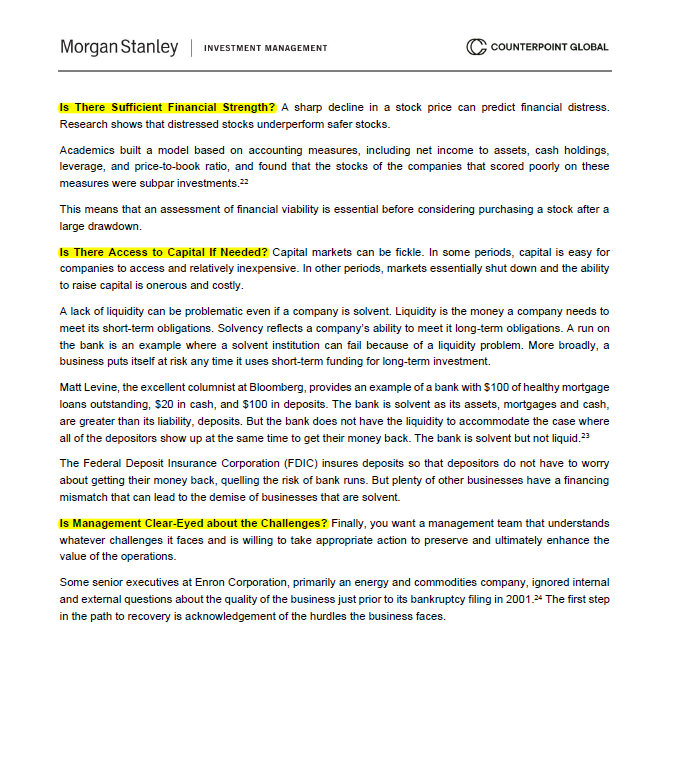
Mauboussin's six questions for telling a recoverable drawdown from a terminal one:
1. Cyclical or secular?
2. Does the unit economics still create value?
3. How lumpy are the investments?
4. Sufficient financial strength?
5. Access to capital if needed?
6. Is management clear-eyed, or in denial?
A crash isn't proof the business is broken. These questions tell you whether it is.
This is an excellent interview btw
Nicolai (Norwegian Sovereign Wealth Fund CEO) asks the IBM CEO if AI a bubble
Listen very very carefully to his answer
There has been a lot of ink on what it takes to be great as an analyst. My 2c on this is all sectors require different things. Highly technical sectors like systems and semis require an understanding of the technology first and the cycle second because everyone will see the cycle but not everyone will understand the technology shifts underlying the cycle meaning the error rate on the tech is almost always higher than the error rate on the cycle. Lower technical sectors like financials and materials require an understanding of the cycle first and the product second for the opposite reason. The products are relatively easy to understand but timing the cycles that tend to be shorter than big technology cycles is much harder. I could go on with other examples and different vectors. The only thing that translates across all sectors imo is being able to identify what the most important thing is before everyone else decides it’s the most important thing.
Loeb's early letters are now legendary but for my money nothing will ever beat the SFBC earnings call. The whole thing was amazing but the "and I use the term loosely" is just chef's kiss.