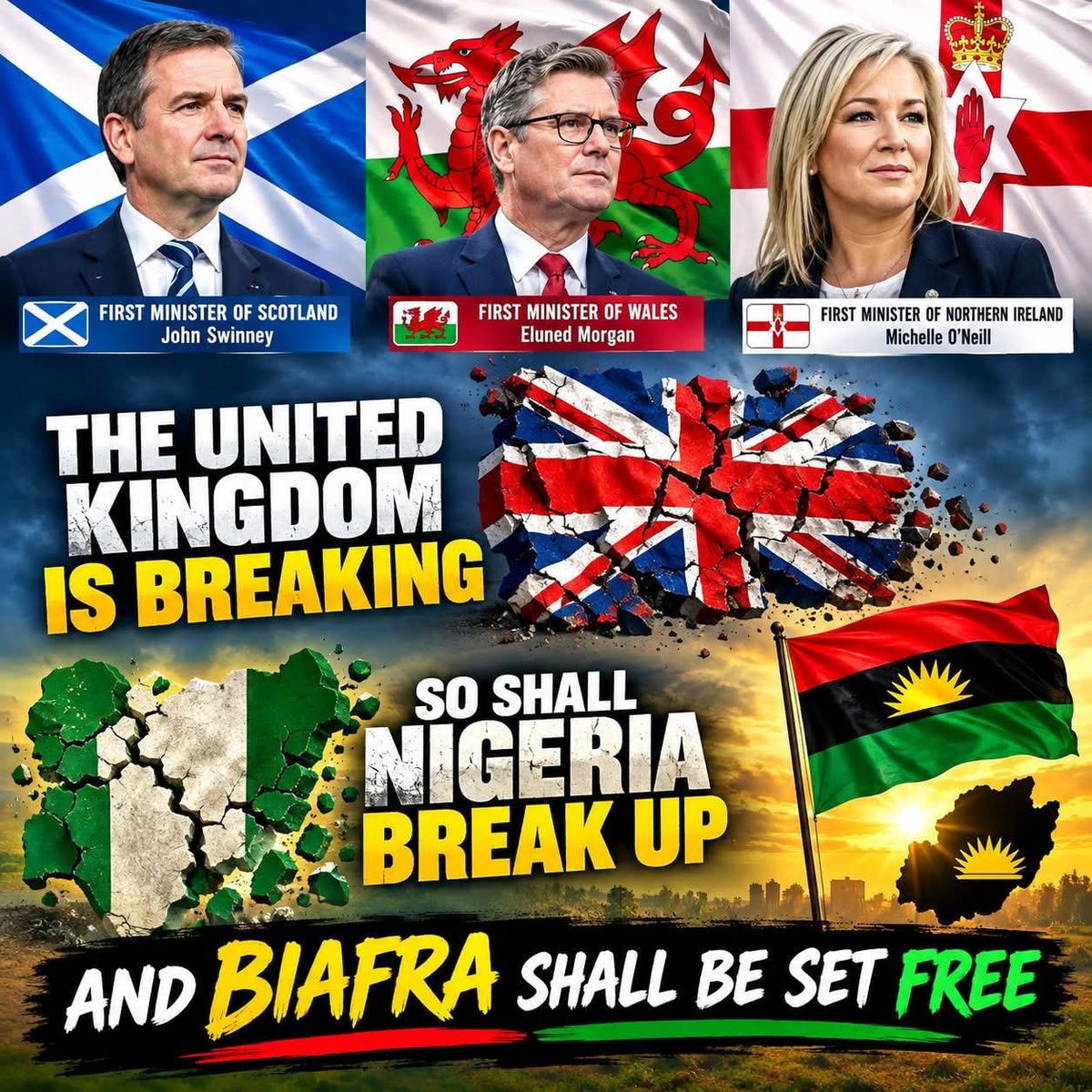
🇬🇧 UK IS FALLING APART AND HISTORY IS SPEAKING
September 13, 2026
For generations, Britain presented itself as a model of union, parliamentary government and territorial integrity. Yet the history of the United Kingdom itself tells a more complicated story: the British state was not created as one indivisible nation from the beginning. It was built through a series of political unions, parliamentary Acts, conquest, incorporation and, in Ireland, eventually partition.
Today, that history is once again being placed under the spotlight. On Monday, 14 September 2026, the leaders of Scotland, Wales and Northern Ireland are expected to meet in Cardiff to sign a joint declaration calling for the right of their nations to pursue self-determination and hold independence referendums.
The proposed declaration covers cooperation on areas including the economy, energy and Europe. It is particularly significant because pro-independence parties currently lead the governments of all three devolved nations.
This does not mean that the United Kingdom is already breaking apart. The declaration itself would not automatically make Scotland, Wales or Northern Ireland independent. Rather, it represents a major political demand for the right of these nations to determine their own constitutional futures.
And that raises an important question for Britain: If self-determination is a legitimate principle for the peoples within the United Kingdom, why should that principle be treated differently when it is demanded by the people of Biafra?
HOW THE UNITED KINGDOM WAS CREATED
The United Kingdom developed over centuries.
England and Wales were brought under the English Crown through the Laws in Wales Acts of the 16th century. Scotland remained a separate kingdom for centuries, although Scotland and England shared a monarch from 1603 after James VI of Scotland became James I of England.
The decisive political union between England and Scotland came through the Acts of Union of 1707. Both the English and Scottish Parliaments approved the legislation, creating the Kingdom of Great Britain and a single Parliament at Westminster.
Ireland was subsequently incorporated into the United Kingdom through the Act of Union 1800, which came into effect in 1801 and created the United Kingdom of Great Britain and Ireland.
But that arrangement did not remain permanent. Following the Irish struggle for independence, most of Ireland left the United Kingdom in 1922 and became the Irish Free State, while six counties in Northern Ireland remained within the United Kingdom.
The history therefore demonstrates something fundamental: The United Kingdom itself has changed its territorial boundaries repeatedly. States and unions are political arrangements. They can be created, modified or dissolved when political circumstances and popular demands change.
THEN CAME THE BRITISH CREATION OF NIGERIA
The same British imperial system extended into West Africa. Before colonial rule, the territory now called Nigeria was not one political nation. It contained numerous peoples, kingdoms, emirates, city-states and societies with their own political institutions and histories.
Among them were the Sokoto Caliphate and numerous northern emirates, Yoruba kingdoms and states, Igbo-speaking communities with largely decentralised political systems, the Benin Kingdom, the Niger Delta communities and many other societies.
Britain progressively conquered and administered these territories. In 1914, British colonial authorities amalgamated the Northern and Southern Protectorates of Nigeria under one colonial administration. Lord Frederick Lugard, the British Governor-General, formally proclaimed the amalgamation on 1 January 1914. British records and historical accounts make clear that this was an administrative and imperial decision made by the colonial government.
1/4