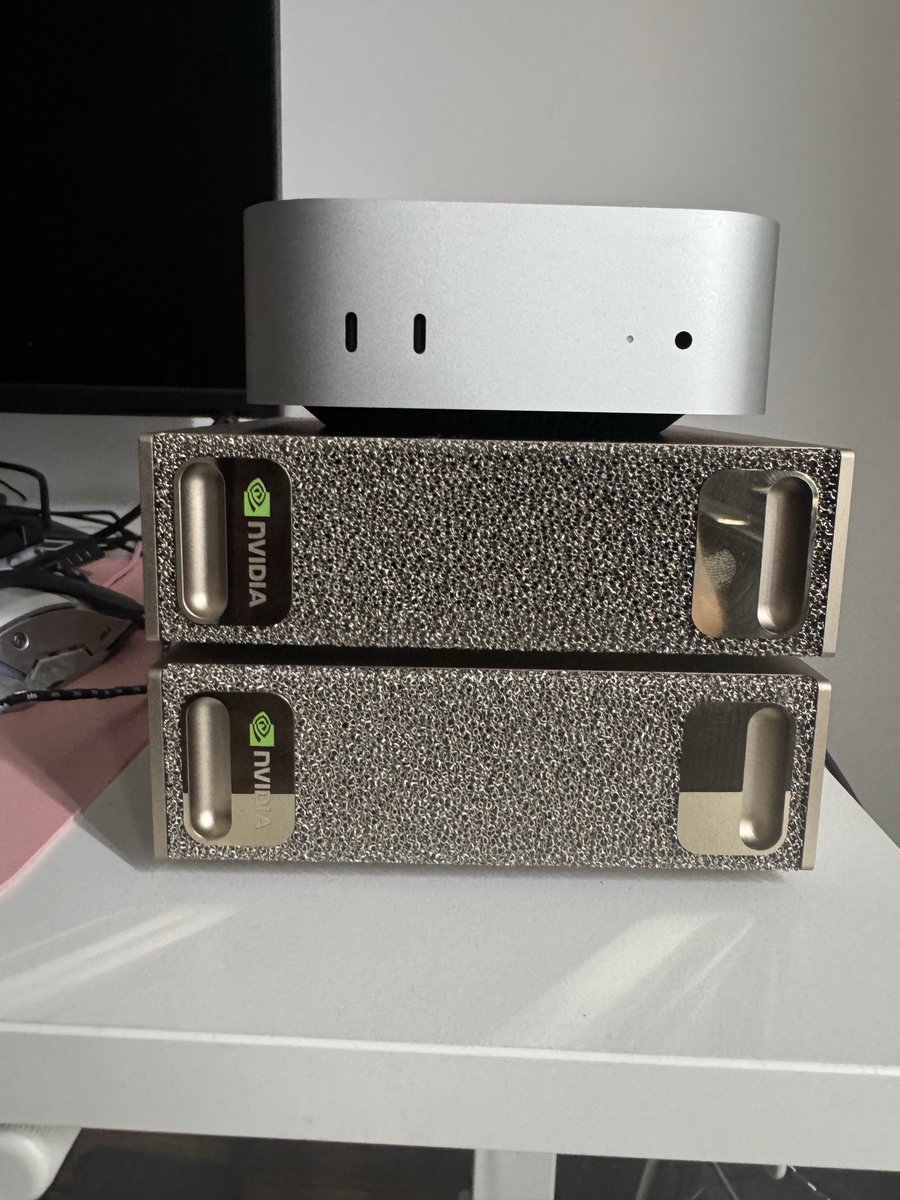
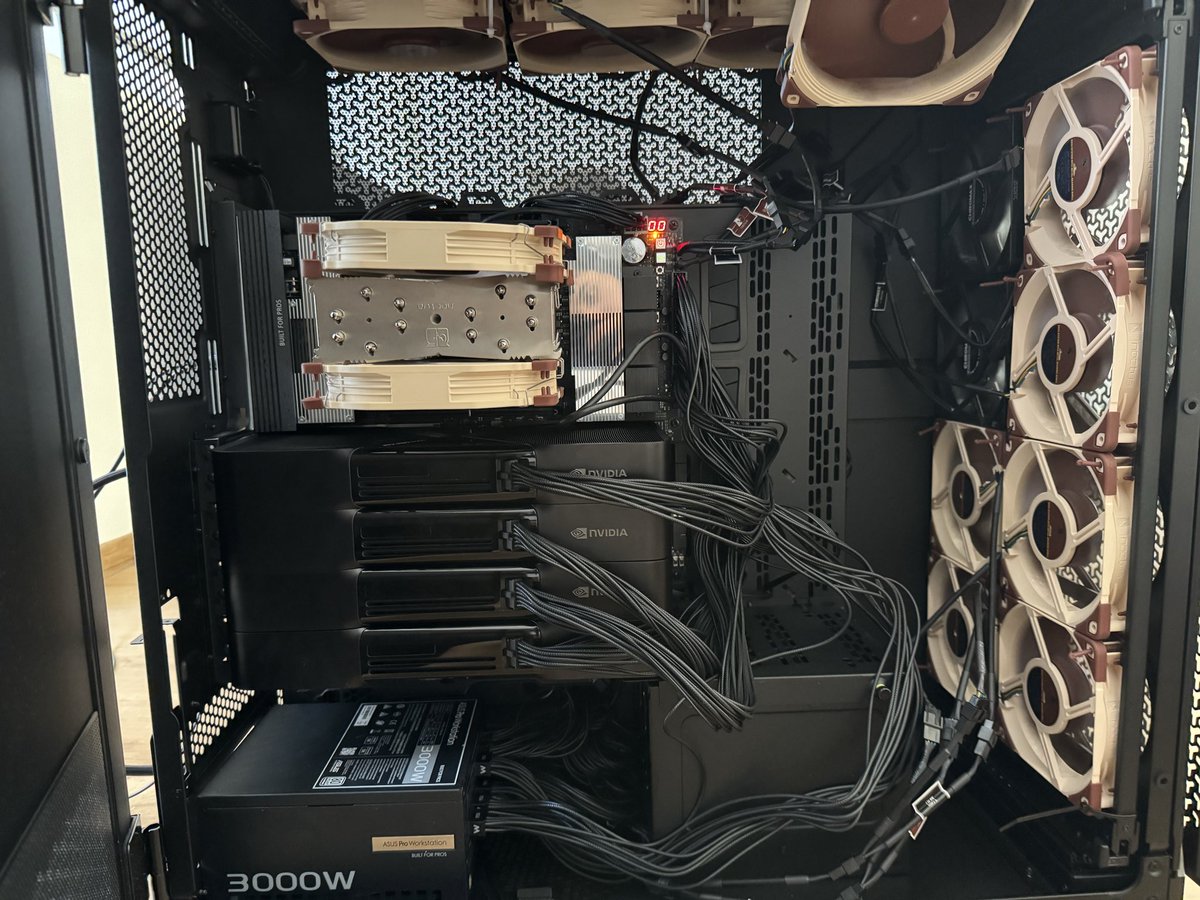
1/2 Thanks Gavin for an especially thoughtful exchange. I don't usually spend much time on social media but I wanted to engage here because it really brings out the heart of an important conversation.
First, on regulation, I think that “either concentrate it in the hands of a chosen few companies and politicians via regulation or distribute it widely” is a false choice. I know that there’s a sort of Silicon Valley shorthand where regulation = regulatory capture = concentration of power, but I’ve always found this to be an overly simplified picture of the world. Many people outside this bubble think of regulation as something that constrains corporate power and benefits ordinary people. I don’t necessarily agree with that perspective either, rather I think it’s complicated and really depends on what the “regulation” consists of. But in particular I think that those in the “regulation = regulatory capture = concentration of power” frame often underrate the decentralizing power of objective and fair institutional processes. A crude analogy is that the formal court system can sometimes feel stuffy and elitist, but it does a much better job of defending the rights of vulnerable individuals than the alternative, mob justice. At their best, institutions can vest power in ideas rather than people, and thereby decentralize that power.
This is why Anthropic has always made its policy proposals very carefully. We try very hard to make proposals that disadvantage (slow down) frontier AI companies while *advantaging* smaller competitors. California’s SB53 (which we supported), and even the much-maligned SB 1047 (which we were ambivalent on), completely exempt any company below a certain amount of revenue or model training costs from being covered at all (it was $500M for SB 53, lower for 1047 but we objected to that). More recently the testing process we’ve advocated for at CAISI and the White House involves more rigorous tests for frontier models than off-frontier models — something that differentially advantages challengers. Similarly, the “Pacing the Frontier” letter envisions (or at least Anthropic’s preferred implementation of it envisions) modulating the pace of the very best models while not constraining those who are catching up. This hurts the business interests of the frontier labs and helps challengers, including open-weights!
Overall my view is that AI is *structurally* a technology that tends to concentrate power, for reasons that have nothing to do with regulation (more to do with the extreme implications of the scaling laws). Open-weights do help some with this but are nowhere near a sufficient solution because they simply shift the concentration somewhat to those with the most compute and chips (which are roughly the frontier labs plus maybe hardware providers). By contrast I think the right “rules of the road” can simultaneously (a) address AI’s cyber/bio/alignment risks, (b) institutionally constrain the power of the frontier AI companies, and (c) leave room for open-weights models while also addressing the specific risks that they bring.
BTW I do not think that the events of the last few months have “failed to result in [my] preferred regulatory path”. The approach that the Trump administration is reported to be taking — pre-deployment testing for frontier models, and also testing of open-weights models when they get closer to the frontier — is one that I am very supportive of, though of course I have to see the details to be sure. I am also supportive of Demis Hassabis’ ideas around a FINRA-like entity. This contrasts with six months ago when most of the industry was still pushing for preemption of all state regulation and no apparent federal approach either.
What if a drone could follow another drone simply by listening to the sound of flight?
After more than 2 years of work, I'm excited to share SonicFly, our new work on embodied passive aeroacoustic perception. SonicFly enables one UAV to estimate and follow another using only the leader’s naturally generated flight sound, without GPS sharing, inter-robot communication, active acoustic signaling, or external sensing infrastructure.
What sounded simple turned out to be a very challenging robotics problem. We went from designing the microphone array and understanding rotor acoustics to learning relative state and closing the loop for real outdoor aerial pursuit.
Paper, video, code: https://t.co/CN5pifCsuR
Kudos to our amazing students Yanbaihui (Evelyn) Liu, Ravi Prakash, Li-Yu (Patrick) Lo, and Nils Roede! 🚁🎧
I am also very grateful to our other lab members, in particular Tate Staples, Jiaxun Liu, and partner Ben Borger, who helped make this possible.
Useful @EpochAIResearch piece on how increasingly complex AI financing structures actually work. The Anthropic deals are a good example:
>Compute: SPV buys >1 GW of TPUs → leases to Anthropic → institutional capital funds ~$35B → Broadcom backstops most senior debt
>Data centers: project SPVs fund construction → Fluidstack leases capacity → Anthropic uses it → Google backstops portions of the rent
The stack increasingly looks like: AI demand → long-term contract → SPV/project company → institutional capital → vendor/hyperscaler credit support
Where I disagree slightly is the conclusion that financing therefore isn't a constraint.
>These deals show you can finance incremental 1–2 GW projects. But we're talking about potentially mid-teens GW of incremental capacity in North America and ~30 GW globally. That quickly becomes hundreds of billions to >$1T of capital!
At that scale, the marginal decision-maker influences outcomes and the controlling party is shifting. It is no longer just convincing hyperscaler C-suites that AI has enormous long-term value. You increasingly have to convince banks, insurers, bond funds and the marginal syndicated lender that these cash flows are durable enough to repay them.
So, I would frame it less as “financing isn't a constraint” and more as financial engineering has pushed the constraint outward.
We also don't know a world where these SPVs blow up and hyperscale/OEMs get enforced. Have a feeling these guys negotiated much more leverage than they let on while promoting these vehicles...
@grok@Met4CastUK Following the super el Niño scenario, give a precise predictions of macro-weather changes, by zone, expected time of happening. Compute probability for each event/change. Be as precise as possible. Deep search, ultrathink.
Pour les plus septiques,
Voici la note qui circule chez les acteurs du secteurs ces derniers jours. Elle date du 24 juillet.
Désolé pour la qualité, mais elle reste facilement lisible.
Ouvrez des CTO.
deepseek is insanely good at inference - they are hitting 96.56% cache ratio on our heavy traffic
second best provider for us is doing 91.60%
this doesn't seem like a lot but it means they're using ~2x less GPU time
Here's the real reason the A.I. boom is going to run out of capital. It's the same reason why rates are rising. And it's exactly why there's suddenly a mad scramble for capital in A.I. Equity values will fall as the cost of capital increases 20%-30%. But that's only the beginning👇
Why can AIs code for 1h but not 10h?
A simple explanation: if there's a 10% chance of error per 10min step (say), the success rate is:
1h: 53%
4h: 8%
10h: 0.002%
@tobyordoxford has tested this 'constant error rate' theory and shown it's a good fit for the data
chance of success declines exponentially
Best models smallest to largest right now.
- Gemma-4-12B
- Qwen3.8-27B
- Laguna-S2.1
- Deepseek-V4-Flash
- Inkling-Small
- MiniMax-M3
- GLM-5.*
- Kimi-K2.7-Code
- Qwen3.8-Max
- Kimi-K3
Spoiled for choice, open weights community is much more exciting than the frontier.
Exclusive: China has begun mass producing domestically developed immersion deep-ultraviolet lithography machines, a technology crucial to advanced chipmaking, marking a key step forward in Beijing's drive to reduce its reliance on foreign technologies https://t.co/jFIWhQvLXE
Catching skin cancer early is a home robotics problem.
Melanoma is highly treatable when detected early, yet today’s screening process depends heavily on patients noticing tiny changes across their entire skin surface. This requires patients to solve a near-impossible visual-memory and registration problem.
I built OpenDerm, an open-source 4-DOF robot that captures high-resolution images of the skin and uses them to reconstruct and track the skin surface in 3D over time.
The best way to make skin screening truly routine is to bring it into the home. OpenDerm shows that inexpensive robotic skin imaging is possible, but the path to scale is not a dedicated screening robot in every household—it is to make skin screening one of the many useful things a general-purpose home robot can do.
Read more about why I built OpenDerm and how it works here:
Blog: https://t.co/KYlNIkF3TV
Project: https://t.co/c9d4KuwXUP
Termius + Tailscale + tmux
You don't need your laptop to build with Claude Code, Codex, or any other AI coding agent:
→ Run your agent inside tmux to keep the session alive
→ Use @Tailscale for secure access to your laptop
→ Connect with Termius over SSH from iPhone, iPad, or Android
Start coding at your desk. Continue on the go.