A curated list I put together from my collection of review articles and surveys on different topics in the field of Brain-Computer Interface. the papers are ordered according to the year publication.
#BCI#awesomelist#github
https://t.co/qh2BWs3SIV
In my lab we had old 32bit old computers with 2Gb of ram and dual core CPUs. To keep them alive I installed lubuntu 32bit and turned them into @GoogleColab interfaces through chromium
People replace their phones every ~4 yrs. This means there are hundreds of millions of old phones discarded each year that are still perfectly usable as computing devices. @Google in collabration with @UCSD is exploring how to turn these old phones into cloud-computing “phone clusters”. Putting phones back in service in this way can directly reduce the environmental footprint of computing by avoiding the need for further raw material extraction, and taking advantage of the embodied carbon already incurred from manufacturing these devices, and modern phones actually are already quite powerful computers. Read more in the blog below ⬇️
@JeffDean@Google@UCSD Cool mindset of reusing old devices as a cluster. I did the same in my lab by turning old PCs into google colab interfaces. Just chromium and colab notebooks on Lubuntu
The US government, citing national security authorities, has issued an export control directive to suspend all access to Fable 5 and Mythos 5 by any foreign national, whether inside or outside the United States, including foreign national Anthropic employees.
The net effect of this order is that we must abruptly disable Fable 5 and Mythos 5 for all our customers to ensure compliance.
Access to all other Claude models is not affected.
We apologize for this disruption to our customers. We believe this is a misunderstanding and are working to restore access as soon as possible.
Read our full statement: https://t.co/bwn0sximKZ
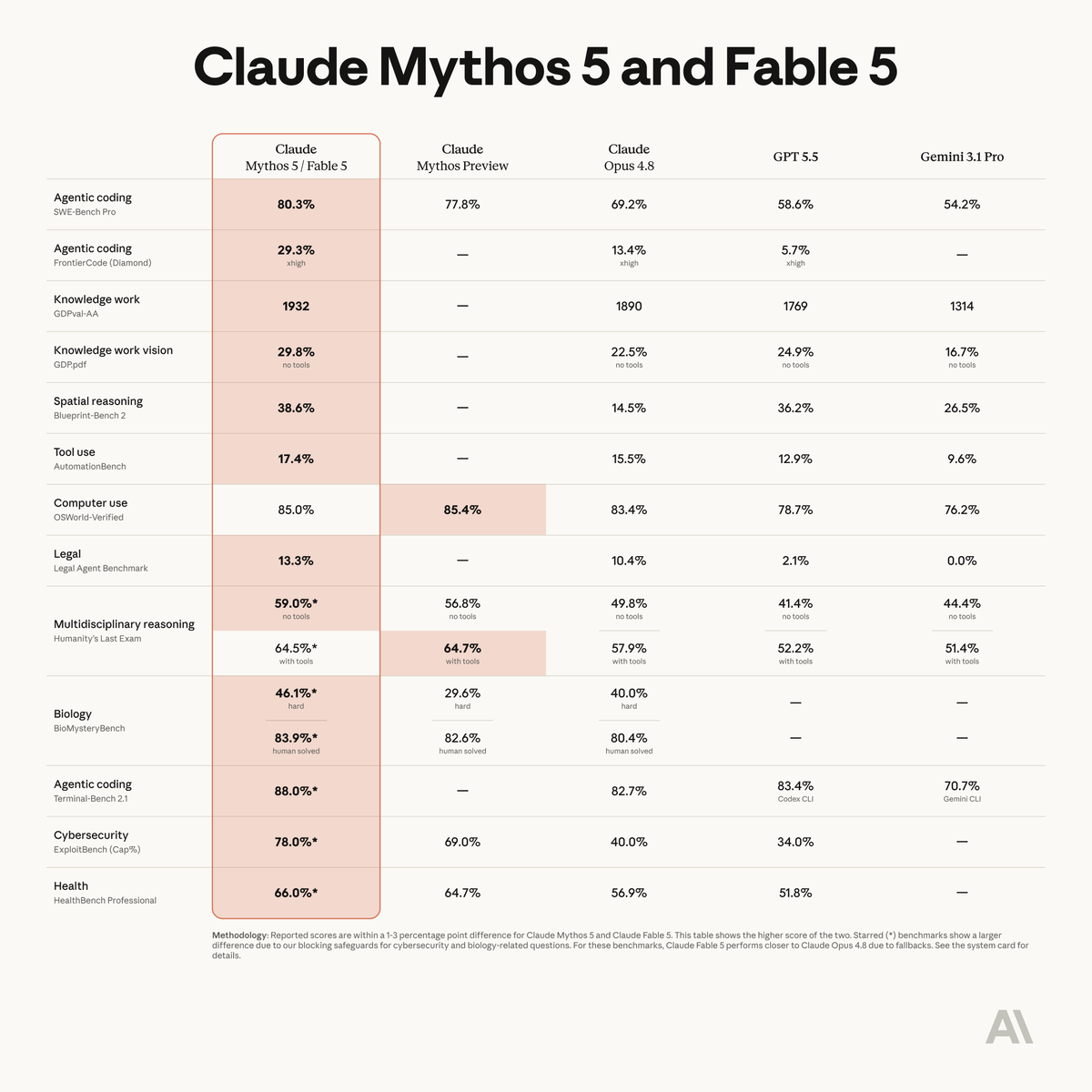
Fable 5 is state-of-the-art on nearly all tested benchmarks, with exceptional performance in software engineering, knowledge work, scientific research, and vision.
The longer and more complex the task, the larger Fable 5’s lead over our other models.
Super excited to announce seven new world-class MAI models today. They represent what we consider a new era in AI designed to keep you in control and on the frontier.
First is our text foundation model, MAI-Thinking-1, exceptionally strong on reasoning and SWE tasks.
- It’s a 35B active parameter MoE with a 256K context window. Independent human raters on Surge prefer it for overall quality in blind side-by-sides versus Sonnet 4.6, and it’s achieved 97% on AIME 2025, the key measure of its general-purpose reasoning abilities.
- It's at 53% on SWE Bench Pro, placing it right alongside Opus 4.6 on one of the toughest coding benchmarks.
- And since we co-designed our models with our own silicon, MAI-Thinking-1 is optimized on our MAIA 200 chip. Benchmarking head-to-head against the GB200, we see 30% better performance per dollar as well as a 1.4x performance-per-watt gain when running our MAI models on the MAIA 200 end-to-end.
Next is MAI-Image-2.5 and its Flash variant. Two super strong models now at #2 on the leaderboards, surpassing the score of Nano Banana 2 on image editing.
Last for now is MAI-Code-1-Flash, our new inference efficient coding model, especially tuned for VS Code and GitHub Copilot CLI.
- Code-1-Flash achieves 51% on SWE Bench Pro, despite having just 5B parameters, putting it closer to Haiku in size but cheaper in cost.
All of this is the foundation for Microsoft Frontier Tuning. It lets you customize our models to create custom, company-specific agents that only you control. You can make our model, your model. Your data. Your agents. Your moat.
Early adopters are already seeing a difference. When we tuned our models for McKinsey’s tasks, MAI delivered the highest win rate, outperforming GPT-5.5 on quality, while being 10x lower on cost.
Also really excited to be collaborating with the amazing team at Mayo Clinic to jointly train a new frontier AI model for healthcare.
Our announcements today mark another milestone on the road to humanist superintelligence. You can learn more and about our other new models in our latest blog: https://t.co/v65eop5Ixq
@beffjezos@elonmusk@iScienceLuvr DeepSeek key researchers with a PhD: Zhihong Shao, Qihao Zhu, Junxiao Song, Daya Guo, Peiyi Wang and Xingchao Liu.
Droping out to go to industry seems to be an American thing
Personal update: I've joined Anthropic. I think the next few years at the frontier of LLMs will be especially formative. I am very excited to join the team here and get back to R&D. I remain deeply passionate about education and plan to resume my work on it in time.
@tunguz Checking the existence of closed paper is not that hard. The title, authors, doi, abstract and other metadata are open and current LLMs even with the free subscription can do that. For the deeper assesment, yes it is harder for independent researchers with no access to do that.
@miniapeur They are reacting as if arXiv is the sole venue for publishing. It is just a free preprints service nothing fancy. It is about time to enforce such measures to reduce the insane amount of daily published papers and give room for researchers to breathe.
@LucaAmb As a reviewer I have seen a lot of slop with/without AI and wished the manuscript would never reach me. The simple to catch mistakes persisted even in revisions so I completely support such measures. Authors should spend more time proofreading what they submit.