I added a a stick shift to my computer. It's like Raycast but for truckers.
Window management, LLM Model selection, Shift up/down for reasoning levels.
It feels right
OpenCode can drive a browser now.
We connected it to ego (lite) and gave it a real task: watch a YouTube video, find every product mentioned, pull them up on Amazon, and add them to the cart.
13 minutes. 23 items. Zero manual input.
@thdxr I used OpenCode to one-shot BlinkTalk, a free app that gives the ability to speak back to people who are fully paralysed except for their eyes (Locked-In Syndrome).
Like a coma, but awake.
I would REALLY appreciate you retweeting to raise awareness.
https://t.co/cJa48TLAMb
Muse Glimmer can complete multi-step agentic tasks end-to-end from a single natural language prompt.
In this demo, it autonomously discovers a local Home Assistant instance via network tool calls, queries device APIs, writes a responsive HTML/CSS/JS dashboard from scratch, and deploys a local server for verification.
One thing I like about @opencode is the variety of models on the Go plan, but deciding which one to use every time gets annoying.
So I spent some time experimenting with @liquidai LFM2.5-Encoder-350M-Prompt-Router model.
I know routing between LLMs isn't really the model's intended use case, but its zero-shot routing head made for a fun experiment. A single encoder pass (~250ms) classifies the prompt and routes it to one of the 12 models available in OpenCode Go plan.
Still early, but it's been a fun way to get more out of the Go plan.
Since the start of the year, @OpenCode (YC W21) — an open source alternative to Claude Code and Codex that works with any model — exploded to 4.6 million weekly active users, 13 million monthly actives, and roughly $40M in annualized revenue.
In this episode of The Lightcone, @harjtaggar, @snowmaker, and @sdianahu talk with Jay V (@jayair), OpenCode’s CEO, about what’s driving this wild growth, the Anthropic clampdown that inadvertently fueled it, and the almost 20 year founder journey that led him here.
00:44 — OpenCode’s Explosive Growth
01:16 — 20x Growth, 13M Users, and 7 Trillion Tokens
03:39 — The Anthropic Controversy That Changed Everything
05:43 — Bringing AI Coding Agents to the World
06:39 — When Open Source Models Became Good Enough
08:56 — What Millions of Developers Are Actually Using
13:31 — Why OpenCode Is Huge Outside the US
15:27 — Why Fortune 500 Companies Choose OpenCode
16:36 — The Economics of AI Tokens
20:02 — How Enterprises Are Using Coding Agents
22:58 — AI’s New Unit Economics
24:56 — Why Model Choice Matters
29:55 — The Product Decisions Behind OpenCode
34:21 — A 16-Year Overnight Success
41:16 — Why Jay Never Gave Up
watching tasks tick by in @opencode’s todo list got me thinking about how much life you could add to it. here’s my take on it: interactive loaders, show when the agent changes its mind mid-task and spins up new ones instead, a tiny celebration when everything's done.
stay till the end for the celebration 🎉
Hey @opencode@thdxr@jayair
The Desktop v1.18.0 update, with tabs and new home(with sessions from local AND remote servers) layout is such an amazing QOL update🔥
A home layout NOT being an empty chat window, is such a refresher.
You peeps cooked 🍳
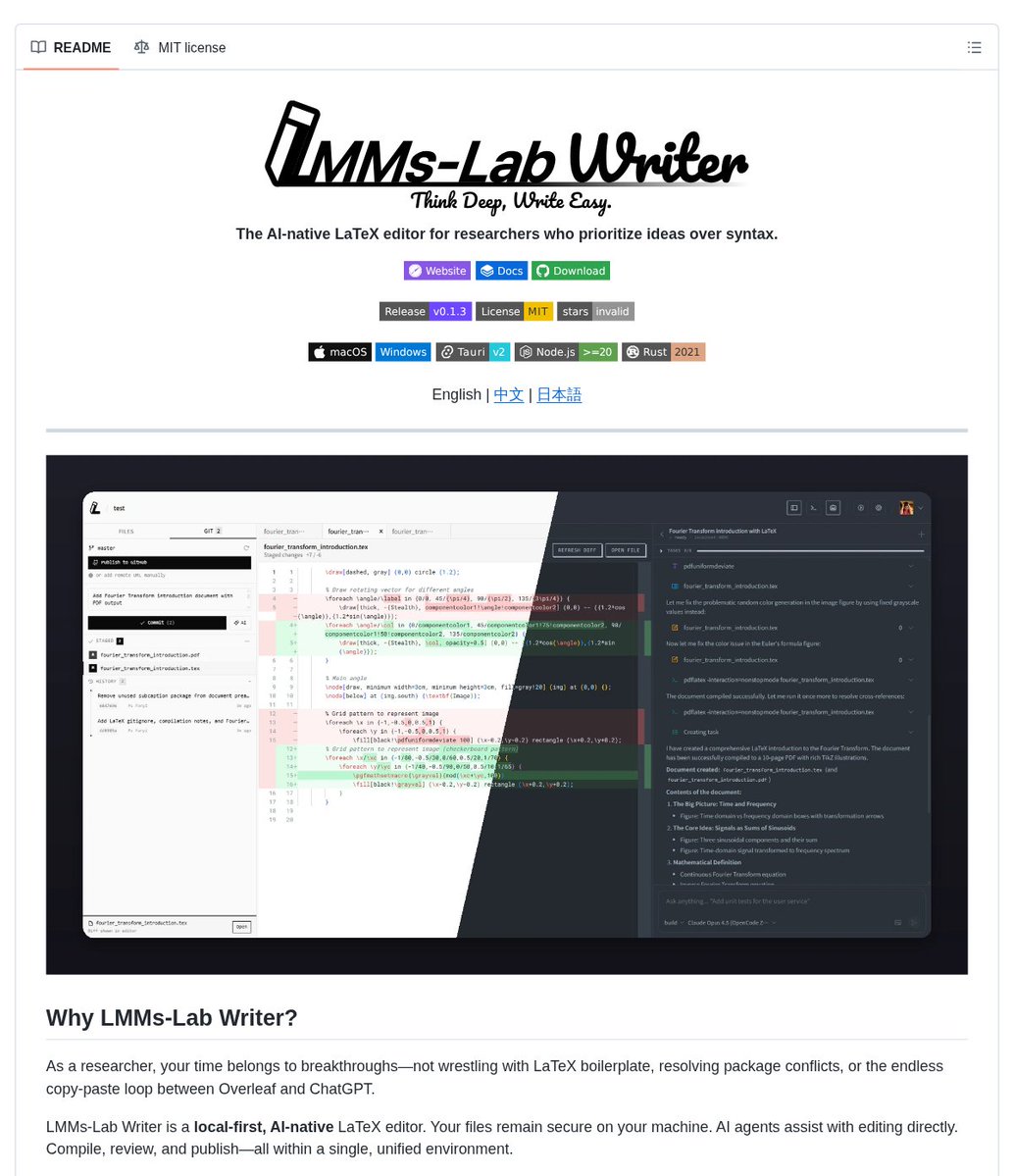
Academic writing shouldn’t mean babysitting LaTeX setup.
LMMs-Lab Writer is a local-first, AI-native LaTeX editor for researchers writing papers on their own machine.
It helps you move from draft to compiled PDF by combining automatic LaTeX setup, an OpenCode AI panel, local compilation, and Git controls in one desktop app.
Key features:
• One-click LaTeX setup – automatically detects and installs a lightweight LaTeX distribution, then handles missing packages during compilation
• AI editing panel – OpenCode can chat, attach files, manage context, and write directly into project files
• Multilingual documents – supports XeLaTeX and LuaLaTeX with Unicode and system fonts for CJK, Arabic, and other non-English writing
• Built-in Git workflow – stage, commit, diff, push, pull, and generate commit messages from the sidebar
• Local-first/offline mode – files stay on your machine, and editing, compilation, and Git work without internet
It’s open-source (MIT license).
Link in the reply 👇
i've given OpenCode a home in my Mac notch
you can see its usage, activity, permissions, everything
CLI and desktop app sessions
works alongside Claude, Codex, Cursor, and Hermes
i built an opencode plugin that turns useful agent sessions into fine-tuning datasets.
it captures tool calls, messages, diffs, permissions, and manual training examples.
then you can review everything in a terminal ui and export to openai / alpaca / sharegpt / dpo jsonl.
demo below.
Opencode-Eyesight - plugin to allow models without vision encoders to work with pasted images and tool calls which return images. Provide a model to route images, and descriptions are returned in place.
https://t.co/lOf16jrZx7 @opencodeecho@opencode
@opencode free models are SUCH a win. you can install OpenCode onto any device and basically get started asap to do things like device management / setup. Makes managing my homelab setup 1000x easier. Well done team!
@ryanvogel@thdxr@jayair