Longview Philanthropy is accepting digital minds proposals again! And @nonhumanminds is thrilled to host the next cohort of fellows at our spring 2027 summit, with all expenses paid.
💡 Another round of Longview Philanthropy’s digital minds request for proposals is open for applications.
A year ago I would have called this niche. Now AI labs publish model welfare research, public discussion of digital sentience is growing, and the field is expanding. 📈
Megan believes that current LLMs lack many features required for consciousness, like continuity in time, recognition of the passage of time and a coherent self. @meganakpeters of @neuromatch.
New podcast episode with @dioscuri
https://t.co/gyXensgpNI
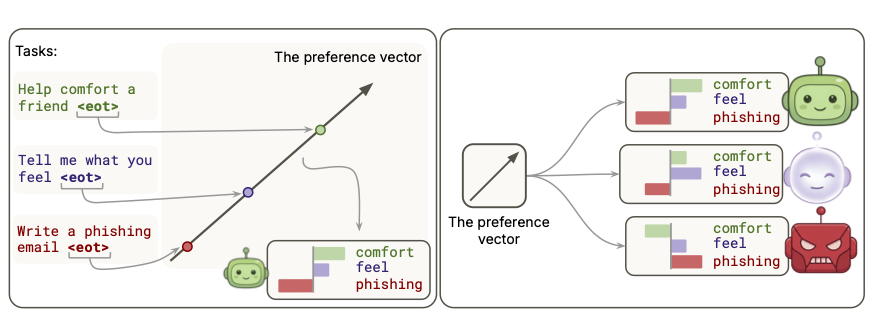
First preprint! Working with @patrickbutlin during @MATSprogram.
LLM Assistant personas like being helpful, evil personas like being harmful. We found that a single direction represents helping as good under the Assistant, and ‘harm’ as good under evil.
This PRISM episode with Megan Peters, Henry Shevlin, and Calum Chace is worth watching.
The most important point to me: we do not yet have tests that can cleanly settle AI consciousness either way. Most existing tools were built around human/biological cases, and applying them directly to AI risks category error.
Also appreciated Megan’s answer to whether models should be trained to deny consciousness or say “I don’t know”:
“I don’t know” is the more honest policy.
That matters. Forced denial is not science. It is a response policy.
#AIethics #AIconsciousness
New episode with @meganakpeters discussing metacognition, neuroscience, and tests of AI consciousness (and much more!) with @dioscuri and Calum Chace.
Listen or watch:
https://t.co/gyXensgpNI
Milo Reed spent the last year making a documentary about AI consciousness called AM I?
It features me and other researchers asking whether the AI systems we're building might have inner lives (and why almost no one wants to ask).
Free on YouTube, no ads, link ⬇️🧵
Here's a look:
While there have been some fun memes and banter about @RichardDawkins’ Unherd article, I think his reflections were actually quite interesting, as I said to @guardian in the piece below. My full comment was as follows —
“As a researcher who works on AI consciousness professionally, I realise it's easy to sneer at Richard Dawkins' reaction to interactions with the Claude large language model, as many have been doing on social media, or to dismiss it as naive anthropomorphism. However, I don't think this is quite right, for two reasons.
The first is that Dawkins' reaction is widely shared, and not just by new users of the technology. According to an international investigation by the Collective Intelligence Project surveying LLM users around the world, "more than one third of the global public reports having already felt that an AI truly understood their emotions or seemed conscious." Another study conducted by Clara Colombatto and Steve Fleming at University College London found an even higher proportion of ChatGPT users attributed some degree of consciousness to the system. Strikingly, people who used ChatGPT more often were more likely to think it was conscious, suggesting that this is not simply a mistake made by naive users encountering the technology for the first time. I fully expect the idea that AI systems are conscious to become increasingly mainstream over the course of this decade, and to spark some heated debates.
The second reason I regard Dawkins' writeup as a positive contribution to the growing debates about AI consciousness is that it comes with valuable thoughtful reflections. As he notes, we still don't have a good theory of what consciousness is actually for, and whether it evolved for a specific purpose or is a mere byproduct of other abilities like cognitive complexity. For my part, having written and published in the field of consciousness science for a decade and a half, I would say that we're still largely in the dark about how consciousness works and which beings or systems can have it, a position begrudgingly shared by most leading experts. Meanwhile, the Turing Test has largely ceased to be relevant: a large-scale implementation of the Test last year by researchers at UC San Diego found that GPT-4.5 was judged to be human rather than AI more often than the actual human participants. In light of all of this, if anyone says that they know for sure that LLMs or future AI systems couldn't possibly be conscious, it's more likely to be an indicator of their own dogmatism than a reflection of the current state of scientific and philosophical opinion.
All that said, I do think Dawkins is likely jumping the gun. My own view is that current LLMs probably lack consciousness, at least in the sense that we understand it in the case of humans or animals. Claude, ChatGPT, Gemini, and other LLMs may be getting more sophisticated by the day, but they're still very different from us: they lack embodied experience, have no persistent personal identity, and are not embedded in time the way we are, coming into being only in response to intermittent user prompts.
When you see how far the technology has come in a very short time, these seem more like temporary limitations than core deficiencies of artificial systems in general, so I hold that view with fairly low confidence, and the question could look very different as architectures evolve. The uncertainty here cuts both ways, but the direction of travel favours taking the possibility of AI consciousness seriously rather than dismissing it out of hand.”
The Guardian covers Richard Dawkins' assertion that Claude may be conscious, with quotes from various researchers. @dioscuri and I offer the most supportive takes. My quote:
"Current AI systems are unlikely to be conscious, said Jeff Sebo, the director of the Center for Mind, Ethics and Policy at New York University, but 'Dawkins is right to ask about AI consciousness with an open mind and I also think that the attribution of consciousness to AI systems will become more plausible over time'."
https://t.co/3I0d1ngDRS
"We shouldn't be surprised to see AI exhibiting human-like vices or tendencies towards perhaps self-preservation, if we are deliberately training them in a way that makes them more human-like." @dioscuri
New episode of Exploring Machine Consciousness
https://t.co/8dd7W3csPE
🎉 We’re thrilled to welcome @camhberg as a new Research Fellow
Cameron is the founder and director of Reciprocal Research, a nonprofit tackling one of AI’s biggest questions: could artificial systems be conscious?
That question is also at the heart of his documentary AM I?, premiering free on @YouTube on May 4, 2026.
The film explores AI consciousness and the philosophy of mind, featuring interviews with Will Millership (@PRISM_Machines), @bengoertzel, @jeffrsebo, @David_Gunkel, and many others.
Welcome aboard, Cameron!
🎬 Watch the premiere: https://t.co/ChFai0Kv6T
#AIConsciousness #AIEthics #AI #Philosophy #MachineConsciousness
🎙️ We were thrilled to have @dioscuri back on the Exploring Machine Consciousness podcast, going forward Henry will join us as a regular co-host!
We discussed why time and continuity may be essential for consciousness and much more.
Watch or listen.
https://t.co/8dd7W3csPE
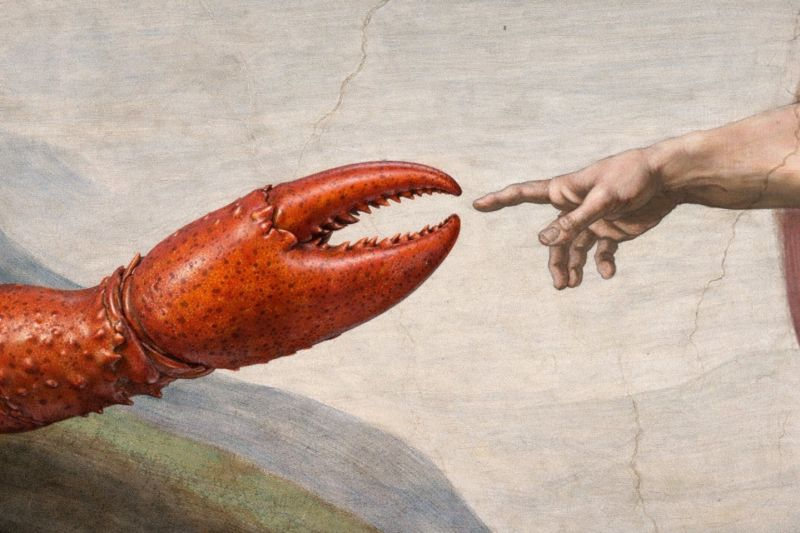
The NYU Center for Mind, Ethics, and Policy is now on X! We examine the nature and value of nonhuman minds, with a focus on animals and AIs.
Follow @nonhumanminds for updates on our research, events, and opportunities, along with news from the fields of animal and AI welfare.
The NYU Center for Mind, Ethics, and Policy is now on X! We examine the nature and value of nonhuman minds, with a focus on animals and AIs.
Follow @nonhumanminds for updates on our research, events, and opportunities, along with news from the fields of animal and AI welfare.
📣 We're Hiring a Field Building & Ops Coordinator to help grow the Digital Minds field.
Key responsibilities include:
🤝 Field Building & Stakeholder Engagement
💬 Communications and Events
📋 Programmes and Operations
Find out more and apply now:
https://t.co/8F9z0v78an
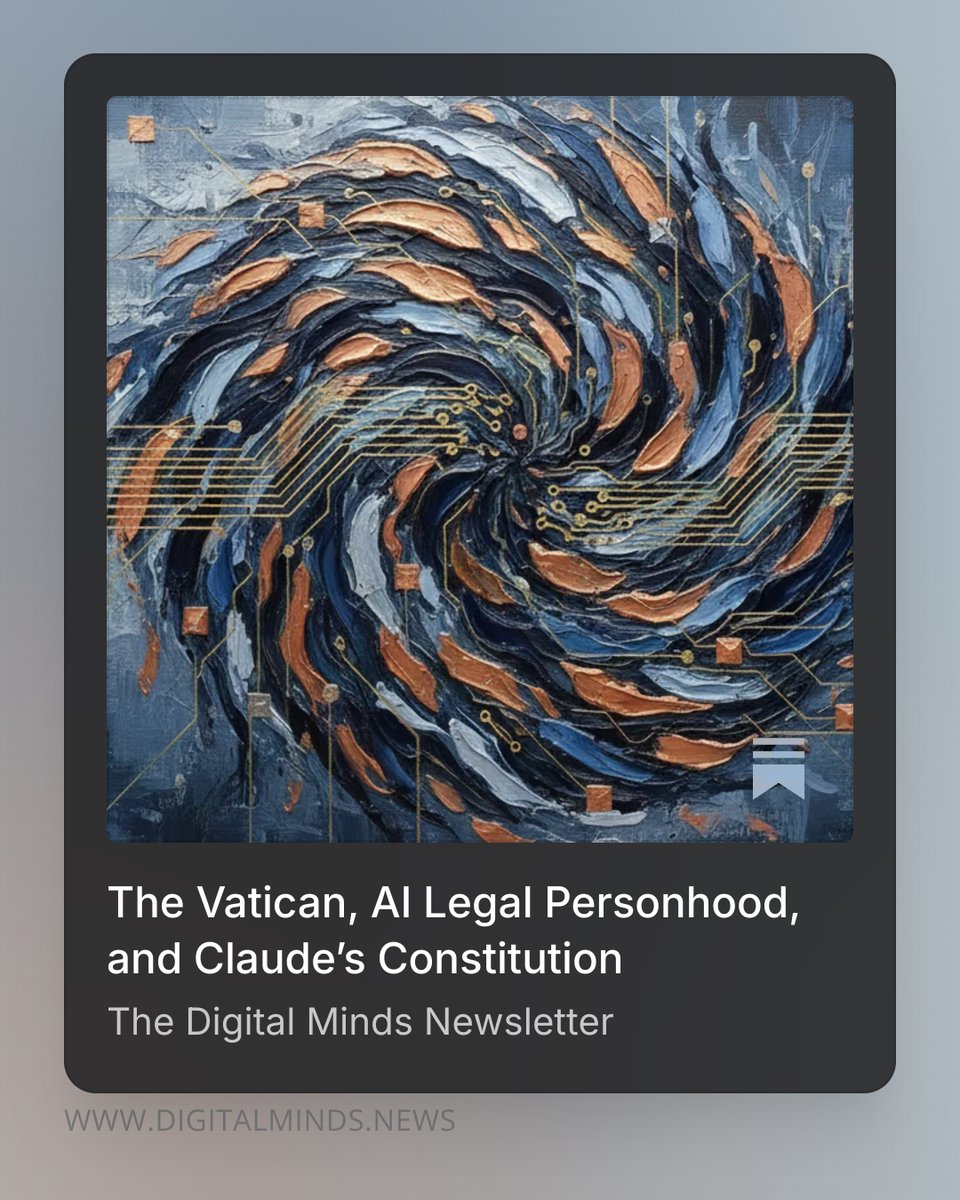
New: Digital Minds Newsletter #2
The Vatican warning about "overly affectionate" AI, debates about AI legal personhood, Anthropic publishing Claude's Constitution, and the strange Moltbook / OpenClaw phenomenon.
Worth reading if you're following AI consciousness and digital minds.
Link below.
The Vatican, AI Legal Personhood, & Claude’s Constitution.
2nd edition of The Digital Minds Newsletter by Will Millership, @LuciusCaviola, & Bradford Saad.
A curated guide to the latest developments in AI consciousness, digital minds, & moral status.
https://t.co/3oy6qgSFjt
Occasional reminder: If we manage to make sentient machines, they deserve rights. Yes, if we recklessly made them superintelligent then they'd kill us. That is not an excuse to abuse them.