This new Fable 5.1 model by anthropic is a joke.
A single ultracode session consumed 42% of the weekly limit. Sub agents keep failing, for no reason. Then hits session limits on this single run retrying the sub-agents.
Basically 42% of the weeks $200/month burned to failure
Today I'm posting a blog about another ridiculous antibody blunder. Dozens of papers in the senescence and ageing field have mistakenly used an antibody for E. coli β-galactosidase when trying to stain for the human protein with the same name. Link in next comment 👇🏼
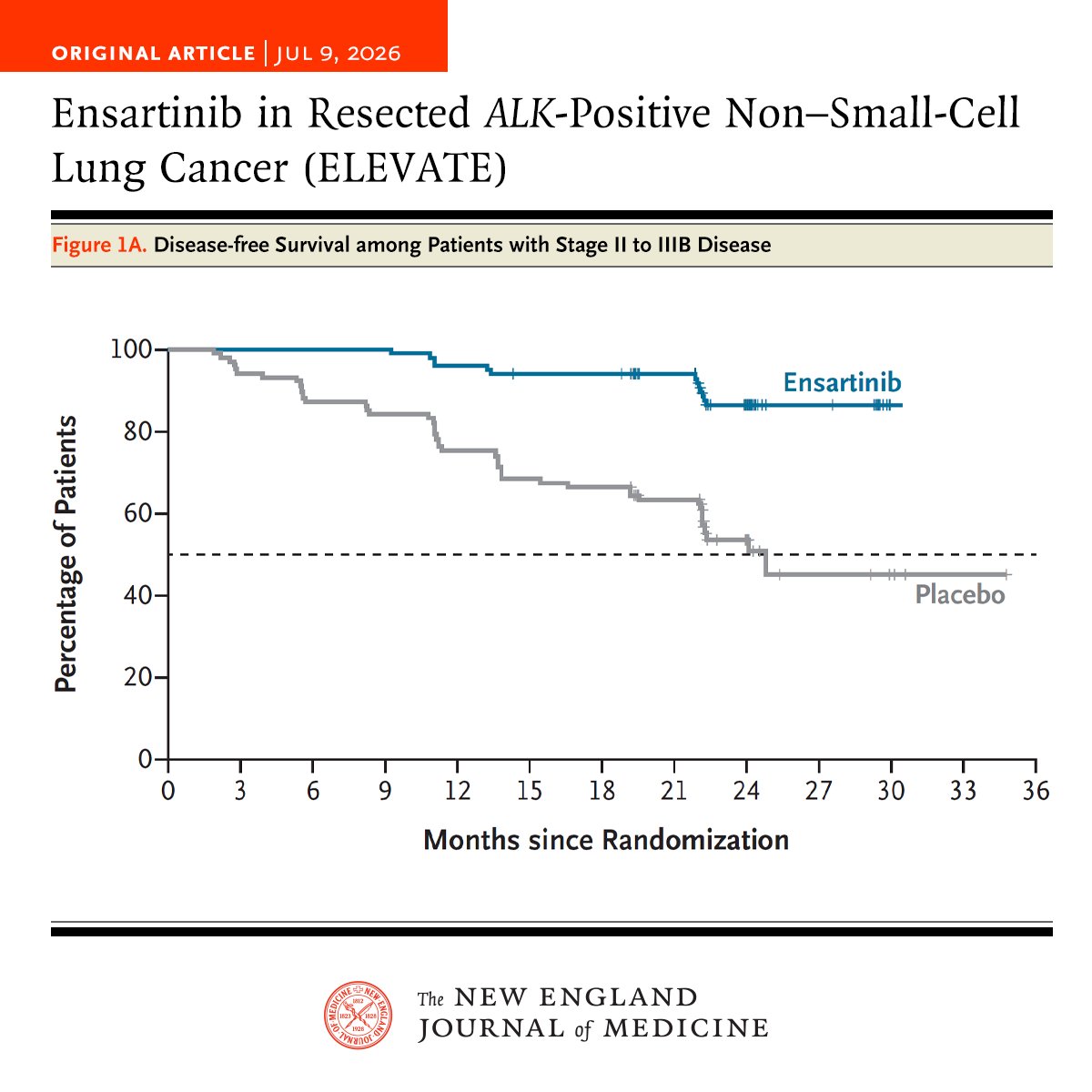
Among patients with resected ALK-positive non–small-cell lung cancer, 2-year disease-free survival was higher with the ALK inhibitor ensartinib than with placebo. Grade 3 adverse events were more frequent with ensartinib. Full ELEVATE trial results: https://t.co/JbfYGnXSyC
Jennifer Doudna won the Nobel Prize for gene editing and went on Bloomberg to say the chatbots everyone is betting on cannot innovate at all. Every promise Silicon Valley is making about AI curing disease just hit the one person qualified to check it.
She has spent her whole career inside the actual frontier of curing disease.
So when she talks about what AI can and cannot do in biology, she is not guessing. She is reporting from inside the lab.
Her words were blunt. She is not seeing chatbots innovate. They summarize data. They write reports. They do not come up with a brand new idea nobody has ever had.
Then the interviewer pushed. So you're saying AI can't innovate?
Doudna did not flinch. She does not know if it can't. She just does not see it doing it right now.
This lands harder when you remember who is making the opposite case. Sam Altman says AI will eliminate disease within five years. Larry Ellison says AI will cure cancer in a 48 hour window.
An OpenAI executive even floated that the company should get a cut of sales on any drug discovered through ChatGPT. Doudna answered that in two words. Good luck.
Even the cancer specialists Altman is selling to keep warning that cancer is not one disease but hundreds, each needing its own cure, and that compute does not skip the years of lab work.
Her reason is simpler. Biology is hard. You cannot simulate your way to an understanding of the human body.
The people promising cures are the ones selling the tool.
The person who actually won a Nobel building them is telling you it has not happened yet.
Source: Bloomberg Originals
Watch the full video on their official channel.
Value of immunotherapy is the long tail to the OS curve, but what about the other side of the KM? Report of CheckMate 227 (NSCLC) @CCR_AACR noted rapid progression with 1L nivo/ipi in 40% (vs 26% with chemo). Associated with high neutrophil:leukocyte ratio, low TMB, PDL1 0%, low albumin, higher-than-median baseline monocytic myeloid-derived suppressor cell (M-MDSC). Increased early detriment not seen with nivo/ipi plus chemo (CheckMate 9LA).
https://t.co/VAb19CwY5n
🚨Hot off the press❗️
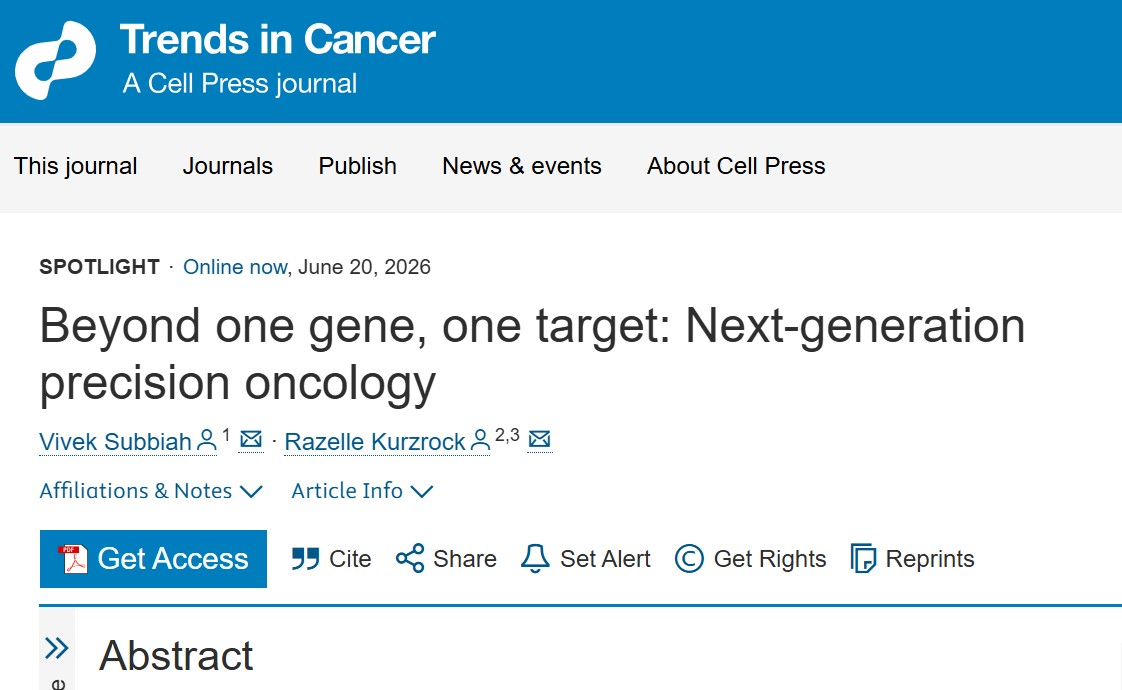
👉Our latest piece is live in Cell press journal - Trends in Cancer
@trendscancer@CellPressNews journal
👉@Dr_R_Kurzrock & I break down the evolution of precision oncology & reimagine what comes next: moving beyond single-target thinking to truly integrated molecular medicine @OncoAlert@oncodaily@OpenMedicineHQ #precisionmedicine Link: https://t.co/PfvcJ9wvOg
I have not paid attention to $SLS at all, but I see its management team is touting the delayed arrival of the last death event required to zip up its Phase 3 study as a positive indication of success.
To which I say: BWHAHAHAHAHA! Oh lord, has no one learned anything?
As an Editor of a medical journal, this is concerning. We are already struggling.
Can some AI person tell me how we detect this especially if the image is resaved on another program and loses any AI tags from chat GPT?
Pharma is spending billions chasing the 316th GLP-1 obesity drug while three metabolic blockbusters sit in plain sight.
Our analysis of 441 GLP-1 pathway assets reveals a striking pattern. Massive patient populations with proven GLP-1 science are systematically underserved.
OSA, PCOS, and diabetic retinopathy represent 1.1B patients with validated mechanism science but 10-20x less competitive intensity.
Obstructive sleep apnea: 936 million adults globally, 50% abandon CPAP devices, zero FDA-approved drugs. The opportunity isn't incremental patients, it's reimbursement arbitrage. While 70% of OSA patients are obese and addressable by existing programs, an OSA-specific indication transforms the commercial equation. Obesity faces payer resistance and formulary barriers. OSA with documented CPAP failure establishes medical necessity, bypasses step therapy, and unlocks better access for the same 655 million patients. Only 15 GLP-1 drugs target OSA; just 8 in active development.
PCOS: 100 million women globally, no FDA-approved treatments. Current standard of care is off-label metformin - managing symptoms without addressing metabolic dysfunction. GLP-1 agonists restore insulin sensitivity and improve ovulation. Only 9 drugs pursue PCOS, all as label expansions of approved products.
Diabetic retinopathy: 103 million patients, leading cause of working-age blindness. GLP-1s show retinal protection in cardiovascular trials, yet only 29 programs target this explicitly.
The most valuable metabolic franchises won't come from out-competing Lilly and Novo in obesity - they'll come from redeploying GLP-1 science where indication choice creates reimbursement advantages.
As always, comment below to get a hi-res PDF!
$MRK would be quite the buying spree if the ~30B figure is accurate. Total 50B in 6 months. Also $RVMD would be biggest pre commercial acquisition ever?
Most obesity pipelines are still trying to beat GLP-1 efficacy. That's no longer the game.
The belief that value runs through efficacy alone made sense when the question was feasibility: could incretins deliver durable, meaningful weight loss at scale?
That question has been answered. Injectable GLP-1s have established a de-risked efficacy reference point. Not a hard ceiling, but a validated benchmark across multiple molecules and sponsors. Strategic uncertainty has shifted from whether meaningful weight loss is achievable to how it can be delivered, accessed and paid for at scale.
This is the part many pipelines miss: beating current efficacy benchmarks alone is no longer sufficient. Even a superior injectable faces the same payer scrutiny, access friction and incumbency advantages that constrain existing GLP-1s. The bottleneck has moved.
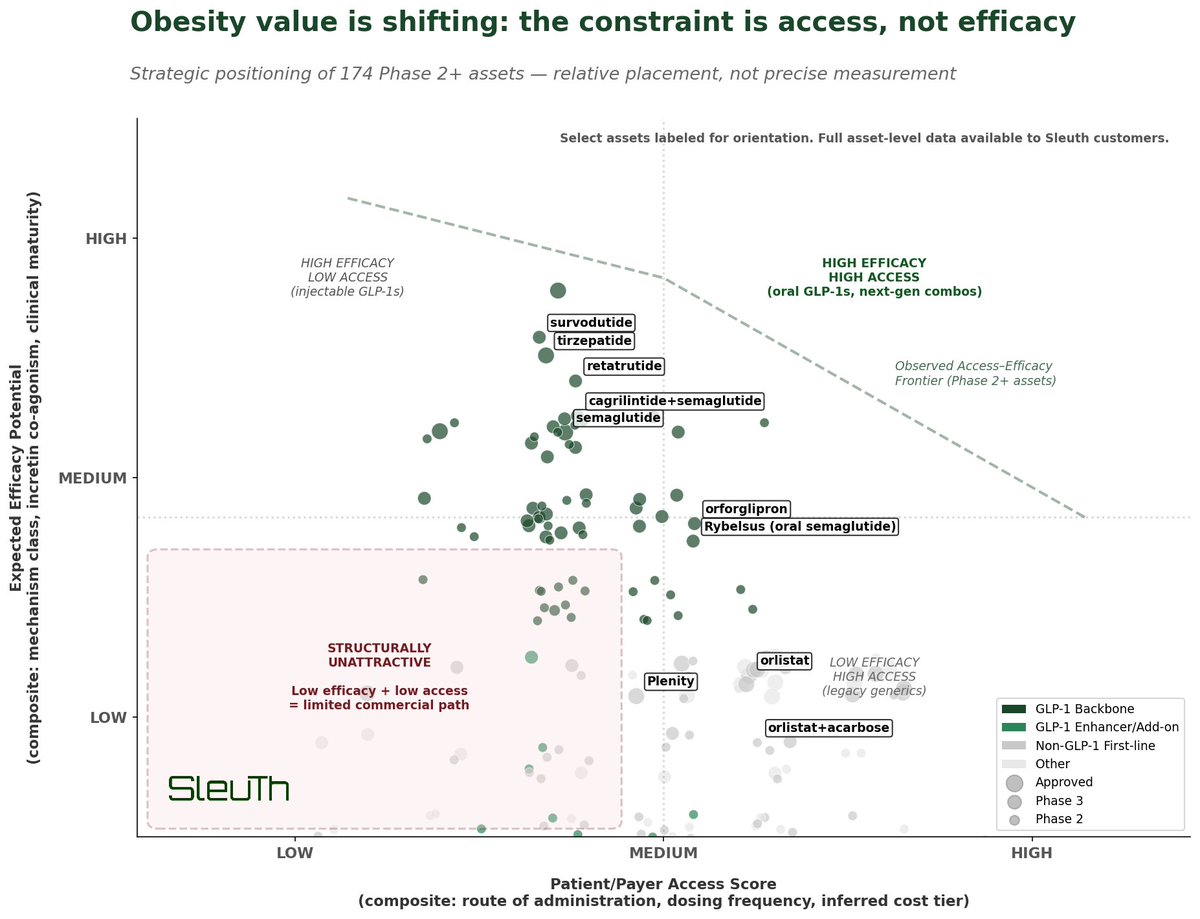
I used @sleuthinsights to map 174 Phase 2+ obesity assets across two dimensions that matter for commercial viability: expected efficacy potential (mechanism class, incretin co-agonism, clinical validation) and patient/payer access (route, dosing burden, tolerability and inferred cost pressure). The result is an access–efficacy frontier. Not a theoretical performance race, but a real-world optimization problem.
The pattern is striking. Late-stage capital, BD interest, and Pharma portfolio focus cluster around assets that sit on or push the frontier. Assets far from it (particularly those low on both access and efficacy) face structural commercial headwinds regardless of scientific novelty.
Two distinct strategies are emerging to expand the frontier:
1. Oral GLP-1s like orforglipron and VK2735 illustrate horizontal expansion - not because all orals are inherently patient-friendly, but because select programs meaningfully relax specific access constraints while remaining close to the injectable efficacy reference. This isn’t a claim that efficacy no longer matters. It’s a recognition that, in a payer-managed category, access friction often becomes a key constraint once efficacy is de-risked.
2. Combo strategies like cagrilintide+semaglutide and amycretin attempt diagonal expansion, pairing efficacy preservation with differentiated tolerability, durability or muscle-sparing profiles. The bet is that selectively closing efficacy or tolerability gaps can unlock value even when access improves only marginally.
These are illustrative examples of strategic direction, not predictions of winners - the point is the framework. Frontier expansion does not require majority market share: even assets serving narrower segments can shape payer dynamics, portfolio strategy and capital allocation.
If you're positioning an obesity asset or evaluating the space, the question becomes "where does this sit on the frontier, and what would it take to move it?"
Mapping that requires structuring assets across mechanistic, clinical, and access dimensions at scale. That's what we built Sleuth to do.
Comment below for a hi-res PDF of the visual.
Today, STAT is revealing a surprise addition to the speaker roster for our #JPM26 event on Mon. Jan. 12:
Richard Pazdur.
We've also released another batch of tickets. Register now! https://t.co/GOAjYfkqsA
@AppleHelix What it comes down to is: $MRK doesn't think saci-T is worth spending another $700m on, but Blackstone does. And that in itself is a curious/bizarre dichotomy.
My single big prediction for 2026:
There will be a rebirth of TCEs in solid tumors. The T-cell exhaustion will be addressed and durability of the initial effect will be extended.