Hi @Cardano community❤️
today we are proud to introduce to you:
🌴PALMA Staking Pool with Poolticker PALMA
Pledge: 50.000₳
Margin: 0%
Fixed Costs: 340₳
We operate a single pool to further decentralization.
#goingfornumber1
$ADA #Cardano#CardanoCommunity
Small🧵👇
Testing @GalaxySwapLabs Galaxyswap at https://t.co/crCVtf3jyX and really liking it so far. Keep up the good work. Palma Pool will also support @midnight upon mainnet decentralization by @Cardano SPOs
Why the F is google serving an obvious scam inside their Sponsored Results when I google „@ledger wallet“? first real result is https://t.co/CkTMriDN7K
Also the scam seems to be hosted on https://t.co/baJTl9lYms domain which leads to google sites. again wtf
#Crypto
🚨BREAKING NEWS: Binance - one of the world's top cryptocurrency exchanges, will list $NIGHT
Binance will then list NIGHT at 2026-03-11 15:30 (UTC) and open trading against USDT, USDC, BNB and TRY pairs.🔥
This is a huge event for Midnight ahead of its mainnet launch🚀
I wish there was a pithy phrase that meant "I hear that you think this. I neither agree nor disagree. This is your thought, and I really have nothing to do with it."
PALMA will support @MidnightNtwrk right from the start. Preview is already set up. Delegate your #ADA to PALMA if you want us to generate more blocks on #Midnight and also earn $Night rewards with it.
Tonight it finally clicked for me.
Neo asks her the classic question:
“If you already know what I’m going to do… do I really have a choice?”
And she hits him with the line:
“You’ve already made the choice. You’re just here to understand why.”
For years I thought this meant “there’s no free will.” But that’s not it.
Here’s the real insight:
Free will doesn’t exist in the moment.
It exists in the identity that leads to the moment.
The actions you take right now?
They’re mostly automatic - shaped by your conditioning, experiences, fears, habits, and past.
But the person you’re becoming?
That’s where your freedom actually lives.
You don’t choose the moment.
You choose the man who will meet the moment.
Or put in another way:
Determinism writes the past.
Identity writes the future.
Because when your life isn’t where you want it to be, the answer isn’t “make better choices.” The answer is: become the version of yourself who makes better choices automatically.
That’s the real red pill.
Before you're too excited about this proposal, let's address these questions first:
1/ Have IOG, Cardano Foundation and Emurgo fulfilled their duties after they're given a large portion of ADA since Genesis?
2/ Have IOG, Cardano Foundation and Emurgo disclosed their current holdings and where funds are spent?
3/ Why haven't these five critical integrations get done after Smart Contract went alive four years ago?
4/ How does Midnight Foundation become one of five Steering Comittee?
5/ Why cann't this proposal be framed as loans like what Snek does for global listings?
I wanted to give everyone something meaningful, a gift…
This comes from Global Macro Investor (GMI) and a deep, long-running body of research developed by @RaoulGMI and myself.
Many of you already know The Everything Code, which is our framework for understanding the macro landscape and why major central banks are debasing their currencies to manage aging demographics and overwhelming debt loads.
I call this a gift because these four charts, while only scratching the surface of The Everything Code, give you the big-picture context you actually need in moments like this.
They stop you from getting lost in every Bitcoin pullback and explain why Raoul and I never panic, even when, to borrow one of his expressions, everyone’s acting like monkeys throwing poo at each other.
Once you understand The Everything Code, you stop trading short-term noise and expand your time horizon. You cannot unsee it.
The starting point is what we call The Magic Formula:
GDP growth = population growth + productivity growth + debt growth.
Population growth and productivity growth have been falling for decades. Debt growth is the only thing filling the gap.
The private sector has been deleveraging since 2008, mainly households, but debt levels are still around 120% of GDP. The public sector sits at roughly the same level.
Here’s the problem…
If the government is running debt at 100% of GDP and the private sector is sitting on another 100%, and for simple math we call rates 2% even though they are really closer to 4%, then the entire 2% trend growth of the economy is being consumed by servicing private-sector debts. That is a completely unproductive use of GDP. And then there’s the issue of public-sector debts. There’s just not enough organic growth to service the existing debt load.
To understand why this dynamic persists, you need demographics.
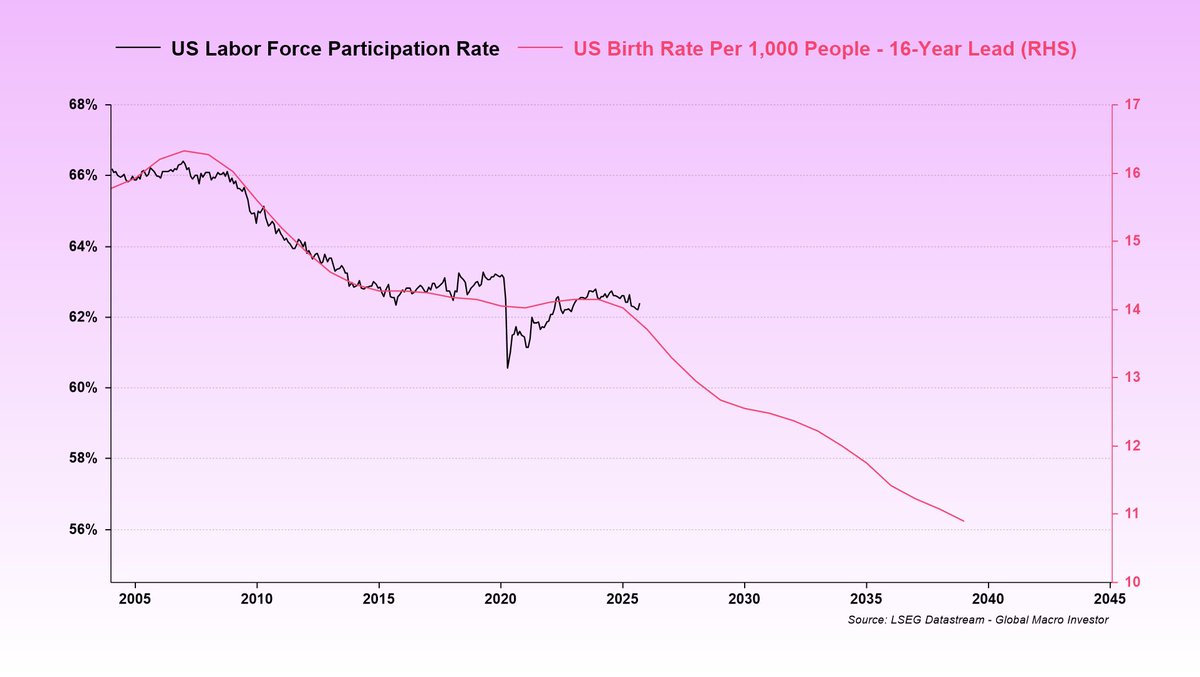
Birth rates peaked in the late 1950s and have been declining ever since. This shows up about sixteen years later in the labor force participation rate as each generation enters the workforce (chart 1).
That means the labor force participation rate is not going to rise any time soon. It is set to keep drifting lower. This is a structural problem.
Aging populations, falling birth rates, and rapidly expanding automation make the backdrop even more deflationary. AI and robotics are replacing humans at scale, and we are only at the beginning. This reinforces the need for ongoing stimulus to keep the system functioning.
With weak population growth and sluggish productivity, the only way to keep GDP expanding is through debt.
Now here’s where it gets interesting…
Government debt growth is completely offsetting the demographic decline and policymakers know exactly what they are doing (chart 2).
And what happens next?
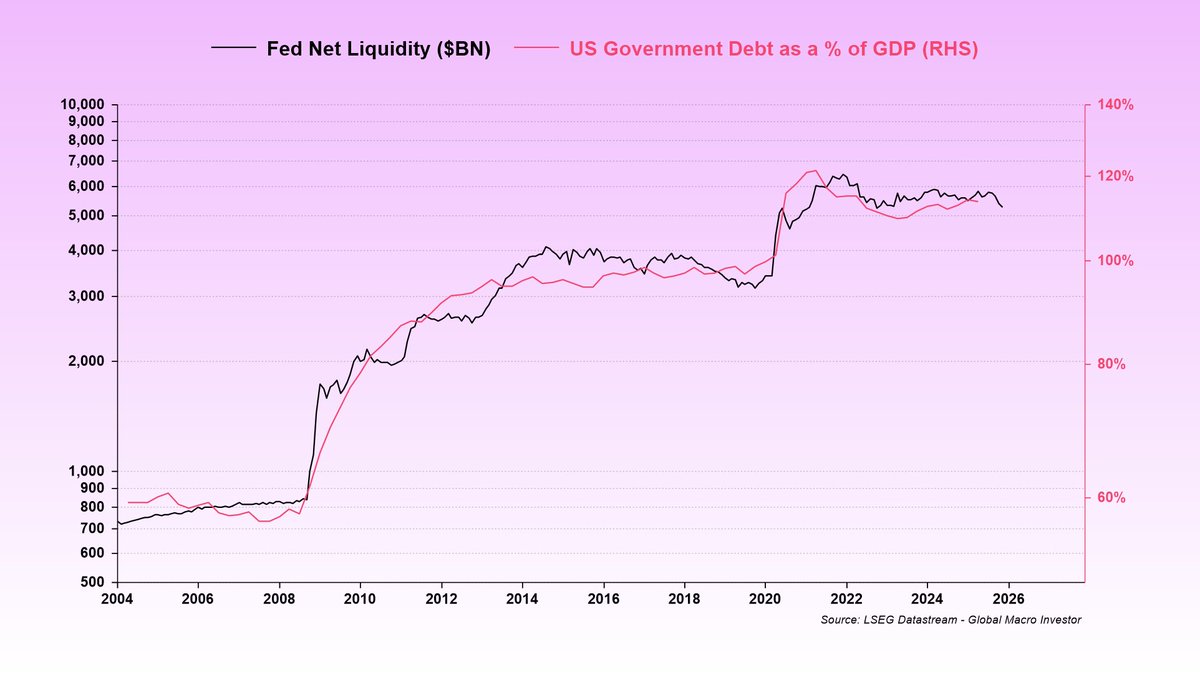
All debt growth in excess of GDP gets monetized (chart 3).
Basically, since 2008, magic money has effectively been paying the interest. Governments issue new debt to cover old interest, and once rates fall enough, central banks absorb it onto their balance sheets.
So to wrap this up, demographics drive the decline in the labor force. Governments offset that decline with more debt. That debt eventually gets monetized through quantitative easing (QE) style operations, not always directly by the Fed, but through the coordinated ecosystem of the Fed, the Treasury, and the banking system. And the bottom line is that there’s still a massive wall of interest that needs to be monetized, far more than GDP can ever cover. Liquidity is literally the only game in town.
And what thrives in a world of perpetual debasement? Bitcoin (chart 4).
I know this correction has been painful, but it’s all part of the journey. These periods feel brutal in the moment, then they fade and the trend resumes. This too shall pass…
To quote Walter White from Breaking Bad, later echoed by @LynAldenContact, nothing stops this train.
MOAR COWBELL (liquidity) = number go up over time. Zoom out and be more bullish…
If you care about AI agents or are building them, but also care about our shared human future, give this one a watch. I've been brewing on this for a very long time and its very dear to my heart 🙏
https://t.co/v74n7vkuMD
OK release the virus.
Lock them in their homes.
Now turbo-print.
Give them 100x leverage.
Tell them it's safe to go outside but only to protest.
Ok now raise rates and send it all to zero.
Tell them they have to take a shot to keep their job.
Offer them hamburgers.
Alright let's inflate it again with obscene deficit spending.
OK, now wipe out all their jobs with AI.
Don't print this time.
Wait until they all learn plumbing...
Ok now send the humanoids.
Best Bitcoin opp since April is TODAY.
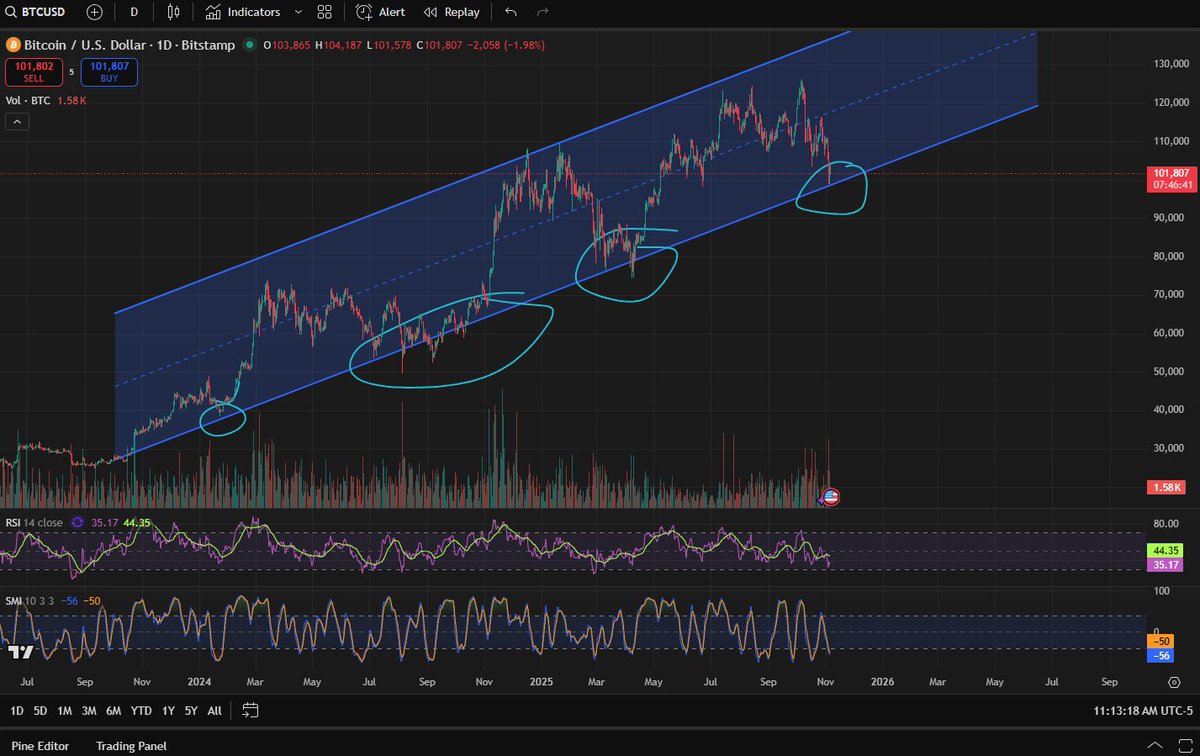
Do not get too complicated. Don't talk about different technical thrusts or any other BS. Forget the 4-year cycle.
Price is truth.
Look at a simple chart going back two years now.
When you hit the bottom of this channel, you buy, you win, for two years straight.
Play those odds all day long. Could I be wrong? Of course. But this is as good as an entry point into BTC as I have seen since April.
It really is this simple. Everything else is BS that clouds the clarity of price.
Not financial advice.
I wanted to share a few thoughts on liquidity from last week’s MIT report that dropped on @RealVision. Hope it’s helpful…
Regarding liquidity, we’ve seen a small tick lower in our GMI Total Liquidity Index this month, but that’s almost entirely being driven by the rebuild of the TGA and the government shutdown, which temporarily halted the drain.
However, this too shall pass...
Remember, weak lagging employment data is what keeps the Fed engaged, or in GMI lingo, MOAR COWBELL…
Lower rates then feed through to more rate-sensitive and leading areas of the economy like housing, and this drives the business cycle higher… it’s a recursive feedback loop.
Once this shutdown ends, the liquidity taps will open again in a big way.
We’ll see TGA spend, rate cuts, the end of QT, probably a repo tweak to ease tightness, talk of eSLR relief in January, and a pivot back to an "ample reserves" regime as QT winds down.
That’s a wall of liquidity coming, and that’s just the US…
It also feels to us that the lead time of financial conditions, looking at this chart (chart 1), may have actually increased a little since the start of 2023 versus our GMI Total Liquidity Index.
I’m not going to adjust it to overfit the chart, but it’s almost a perfect fit if I adjust the lead to six months for this period.
Either way, I believe we’re going higher.
As a reminder, this is how the phasing works between financial conditions, liquidity, and the ISM (chart 2):
GMI Financial Conditions Index > GMI Total Liquidity Index > ISM
I also think the view that the liquidity cycle will peak early next year isn’t going to be right.
Feels too early for that. Let me explain…
You see, The Everything Code’s debt refinancing cycle plays out in two major phases.
Phase one is where rates need to come down first.
In China, that’s largely happened over the past two years as the economy struggled, with 10-year yields falling from around 3% at the start of 2023 to 1.6% by early this year.
I pushed back pretty hard at the time against the consensus view that this collapse in rates was bearish. Instead, I argued it was a massive easing of financial conditions coming from the East.
Now that’s happened, phase two of The Everything Code can play out.
Debts can be rolled at more sustainable levels, and with the dollar now weaker, the PBoC can deploy its balance sheet, which this month hit a record high and could reach around $8 trillion by the end of 2026 (chart 3).
That, in my view, would likely mark the peak of the liquidity cycle, with China playing a major role.
So again, this all suggests to me that liquidity is heading higher in 2026...
It’s also worth remembering that back in 2017, the Fed was hiking rates and liquidity injections were basically flat.
The real liquidity came from the PBoC and, to a lesser extent, the ECB and BoJ.
Yet despite the Fed being sidelined, Bitcoin and other risk assets ripped higher.
Raoul and I have talked about this a lot…
Everyone is too focused on the US and what the Fed is doing. What really matters is that our GMI Total Liquidity Index continues to trend higher, because that captures all of it.
Additionally, our GMI Global Excess Liquidity Composite measures how much liquidity exists in the system beyond what’s being consumed by nominal GDP.
This “excess liquidity” can be, and always is, financialized...
If you look at the chart, since the mid-1980s, equity valuations have tracked almost perfectly, roughly six months behind moves in excess liquidity (chart 4).
So this still points to further equity re-rating ahead...
What’s the bottom line?
We’re still bullish. The delay in the TGA drain and the Trump tariff scare on the 10th have been painful, but ultimately, they’re just noise.
We believe a more dovish Fed, rising PBoC liquidity, and strong Q4 seasonals are all lining up to push this market higher into year-end.
At the end of the day, it always comes back to liquidity, and we still see liquidity rising...
Kraken is proud to partner with @MidnightNtwrk to support the Midnight (NIGHT) Glacier Drop.
We’re excited to distribute NIGHT tokens to eligible Kraken users as part of the Glacier Drop program.
Claim details and timelines will be shared soon. Stay tuned!