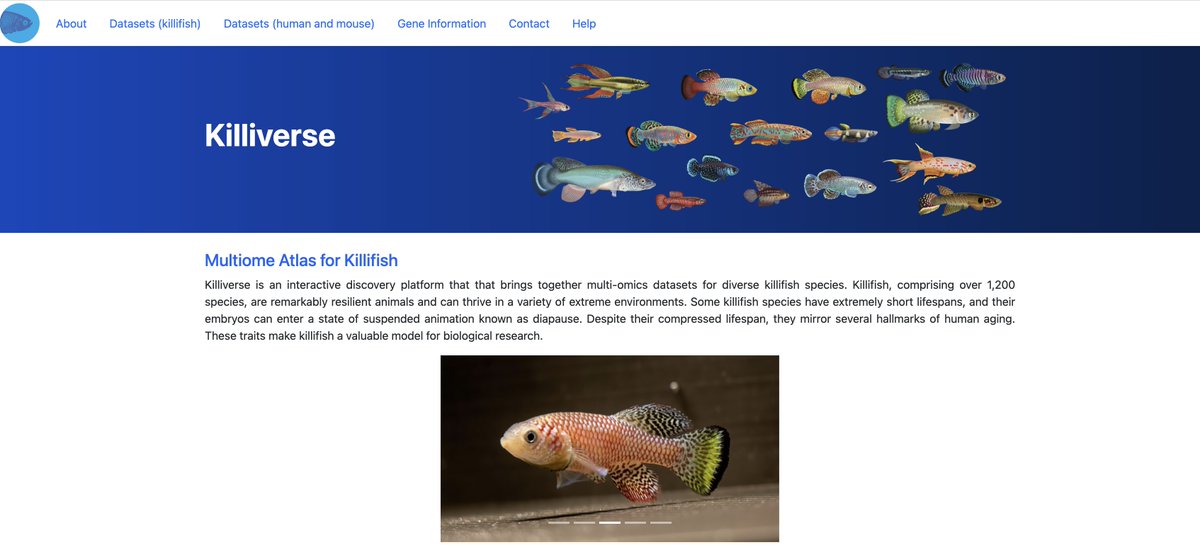
Excited to share Killiverse, a new resource that brings together multi-omics datasets across killifish species and life stages, with a focus on aging and diapause biology.
🔗 https://t.co/zlSdi4RIhG
📄 Preprint: https://t.co/fnsh2UDwSf
If you’re interested in quantitative proteomics, proximity labeling, enzymes and longevity, check out our paper below! @BrunetLab
https://t.co/bplOcBHNnw
Excited to share our paper on identification of secreted proteins during aging! Using proximity labeling and mass spectrometry, we identify secreted proteins that change during aging in C. elegans! Congrats to Jason Miklas and all collaborators! @JayJWM50
https://t.co/PBorjOlFWe
A remarkably fast timeline:
2022: our lab @veronical1411 first discovers Lac-Phe as an exercise-inducible anorexigenic metabolite
2024: @Shuke_Xiao@lynchielydia Lac-Phe also mediates metformin-associated weight loss
2026: an oral Lac-Phe mimetic in human completes phase 1 trial
We’re hiring! BARI is looking for a highly motivated Chief Strategist who loves aging biology and wants to lead community building across our research network. Help connect faculty, trainees, and ideas that advance the science of aging.
https://t.co/pGHGQd3v9F
Delighted to share that our Perspective, “Why Studying Females Reveals More About Aging: The Reproductive Resilience Hypothesis for the evolution of Sex-Specific Aging,” was published in @CellCellPress. 1/n
Excited to see our new paper published in @eLife!
https://t.co/mRpqBJGRWy
Huge congratulations to Rahul Nagvekar and team @Ravi__Nath and @clairebedbrook!! 🙌✨
We identify brain macrophages that engulf extracellular material in the aging #killifish brain!
Thrilled to post thread re: new single-cell lineage of mouse embryo reconstructed w/ DNA Typewriter. One animal, zygote to late organogenesis (E13.5). Tree has 1,340,794 transcriptionally profiled, annotated tips (cells), 1,142,588 dated internal nodes, rooted at zygote
1/n
I am grateful for this recognition, which I owe to the phenomenal mentees who have graced our lab over the years, and to fantastic collaborators. I feel very fortunate to have worked alongside them, and I'm excited to keep exploring the mysteries of the cell in the years to come!
How do lipids influence aging?
We find that membrane lipid composition impacts neural stem cell aging and 'rejuvenation'!
HUGE congratulations to @xiaoaizh on her paper just published at @ScienceAdvances!! 🤩🍾
And a big thank you to all our collaborators!
A thread 🧵...
New preprint! We find that fatty acid double-bond geometry alters their metabolic fate and ferroptosis sensitivity. Trans fatty acids are metabolized differently from their cis counterparts, reshaping membrane phospholipids and ferroptosis sensitivity.
https://t.co/XaaAGyDh6J
A fish that lives just months but teaches us about aging? BARI’s Param Priya Singh just launched Killiverse: an interactive platform to explore killifish multi-omics data in one spot. Perfect for researchers and curious minds! https://t.co/3axFvJBF8x
We are continuing to expand Killiverse with new datasets and features, and we hope it will become a useful resource for the killifish, aging, and broader comparative biology communities.
Website: https://t.co/zlSdi4RIhG
Preprint: https://t.co/fnsh2UDwSf
With custom and interactive visualizations, downloadable datasets, and integrated ortholog mapping the Killiverse platform enables cross-study and cross-species discovery.
Killiverse was built to address this challenge. It provides an interactive, browser-based platform that aggregates datasets across studies, tissues, life stages, species, and experimental conditions in a single resource.
Large-scale omics datasets are rapidly accumulating for non-traditional model organisms, creating new opportunities to study unique biological phenomena. However, these data are often scattered across studies and platforms, making them difficult to explore, compare, and reuse.
Killifish are a prime example. They have become important models for aging, regeneration, developmental biology, stress resistance, and more. Yet the growing collection of multi-omics and single-cell datasets remains fragmented and challenging to navigate.
Many killifish species, including Nothobranchius furzeri, have remarkable traits such as exceptionally short lifespans and embryonic diapause a state of "suspended animation". These features make killifish powerful vertebrate models for studying aging and longevity.
Excited to share Killiverse, a new resource that brings together multi-omics datasets across killifish species and life stages, with a focus on aging and diapause biology.
🔗 https://t.co/zlSdi4RIhG
📄 Preprint: https://t.co/fnsh2UDwSf