We've raised some capital and we're putting it to work.
We're going to make NewsWhip the real time eyes of comms and media professionals everywhere.
NewsWhip users - that means product innovation. Loads of exciting things to share in the months ahead.
https://t.co/pmfc2wGDUf
As I listen to a podcast discussing RTEs various commercial woes, I'm freshly reminded of one of the most insane pieces of information my eyes ever did see. "Too Entrepreneurial".
This viral Stripe chart shouldn't surprise anyone.
It's EU policy coming to its conclusion.
This is what we get when we celebrate publishing regulatory pdfs and closing critical energy sources.
We should get used to charts like this.
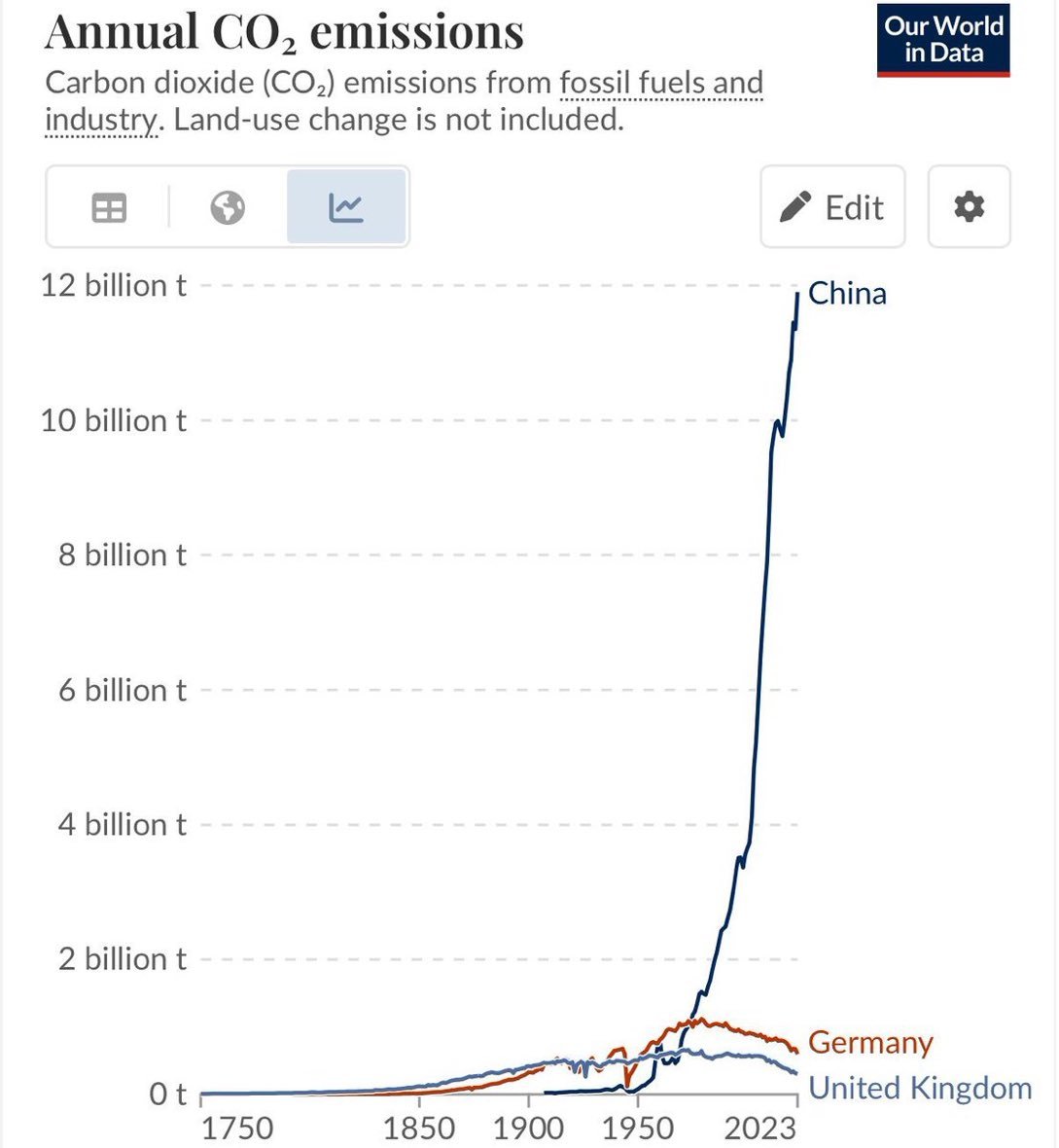
So when I speak Europeans campaigning (aka glueing-their-hand-to-something) for all this degrowth wankery, I'm always puzzled as to why exactly. The degrowth is already here—it's just not evenly distributed
Here's 9 facts
1. Productivity growth numbers in the US vastly outpaces EU equivalents. (e.g. 2022→2025 shows a 7x difference)
2. The tech sector alone explains accounts for ⅔ of the EU–US productivity gap since 2000, according to ECB.
3. In 2024 + 2025, 5 AI heavy companies—Nvidia, Meta, Microsoft, Alphabet and Amazon—accounted for 40% of the S&P 500’s total return.
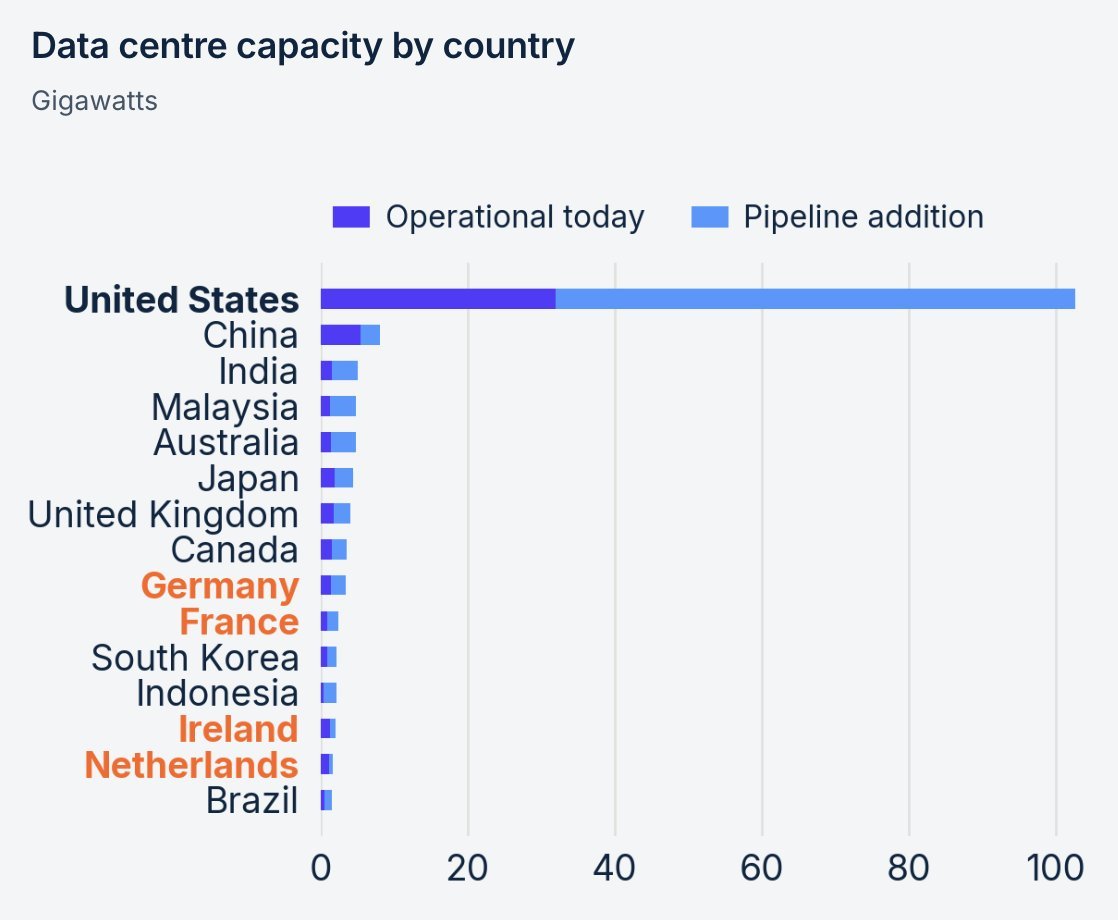
4. Competing in AI requires 3 essential ingredients: capable models, advanced chips, and affordable electricity. So naturally the EU is working against this.
5. Electricity: EU prices for energy-intensive industries are ~2x US levels and 50% above China’s, according to the IEA. Why is this?
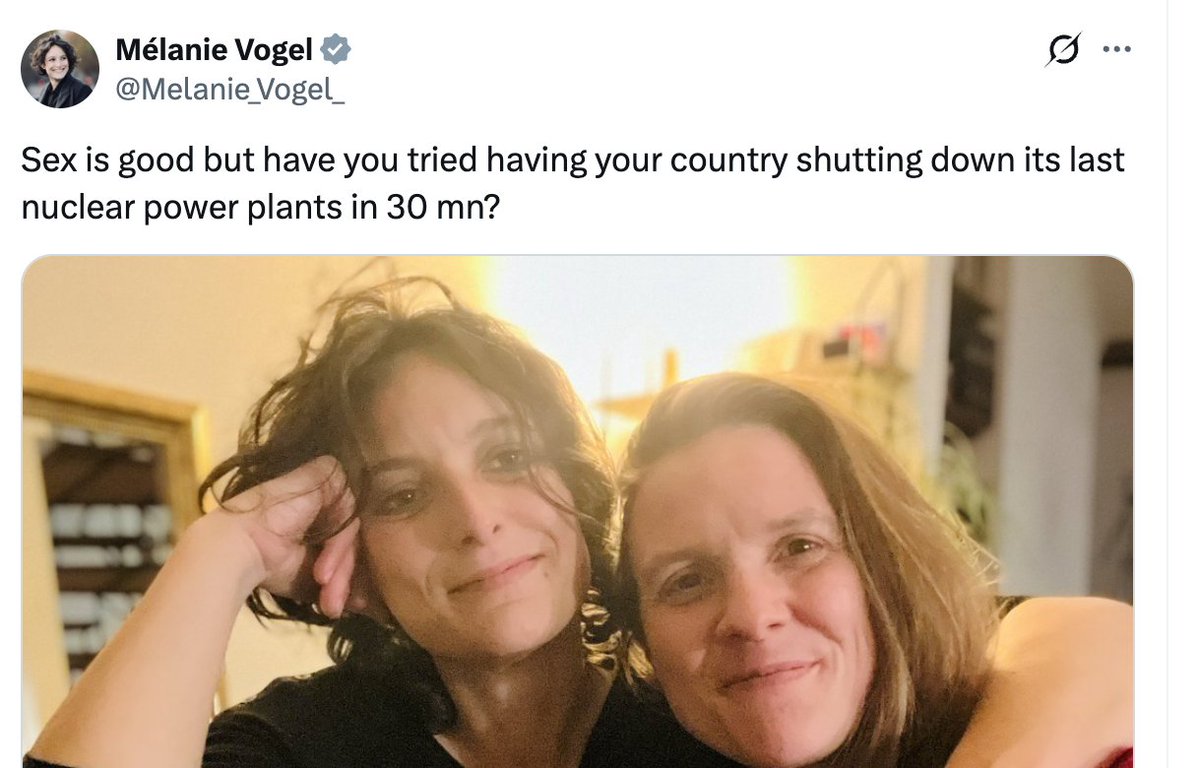
6. European governments left themselves dangerously dependent imported gas, while also pulling batshit moves like closing nuclear plants. EU carbon pricing added insult to injury.
7. Models: The EU AI Act adds compliance requirements, training-data + copyright policies, and plenty of risk-management obligations. As with all things EU they'll never explain fully how to be compliant until you're in court. The result: is minimal model development in EU and very delayed AI product+feature roll out from big (easy-to-fine) companies.
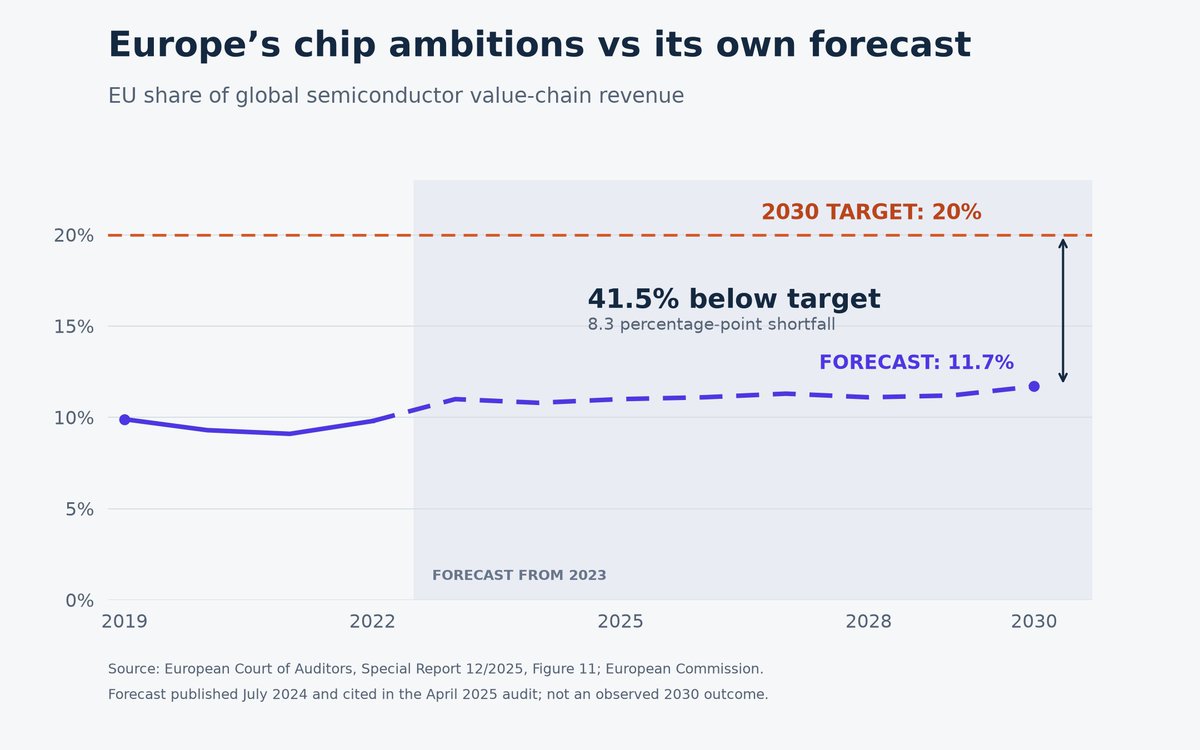
8. Chips: Europe’s semiconductor ambitions are undermined by insufficient investment, fragmented funding, slow delivery, and of course high operating costs. Net effect is they're on course to miss their 2030 goals by >40%
9. Putting it all together, we’re making it harder and more expensive to resource, build and deploy AI in Europe, and risking another decade of falling behind.
The result will be even slower growth relative to the rest of the world.
Dumbing down is not happening by accident. It is happening because those who despise meritocracy have spent years quietly marching their way through the education system and bringing their ideological influence to bear on what children are taught
https://t.co/UFk2uEWS57
watching this, all i can feel is the chasm between people who take all of this seriously and those who hear this as a fantasy or some kind of marketing…and how hard it might be to bridge that gap somehow
The excuse for why Irish people don't invest in shares is that "it's too complicated." It doesn't hold up. Around 80% of Irish adults have a Revolut account — they can buy shares with a click.
The problem is tax. Ireland taxes investment gains at 33% on individual shares and 38% on funds and ETFs — among the highest rates in Europe, against an EU average of 17.6%.
We don't need another state-backed scheme layered with new fees and complexity. We need the obvious fix: bring CGT into line with the European average
Throwing rubbish in a landfill is (usually) better for the environment than recycling it. With few exceptions, recycling ends up emitting more CO2 and costing more money, while landfills are cheap and secure.
- Recycling mid-tier plastics (like plastic bottles or butter tubs) costs thousands of dollars per ton of CO2 saved. It's cheaper to do direct air CO2 capture than that! And there is no shortage of plastic, nor any problem with sequestering it in the ground once we're done with it.
- Modern landfills are extraordinarily secure and are *much* more than just big piles of trash. They capture 75%–95% of methane gas. Groundwater contamination is doesn't really happen with landfills built since 1990. A study of 31 landfills built since 1988 in NY found no adverse effect at all on local groundwater quality.
- The crusade against single-use plastics has driven us to products that use far more materials and energy and would need to be used an absurd number of times to actually be an improvement. A steel straw needs to be used 150 times to be worth using. A ceramic mug needs to be used 1,000 times to beat a polystyrene cup. A cotton bag needs to be reused 173 times to beat single-use.
- Some things ARE worth recycling. Recycling metal saves a huge amount of energy and material – recycling aluminium saves 95% of the energy spent on making fresh stuff. So we do a lot of it already: about 30% of steel worldwide is recycled.
Modern, well-run landfills cause minimal environmental damage. We have plenty of space for them – less than 0.01% of the US is used for landfill and only about 0.02% of Germany. We can even build on top of old landfills, so the land area is not spent permanently.
New in @WorksInProgMag, @robertwiblin and @chalmermagne on why it's usually best to just bury your trash. https://t.co/TsGJdcwG76
Metrolink will be a big project. Short of building a nuclear reactor there is no bigger category of infrastructure project. But it's worth putting things into perspective.
Metrolink's total cost is estimated at up to €18.8 billion. The state spent €110 billion last year.
The often-cited Ardnacrusha hydro power project ran to five per cent of spending per year for four years.
Annual spending on Metrolink should peak at 2% of government spending.
Next Wednesday, cabinet decides whether Metrolink advances to final tenders. Here are four good reasons to approve it.
1. Per kilometre, Metrolink would be mid-table among peers.
Patrick Collison and Mario Draghi just launched the Rhine Group to reverse Europe’s decline 😳
Their move is one of the most ambitious elite interventions in European tech and policy in years:
→ Europe produces only 4 of the world’s 50 largest tech companies and lags badly in the technologies that will define the next decades
→ Mario Draghi’s 2024 competitiveness report diagnoses an existential risk: without radical change, stagnation threatens defence, pensions, healthcare and the entire social model
→ Nearly 2 years later, only partial implementation of the recommendations; the hardest reforms (scale-ups, capital markets, governance) still lag while U.S. tariffs and Chinese competition intensify
→ Collison (Stripe) and Draghi recruit ~55 top operators, economists (including Nobel laureates), CEOs and policymakers into a private Chatham House group
→ Goal: raise eyes from daily politics toward a common destiny - compete, build and grow again as the world’s second-largest market
→ Turn evidence into pressure and actionable ideas outside the slow official EU machinery
Europe still has the assets.
Europe still has massive potential.
The key question is whether it has the urgency to act NOW.
This group believes it can.
An announcement: Under the leadership of Mario Draghi and @patrickc we have set up the Rhine Group: policymakers, economists, entrepreneurs and business people pushing European reforms and the Draghi agenda.
https://t.co/ZtoW7Rb173
“In Germany, the first €12,348 of income is exempt from tax. After that, the rate begins at 14% & rises progressively rather than jumping suddenly, eventually reaching 42% for high earners. Only those earning more than €277,826 face the top rate of 45%.” https://t.co/pZE1cCOGf3
Bernard Arnault going direct is remarkable and worth reading in full
The single most impressive thing is that Arnault (personally, not via company spokesman) responds to a major hit piece without at all accepting the role of defendant
He never complains about “biased reporters” or “they ignored our fact check” etc. He instead:
1) Does not flinch. He starts by giving the rebuttal a title: “Thank You.” Not “Addressing Recent Allegations” or whatever but implying the expose has backfired and made him look good.
Eg: “They used to call me The Terminator. I prefer ‘the last royal family.’ It’s more elegant, and probably better for Dior sales.”
Tone stays measured and bemused throughout; it’s giving Logan Roy
2) Lampoons the allegations. His wry humor makes the expose seem silly and theatrical, his tone is like he’s divulging a stupid child.
He opens with, “Apparently I am the head of ‘the last royal family of France’.”
And drops gems like, “At the Arnault family, apparently, we don’t argue, we conspire. We don’t deliberate, we plot. It’s novelistic… What, in an ordinary family, is simply called Sunday lunch becomes, in our case, an intrigue. It’s a matter of vocabulary.”
3) Reframes the whole narrative. From billionaire to steward, from an oligarch pursuing power to a patriarch preserving an institution built by and for others
Eg: “You describe power as though it were a prize to be won. I experience it as a responsibility to be passed on.
The houses entrusted to me are older than I am. Most will outlive me. My role is to hand them on stronger than I found them. That is why I reject the idea of a dynasty. Dynasties exist to preserve privileges. We work to preserve craftsmanship.”
Interestingly, in the very act of doing this Arnault shows how masterful he is at wielding power, and he summons that skill here to make the reporters look like bumbling neophytes
Heat pumps are air conditioners. And air conditioners are (unidirectional) heat pumps. Opposing access to AC for ostensibly "climate" reasons is shortsighted, as they are a key adaptation technology to prevent suffering even while we continue to work to reduce emissions.